





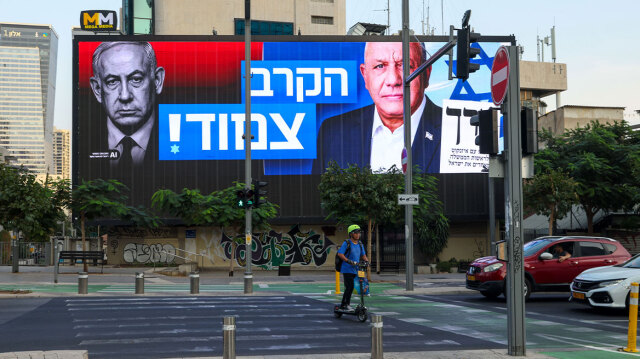
Israel is voting today in its first parliamentary election since the Hamas attacks of 7 October 2023, with the latest opinion polls offering no clear indication of who will form the next government. Israeli Prime Minister Benjamin Netanyahu is fighting to remain in power, while former military chief Gadi Eisenkot hopes to translate his growing electoral support into a change of government.
Voter turnout in Israel’s parliamentary elections continues to rise sharply, reaching levels not seen in decades as citizens head to polling stations across the country.
According to the latest official figures released by the Central Elections Committee, turnout had reached 55.7% by 4pm on Tuesday, marking an increase compared with previous elections and the highest participation recorded at that point in the day since official monitoring began in 1973.
In absolute terms, approximately 4.85 million voters had already cast their ballots, highlighting the exceptionally strong participation as voting enters its final hours.
With large numbers of voters still heading to polling stations, the Central Elections Committee’s deputy director-general, lawyer Dean Livne, confirmed that voting could be extended where necessary.
“If there are long queues at polling stations after 10pm, voting will continue as normal,” he said, making clear that voters already waiting in line would not be prevented from casting their ballots.
Voter turnout across Israeli cities
The Central Elections Committee also released detailed figures showing turnout by municipality and region as of midday, revealing significant differences across the country.
In Israel’s three largest cities, participation was relatively similar, with Tel Aviv recording 28.6%, Jerusalem 26.8% and Haifa 26.6%.
The highest turnout was registered in smaller communities and settlements, with Atwana leading the country at 64.1%. Abigail followed with 49.5%, Qasr al-Sir with 47.9%, Kaba’a with 47.8% and Nirit with 47.6%.
Particularly notable was participation in the Bedouin city of Rahat, where turnout reached 36.9%, exceeding the figures recorded in several secular and ultra-Orthodox communities in central Israel.
In Modi’in, turnout stood at 36.7%, compared with 33.2% in the ultra-Orthodox city of Modi’in Illit. Beersheba recorded 27.4%, while Netanya stood at 23.8%.
Elsewhere, turnout reached 30.3% in Sderot, 30.2% in Ofakim and 23.9% in Kiryat Shmona.
Polling stations are scheduled to remain open until 10pm, although different arrangements apply to certain special voting locations.
Netanyahu votes in Jerusalem, Eisenkot in Herzliya
Netanyahu cast his ballot in Jerusalem alongside his wife, Sara, more than five hours after polling stations opened.
Speaking to reporters, Netanyahu urged Israelis to take part in the election, declaring: “Get out and vote!”
Opposition leader Gadi Eisenkot also exercised his right to vote, casting his ballot in Herzliya.
The two politicians are among the central figures in an election that will determine the composition of the next Knesset and the country’s future governing coalition.
Man carrying knife arrested near Yair Golan in Tel Aviv
Security forces were placed on alert in Tel Aviv following an incident involving Yair Golan, leader of the Democrats party.
Golan was touring Hasila Park as part of efforts to encourage voter participation when an unidentified man approached him carrying a knife.
Members of the politician’s security detail immediately intervened, restraining the suspect before he could get any closer. During the confrontation, a knife reportedly fell from the man’s clothing onto the ground.
Police were called to the scene and arrested the suspect.
An investigation is under way to establish the circumstances of the incident and determine the man’s motives.
Eisenkot’s party alleges systematic attempts to undermine the vote
Meanwhile, a separate controversy emerged after Gadi Eisenkot’s Yashar party filed a formal complaint with the Central Elections Committee, alleging systematic attempts to interfere with the voting process.
According to the party, multiple incidents were reported at polling stations across the country involving ballot papers bearing its electoral symbol, “Derech”.
In some locations, the party claimed, its ballot papers were missing entirely from voting booths. Elsewhere, they had allegedly been damaged, placed upside down or marked with writing that could render them invalid.
Yashar described the incidents as a “systematic attempt at sabotage”, warning that they threatened the credibility and integrity of the election.
“Anyone who attempts to steal ballot papers is attempting to steal the election. This is a flagrant violation of electoral integrity and the fundamental right of citizens to vote freely,” the party said in a statement.
The allegations have added another source of political tension to an already closely watched election. The claims have not yet been independently established.
When will the first election results be announced?
Vote counting is scheduled to begin immediately after polling stations close at 10pm on Tuesday, Israeli and Greek time.
Each local electoral committee will count the votes and forward the results, together with the ballot boxes, to the relevant regional elections committee.
The voting records will then be verified before the results are transmitted electronically to the Central Elections Committee’s computer systems at the Knesset.
The first preliminary results are expected overnight on Tuesday into Wednesday, although a complete picture will take longer to emerge.
One of the reasons for the delay is the need to count votes submitted in special double envelopes. These are used by certain categories of voters who cast their ballots outside their usual polling stations, including military personnel stationed in Lebanon or Gaza.
Under Article 11 of Israel’s Basic Law concerning the Knesset, the Central Elections Committee has eight days from election day to publish the official results in the government gazette.
This means the legal deadline for announcing the final results is 4 November 2026.
However, the committee expects the counting process to be completed significantly earlier, potentially by midday on Thursday, 29 October.
The issues shaping the election
At the heart of the electoral battle is accountability for the events of 7 October, alongside competing visions of how Israel should be governed after the war.
The Financial Times describes a deeper struggle over the country’s character, encompassing relations between the government and judiciary, the influence of religious parties, settlement expansion and the balance between the nationalist right and liberal democratic forces.
Investigating responsibility for the October 2023 attacks and the conscription of ultra-Orthodox Jewish men are among the most contentious issues.
The exemption of ultra-Orthodox men from military service has become particularly sensitive in a society that has endured prolonged military mobilisation and heavy losses.
Meanwhile, the cost of living and access to affordable housing remain major concerns for ordinary Israelis, even as national security dominates political debate.
The next government will have to reconcile demands for military readiness, social fairness and economic recovery.
What the latest opinion polls show
The polling figures help explain why today’s vote could usher in a prolonged period of political uncertainty.
In the final Channel 12 poll, as reported by the Times of Israel, Eisenkot’s Yashar party was projected to win 23 seats, ahead of Netanyahu’s Likud on 21 and former prime minister Naftali Bennett’s Beyahad party on 15.
The Democrats were projected to secure 10 seats, followed by Yisrael Beiteinu with eight.
Overall, the bloc seeking to replace Netanyahu was projected to win 56 seats, compared with 50 for his allies and 14 for the two Arab parties.
Channel 13 offered a similar picture, projecting 54 seats for the anti-Netanyahu bloc, 50 for Netanyahu’s allies and 16 for the Arab parties.
Neither poll gives either of the two main political blocs the 61 seats needed for an absolute majority.
Public broadcaster Kan also identified a potential deadlock, projecting 22 seats for Eisenkot, 20 for Likud and 14 for Bennett.
Its poll placed the opposition bloc on 52 seats, Netanyahu’s alliance on 50 and the Arab parties on 14. A joint list bringing together the Reservists’ Party and the Economic Party was projected to secure four seats but was counted separately.
That distinction matters: classifying a smaller party as part of a potential political bloc does not mean that it has agreed to join a governing coalition.
Not all polls, however, point in the same direction.
Haaretz notes that Channel 14 surveys conducted in the final stages of the campaign projected as many as 64 seats for Netanyahu’s bloc.
The discrepancy calls for caution. A parliamentary deadlock is the prevailing scenario in polls conducted by several major broadcasters, but it is not an established election result.
Another potentially decisive factor is Israel’s 3.25% electoral threshold.
In the Channel 13 poll, Ofer Winter’s party was polling at 3.1%, while the joint Reservists–Economic Party list stood at 3%.
Even small shifts in support could therefore determine whether entire parties enter parliament, potentially transforming the distribution of seats and the options for coalition-building.
Scenario one: A government without Netanyahu
The first scenario involves the formation of a government that excludes Netanyahu.
If the parties seeking political change secure a parliamentary majority on their own, negotiations would largely revolve around the premiership, ministerial appointments and a common policy programme.
However, most opinion polls suggest they will need additional support.
This could give the Arab parties a potentially decisive role, whether through formal participation in government, external parliamentary support or an agreement to abstain in critical votes.
The obstacle is political rather than purely mathematical.
Several leading contenders and potential coalition partners have rejected arrangements that would leave a government dependent on Arab parties.
The numerical possibility of forming a majority does not necessarily translate into a viable political agreement.
Any such coalition would also face difficult questions about its internal cohesion.
Bringing together different strands of the right, centre and left would require compromises extending well beyond the shared objective of removing Netanyahu.
Differences over the Palestinian question, the relationship between religion and the state, and cooperation with Arab lawmakers could quickly become sources of tension.
Moreover, a change of prime minister would not automatically mean a fundamental shift in Israeli policy towards the Palestinians.
As Le Monde points out, Eisenkot represents an alternative in terms of institutional governance and tackling settler violence, but he does not support the establishment of an independent Palestinian state.
A new government could therefore bring changes in leadership, political tone and particular policies while retaining considerable continuity in Israel’s underlying security strategy.
Scenario two: Netanyahu remains in power
The second scenario is a renewed Netanyahu government, supported by his current coalition partners or a similar alliance.
That would require either a stronger election result than those projected by Channel 12, Channel 13 and Kan, or the recruitment of additional partners following the vote.
If Netanyahu again depends on far-right and ultra-Orthodox parties for his parliamentary majority, those groups would retain considerable bargaining power.
Pressure to annex Palestinian territories, alongside demands from his more hardline coalition partners, would consequently continue to shape government decisions.
Scenario three: A broad coalition between political rivals
A third possibility is a wider political compromise involving parties from opposing camps.
The Washington Post has reported discussions about a potential Netanyahu–Eisenkot government, despite Eisenkot publicly rejecting such an arrangement.
Any agreement of this kind would require substantial concessions over leadership and policy.
It could reduce the government’s dependence on smaller coalition partners, but it would also expose politicians elected on promises to remove Netanyahu to accusations of abandoning their central campaign commitment.
For now, this remains a possible subject of post-election negotiations rather than an agreement that has already taken shape.
Scenario four: Political deadlock and another election
The fourth possibility is that every attempt to assemble a governing majority fails, forcing Israel back to the polls.
There is a relatively recent precedent.
A prolonged period of political instability allowed a Netanyahu-led government to continue operating in a caretaker capacity from December 2018 until May 2020.
A similar deadlock could give Netanyahu additional time in office, even without an electoral victory for his political bloc.
What happens after the election – and who remains prime minister?
Single-party majorities are the exception rather than the rule in Israel’s political system.
The decisive issue is whether a coalition can be formed that commands the confidence of the Knesset.
Following the election, President Isaac Herzog consults parliamentary parties before asking the member of the Knesset considered most likely to form a government to undertake the task.
He is not legally required to choose the leader of the largest party.
The first designated candidate has 28 days to assemble a coalition, with the possibility of a presidential extension of up to 14 additional days.
If that attempt fails, the president can give another member of parliament 28 days to form a government, without the possibility of a comparable extension.
Should the second attempt also fail, or should the president conclude that no viable government can be formed, a further 21-day period begins.
During that period, at least 61 members of the Knesset can submit a written request for a particular MP to receive the mandate to form a government. That candidate then has 14 days to succeed.
If no such request is submitted, or if the final attempt also fails, the Knesset is deemed dissolved and another election must be held on the last Tuesday before 90 days have elapsed from the relevant constitutional event.
Crucially, Article 30 of Israel’s Basic Law: The Government provides that the outgoing government remains in office until a new one is formed.
That means Netanyahu would continue serving as prime minister. Losing first place in the election, or failing to secure a parliamentary majority, would not automatically result in the appointment of a different caretaker prime minister.
A caretaker government continues to exercise executive authority.
As the Israel Democracy Institute explains, the law does not generally strip an outgoing government of its powers, although their exercise is subject to heightened expectations of restraint, particularly regarding decisions that could bind a future administration.
There is therefore no vacuum of power, but equally, remaining in office in a caretaker capacity does not amount to receiving a renewed electoral mandate.
That distinction captures the political significance of today’s election: voters may weaken Netanyahu at the ballot box, but replacing him will ultimately require a workable parliamentary agreement.
Ask me anything
Explore related questions




