





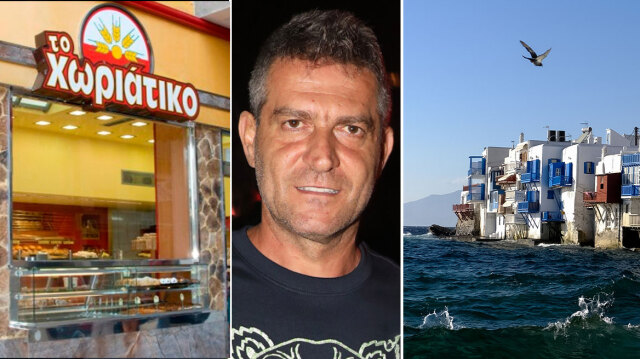
An extensive criminal investigation into the Horiatiko bakery chain has uncovered what Greek authorities describe as a sophisticated network of more than 340 interconnected companies, allegedly used to evade taxes, avoid social security contributions and conceal millions of euros in business revenue.
The 850-page case file compiled by Greece’s Organised Crime Directorate, widely known as the Greek FBI, identifies 149 alleged participants, including 58 people arrested during coordinated police operations.
At the centre of the investigation is businessman Angelos Giannakopoulos, whose business interests allegedly extended far beyond the Horiatiko bakeries, encompassing restaurants, luxury beach bars in Mykonos and Rhodes, and strip clubs in Athens.
According to the investigation, the network generated approximately €170 million in suspected tax-related irregularities, while the authorities have documented €95.5 million in outstanding tax and social security liabilities, including penalties and surcharges.
Investigators have also identified seven public officials whose alleged connections to the organisation are under scrutiny, alongside hundreds of bank accounts and financial transactions involving companies across Europe.
From a trafficking complaint to a major financial investigation
The investigation began on 14 January 2026, following allegations that a criminal network was recruiting foreign women with misleading promises of employment as dancers in Greek nightclubs.
According to the original complaint, the women were subsequently pressured into prostitution, while their earnings were allegedly withheld to repay supposed debts incurred during their transportation to Greece.
Following judicial authorisation, investigators launched surveillance operations, intercepted communications and conducted undercover investigations.
The inquiry eventually uncovered a much broader financial operation, allegedly functioning since at least 2016.
Working alongside Greece’s Independent Authority for Public Revenue (AADE) and the country’s anti-money laundering authority, police examined financial movements through at least 520 bank accounts belonging to more than 300 individuals and legal entities.
The investigation also incorporated criminal case files from prosecutors in Rhodes and Athens.
How the network allegedly operated through 340 companies
According to the case file, the organisation operated a system of more than 340 interconnected companies, many of which were established to manage individual commercial premises.
The businesses included bakeries, restaurants, beach bars and entertainment venues, often operating under recognisable commercial brands.
Investigators believe the system followed a recurring pattern.
A property would initially be leased by a company or individual connected to the alleged leadership before being sublet to another company responsible for operating the business.
That operating company would appoint a nominal director or shareholder, commonly described as a front person, who exercised little or no actual control.
The company would then allegedly accumulate unpaid VAT, income tax, payroll taxes, social security contributions and other financial obligations.
Once debts reached a level likely to trigger enforcement measures, the company would be abandoned, dissolved or placed into liquidation.
Another company, with a different nominal director, would immediately take over the same establishment.
The business would continue operating under the same name, with the same staff, equipment and suppliers, leaving customers unaware that the company responsible for running it had changed.
This allegedly enabled the real beneficiaries to retain commercial operations while substantial debts remained attached to companies that were no longer active.
Nearly €96 million in documented debts
Financial records examined by investigators reveal the scale of the alleged operation.
By September 2026, the network’s basic overdue liabilities, excluding surcharges, totalled €76.96 million.
Of that amount, approximately €38.18 million was owed to the Greek tax authorities, including:
- €21.77 million in VAT.
- €6.55 million in income tax.
- €4.11 million in withheld payroll taxes.
- €593,228 in repayable state financial assistance.
- €763,538 in unpaid beach concession fees and other obligations.
A further €38.78 million was owed to Greece’s social security organisation, e-EFKA.
Once penalties and surcharges were included, total outstanding liabilities increased to €95.56 million, comprising €45.27 million owed to the tax authorities and €50.28 million to e-EFKA.
Separately, sample audits covering businesses in Athens, Mykonos and Rhodes identified an estimated €30.52 million in concealed net profits and €43.3 million in taxable transactions that had allegedly not been properly declared.
Investigators are also examining a suspected subsidy fraud involving a €684,517 grant awarded to a company in Larissa for an investment valued at approximately €1.24 million.
The alleged mastermind known as ‘Boss’ and ‘Daddy’
Police identify Angelos Giannakopoulos as the alleged leader of the organisation.
According to intercepted conversations, associates referred to him by several nicknames, including ‘Boss’, ‘Daddy’, ‘Big Man’, ‘Friend’ and ‘Fanis’.
Giannakopoulos, who has been active in the bakery and hospitality industries since 1996, allegedly exercised strategic control over the companies without formally appearing as their director.
Instead, employment records reportedly listed him as an ordinary employee of different businesses within the network between 2017 and 2026.
His declared positions included security guard, bakery worker, cashier, restaurant cook and senior executive.
Investigators believe these arrangements helped explain his presence at the establishments and financial transactions involving him.
The police case file also alleges that he used six telephone connections registered to third parties or companies within the network.
During communications with outsiders, including a police officer in April 2026, he allegedly introduced himself under assumed names.
The alleged headquarters in Peristeri
Investigators identified a two-storey commercial complex measuring more than 3,000 square metres on Kifisou Avenue in Peristeri as the organisation’s central headquarters.
The building reportedly accommodated numerous interconnected companies, accounting services and administrative operations.
According to police, Giannakopoulos maintained a private office on the first floor.
The complex was leased through one company and subsequently sublet to dozens of others.
In May and June 2026, as investigators intensified their inquiries, several companies based at the premises reportedly terminated their leases or began liquidation proceedings almost simultaneously.
The accountants, family members and trusted associates
The case file describes a structured organisation involving family members, trusted associates, business supervisors and accounting professionals.
The alleged inner circle included Giannakopoulos’s son, Georgios Giannakopoulos, his partner and other individuals associated with property, tourism and hospitality companies.
One trusted female associate, identified by the initials D.K., allegedly coordinated corporate arrangements and maintained contact with accountants, lawyers and public officials.
A central accounting operation, with offices on Heyden Street in Athens and Kifisou Avenue, was allegedly responsible for establishing and dissolving companies, managing employment records and processing electronic financial transactions.
According to investigators, accounting staff also coordinated the repeated appointment and replacement of nominal directors.
The ‘front men’, 13 fictitious identities and six dead directors
One of the most striking findings concerns the individuals officially appointed to manage companies within the network.
According to the investigation, dozens of Greek and foreign nationals, including citizens of Latvia, Poland, Romania, Bulgaria, Albania, Ukraine and Belgium, appeared as directors and shareholders.
Many allegedly possessed limited financial resources and received relatively small payments for allowing their identities to be used.
Investigators also discovered 13 entirely fictitious individuals whose identities had reportedly been created using forged European passports and identity cards.
These documents were allegedly used to obtain Greek tax identification numbers and register companies.
Another unusual finding involved six individuals who had served as nominal directors of companies within the network and died between 2023 and May 2026.
Their deaths left numerous companies with substantial outstanding liabilities before replacement directors were appointed.
Bank accounts across 11 countries and property investments in Dubai
Investigators believe the network used foreign financial institutions and digital payment providers to prevent Greek authorities from freezing or seizing business revenue.
Instead of directing card payments into conventional Greek bank accounts, companies allegedly transferred their takings through payment terminals connected to overseas accounts.
Financial inquiries have identified transactions involving 11 countries, prompting 14 European Investigation Orders and international judicial assistance requests.
Among the transactions under examination are accounts associated with payment providers in Ireland, Denmark and Luxembourg.
Forty-seven Greek companies reportedly maintained Irish IBAN accounts, while another 20 used Danish accounts associated with Banking Circle.
In August 2026, a police investigation at company premises in Rhodes led to the seizure of 38 payment cards linked to accounts abroad, alongside a substantial amount of cash.
Authorities are also examining a €1.5 million transfer to a London-based company in August 2025 and a €2.6 million payment involving a Cypriot company in July 2021, connected to a property transaction in Mykonos.
Seven Cyprus-based holding companies are under investigation.
Other financial inquiries involve companies and accounts in Bulgaria, the Netherlands, Romania, Belgium, Italy and France.
According to the case file, proceeds from the alleged scheme were also channelled into property investments in Greece and Dubai, high-value vehicles and purported severance payments to associates.
Seven public officials and gifts of designer lipstick
Another significant aspect of the investigation concerns suspected connections between members of the network and public officials.
Intercepted conversations allegedly reveal contacts with individuals working in tax offices, social security services and labour inspection authorities.
Seven public officials feature in this part of the inquiry.
The conversations reportedly included coded references to certain officials as ‘our people’, ‘godchildren’, ‘aunt’ and ‘cousin’.
One episode concerned a serious workplace accident involving an Albanian cleaner at a Bread Factory establishment on Syngrou Avenue in Athens.
According to police, the woman was officially employed by one company while working at another within the same business network.
Investigators believe associates subsequently sought assistance from public-sector contacts to avoid sanctions and prevent closer scrutiny of the employment arrangements.
In intercepted telephone calls on 3 April 2026, two individuals allegedly discussed purchasing gifts for public employees ahead of a scheduled Labour Inspectorate appointment.
The gifts included perfumes, bakery products and Yves Saint Laurent lipsticks costing approximately €40 each.
According to the conversations, smaller favours were associated with relatively inexpensive presents, informally described as ‘little lipsticks’.
The discussions reportedly referred to a list of at least ten public employees.
However, the police report explicitly states that investigators did not establish whether the gifts were ultimately delivered or accepted.
The €20 million dispute over Mykonos restaurant Spilia
The investigation also details allegations of intimidation, commercial disputes and involvement by individuals associated with organised crime.
One particularly serious confrontation concerned the well-known Spilia restaurant at Agia Anna in the Kalafatis area of Mykonos.
Following the acquisition of a 50% stake in a company connected to the business in autumn 2023, a dispute allegedly developed between Giannakopoulos and the company’s existing management.
On 1 June 2024, Giannakopoulos and several associates visited the restaurant, where an altercation reportedly led to complaints involving threats and physical violence.
According to a separate extortion investigation, one of the opposing parties allegedly approached a criminal group associated with Edvard Damotsidis, known as ‘Edik’.
A member of that group allegedly demanded €200,000 per month in protection payments for Giannakopoulos’s businesses in Athens.
The group subsequently allegedly demanded that he accept €20 million for his stake in the Mykonos business and relinquish any further claims.
Giannakopoulos reportedly refused and arranged additional personal security, including motorcycle escorts.
Intimidation allegations at Rhodes beach auctions
Investigators also examined the network’s involvement in lucrative beach concession auctions in Rhodes.
During summer 2023, companies allegedly connected to the organisation participated extensively in tenders for 95 beach locations.
These included popular areas such as Anthony Quinn Bay, Ladiko, Tsambika, Elli Beach, Faliraki, Kolymbia and Ialysos.
According to the case file, Giannakopoulos and several associates attended auctions on 29 June and 17 July 2023, accompanied by physically imposing men who worked as security personnel at Athens nightclubs and strip clubs.
Some had allegedly been temporarily registered as office employees or doormen at a Rhodes-based company.
Police believe their presence was intended to intimidate rival bidders and discourage competing offers.
Companies linked to the network consequently secured numerous beach concessions, including bids reportedly reaching €145,180 for individual positions at Elli Beach.
Investigators allege that substantial concession fees subsequently remained unpaid.
A criminal investigation extending well beyond the bakery industry
The scale of the investigation has exposed what police describe as an extensive operation involving company registrations, accounting practices, property arrangements and international banking transactions.
Alongside the suspected financial offences, the criminal case includes allegations relating to money laundering, document forgery, non-payment of debts, trafficking-related activity, extortion, robbery and violations of weapons and immigration legislation.
The 58 arrests were carried out across several locations, including Attica, Rhodes and Mykonos, while dozens of other individuals were identified during the investigation.
The case now places under judicial scrutiny a network that allegedly operated for nearly a decade across multiple sectors of the Greek economy.
The accusations remain subject to judicial examination, and the individuals implicated are presumed innocent unless proven guilty.
Ask me anything
Explore related questions




