





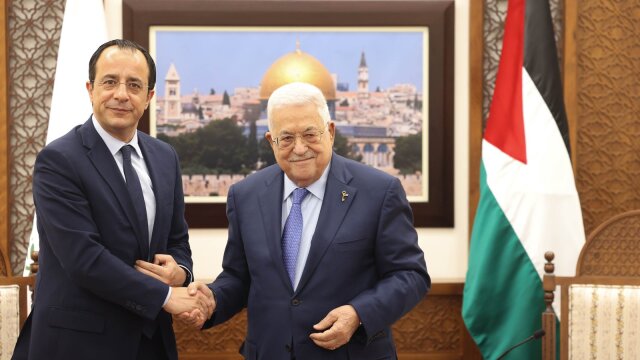
The Palestinian president has urged Nicos Christodoulides to use Nicosia’s ties with Israel to help restart negotiations after a new Israeli government is formed, stressing: “We do not want new military confrontations.”
Palestinian President Mahmoud Abbas has asked Cyprus to play a role in efforts to resume peace talks between Palestinians and Israelis following the formation of a new Israeli government. He made the appeal to Cypriot President Nicos Christodoulides during a working visit to Nicosia.
At their meeting at the Presidential Palace on Thursday, the two leaders underlined the need for security and stability in the Eastern Mediterranean. Abbas said the Palestinians wanted peaceful coexistence with the Israelis rather than further military confrontations.
Christodoulides, for his part, assured Abbas that Nicosia was ready to undertake any role the Palestinian side considered useful, stressing that the Republic of Cyprus sought to help resolve the region’s problems.
The visit comes at a particularly significant moment, as votes from Israel’s 27 October election are still being counted and no clear parliamentary majority has yet emerged.
Abbas calls for Cypriot mediation
Mahmoud Abbas placed particular emphasis on Cyprus’s relations with Israel, urging Nicos Christodoulides to use his contacts with the Israeli leadership to advance dialogue.
He said that, once a new Israeli government had been formed, the Palestinian side would be willing to discuss peace with it.
“We are concerned about the security of the region, and we are concerned about security with the Israelis as well. We do not want military tensions and confrontations,” he said, underlining that he was seeking a solution based on United Nations Security Council resolutions and international law.
The Palestinian president also said his side supported peaceful popular resistance to violations of Palestinian rights.
Addressing Christodoulides directly, Abbas expressed the hope that Cyprus, as a neighbouring country with good relations with Israel, could help ensure that any future dialogue produced positive results.
The Israeli election
Abbas’s reference to the Israeli election takes on particular significance amid uncertainty over the formation of a government.
According to the results available so far, Benjamin Netanyahu’s bloc has secured approximately 53 seats, compared with 48 for the opposition bloc led by Gadi Eisenkot. Arab parties are expected to win around 19 seats.
Neither of the two main blocs has secured the 61 seats required for a parliamentary majority.
Abbas refrained from expressing support for any Israeli political faction, making clear that he was prepared to hold talks with whichever government emerged from the election.
‘Cyprus is part of the solution’
Nicos Christodoulides reiterated that the Republic of Cyprus remained committed to resolving the Palestinian issue on the basis of the relevant United Nations resolutions.
He recalled that Cyprus recognised the Palestinian state in 1988 and referred to his visits to the Palestinian territories in 2023 and 2025.
“The Republic of Cyprus is part of the solution to the region’s problems. It is not part of the problems,” he said.
The Cypriot president noted that a significant proportion of his country’s humanitarian aid was directed towards the Palestinians. He also highlighted cooperation in education.
Palestinians make use of the CYCLOPS training centre in Larnaca, while a Palestinian delegation recently took part in a seminar at the Aerial Firefighting Centre established in Paphos in cooperation with the European Union.
Cooperation with Israel
Abbas’s visit comes just three days after Cyprus and Israel signed a new defence agreement on 26 October.
The agreement provides for the procurement of a new offshore patrol vessel from Israel Shipyards, equipped with systems supplied by Rafael, as well as an upgrade to the existing Ioannidis patrol vessel.
According to the Israeli financial newspaper Globes, the agreement is worth €150 million, although this figure has not been officially announced.
Defence cooperation between the two countries has expanded in recent years. Cyprus also participates alongside Greece and Israel in trilateral initiatives on energy and regional security.
Despite its close relations with Tel Aviv, Nicosia continues to support a two-state solution and maintains regular contact with the Palestinian Authority.
The Amalthea corridor and aid to Gaza
An important element of relations between Cyprus and the Palestinians is the Amalthea humanitarian corridor, established to transport aid to Gaza.
According to an official announcement by the Cypriot Ministry of Foreign Affairs on 27 August, more than 37,000 tonnes of humanitarian aid had been dispatched and delivered since the corridor began operating.
A further shipment of 900 tonnes was announced on the same day, containing food, medicines, medical equipment and essential supplies.
The mechanism remains available for the movement of aid, primarily through the Israeli port of Ashdod, in cooperation with the United Nations and other international organisations. However, no updated figure for deliveries in October has been confirmed.
Gaza, the West Bank and Greece
Mahmoud Abbas referred to the difficult conditions facing Palestinians in Gaza, the West Bank and East Jerusalem, which the Palestinian side claims as the capital of a future state.
His visit is also significant for Greece, which pursues a similar policy of maintaining close relations with Israel while continuing to support a two-state solution.
Athens and Nicosia are seeking to keep channels of communication open with countries across the region, as developments in the Middle East directly affect security, energy and geopolitical balances in the Eastern Mediterranean.
Thursday’s meeting confirms that the Palestinian Authority considers cooperation with Cyprus valuable, including because of the island’s close relations with Israel. For the time being, however, no specific Cypriot mediation initiative has been announced.
Ask me anything
Explore related questions




