





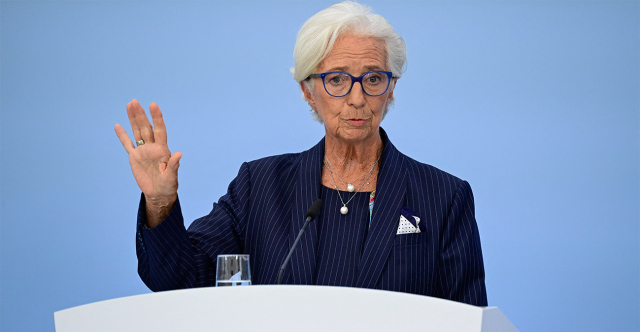
Christine Lagarde has resigned as president of the European Central Bank (ECB) and will leave office on February 7, 2027, the central bank announced on Thursday, setting the stage for a major leadership transition at a time of renewed inflationary pressures across the eurozone.
“The President of the European Central Bank, Christine Lagarde, today informed the Governing Council and the President of the European Council, António Costa, that she will step down from her position on February 7, 2027,” the ECB said in a statement.
Members of the Governing Council thanked Lagarde for her service, giving her a prolonged standing ovation.
Her departure, nine months before the scheduled end of her term, paves the way for one of the most significant leadership reshuffles in the ECB’s 28-year history.
According to the Financial Times, Lagarde’s presidency has been shaped by an extraordinary succession of crises, including the worst pandemic in a century, Europe’s deadliest war since 1945, the most severe inflationary shock in a generation and a trade war with the United States.
Earlier this year, the 70-year-old acknowledged that when she agreed with French President Emmanuel Macron to take over the ECB presidency, she had initially expected to remain in Frankfurt for just five years rather than eight.
President Lagarde has informed the Governing Council and the President of the European Council António Costa that she will step down from her position on 7 February 2027. Her successor will be appointed by the European Council in due course. Press release https://t.co/krd51z9pZO
— European Central Bank (@ecb) October 29, 2026
Lagarde is only the second president in the ECB’s history to leave office before completing her term.
The bank’s first president, Wim Duisenberg, stepped down after five years under a political agreement reached at the launch of the European Monetary Union.
Lagarde is reportedly in discussions about becoming chair of the World Economic Forum.
Breaking news: Christine Lagarde is to step down as European Central Bank president nine months early, setting up a leadership contest just as the central bank faces a resurgence in inflationary pressures https://t.co/OnPhnWRGC2 https://t.co/OIIYEXtlrO
— Financial Times (@FT) October 29, 2026
The race to succeed Lagarde and wider changes at the ECB
The Dutch government is backing Klaas Knot, the former governor of the Dutch central bank, to succeed Lagarde.
Spain, meanwhile, supports Pablo Hernández de Cos, the general manager of the Bank for International Settlements (BIS) and former governor of the Bank of Spain.
The upcoming changes at the ECB extend beyond its presidency.
ECB Executive Board member Isabel Schnabel is expected to leave her position a year early, in January, to take up a senior role at the International Monetary Fund (IMF).
Meanwhile, the term of ECB chief economist Philip Lane is due to expire in May.
The appointment of any new member of the ECB’s Executive Board requires the support of at least 16 of the 21 eurozone countries, representing at least 65% of the euro area’s population.
António Costa: Europe benefited greatly from Lagarde’s leadership
European Council President António Costa confirmed that Lagarde had informed him of her decision and praised her leadership during a period of exceptional economic and geopolitical uncertainty.
“The President of the European Central Bank, Christine Lagarde, has informed me of her intention to step down from her position on February 7, 2027. I respect and acknowledge her decision.
“I would like to thank Ms Lagarde for the dedication she has demonstrated as President of the ECB since November 2019.
“Throughout her tenure, she has led the European Central Bank with a strong sense of duty and responsibility.
“Europe has benefited greatly from her leadership in times of uncertainty and from her unwavering commitment to the European project.
“Through a global pandemic, a war in Europe, energy crises and inflationary shocks, she has demonstrated steady and decisive leadership, helping to safeguard the stability and resilience of the eurozone.
“To ensure a smooth transition to the ECB’s new leadership, the process of appointing her successor will begin today and proceed without delay.”
Costa added that the objective was to secure a timely decision by the European Council, meeting in its eurozone composition, in accordance with the procedure laid down in Article 283(2) of the Treaty on the Functioning of the European Union.
I would like to thank Christine @Lagarde for her outstanding service as President of the ECB. On behalf of the #Eurogroup, I express my gratitude for her contribution to the stability of the euro area and her leadership in these testing economic times. https://t.co/8tySba6HBj
— Kyriakos Pierrakakis (@Pierrakakis) October 29, 2026
Pierrakakis: Grateful for her contribution to eurozone stability
Greek Finance Minister and Eurogroup President Kyriakos Pierrakakis also paid tribute to Lagarde following the announcement of her resignation.
“I would like to thank Christine Lagarde for her outstanding service as President of the European Central Bank (ECB),” Pierrakakis said in a social media post.
“On behalf of the Eurogroup, I express my gratitude for her contribution to the stability of the eurozone and for the leadership she demonstrated during these challenging economic times.
Ask me anything
Explore related questions




