





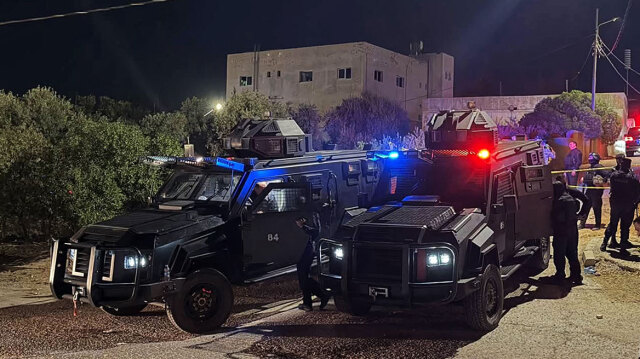
It is Friday, October 23. A funeral is taking place at the Greek Orthodox Church of St. George, in the village of Hamoud, in Jordan’s Karak Governorate. Since the church cannot accommodate the entire village, most people are gathered outside, in the church grounds. Suddenly, three armed men with their faces covered open fire on those attending the funeral. Within five minutes, one funeral turns into ten, while 40 people are taken to hospital with injuries.
A few days later, after the three perpetrators have been arrested and Jordan bombs Syria over the bloodshed, the country’s prime minister says that those who killed the “Rum” had embraced “takfiri ideology”. Earlier, one of the wounded had promised King Abdullah that no one would succeed in driving Christians from their homeland. So what do all these terms mean? How many Orthodox Christians live in Jordan and Syria? Who is pursuing and massacring them, and why?
“Rum”, meaning “Romans” or “Rhomaioi”, is the colloquial name given to the Greek Orthodox Christians of the region. They are not necessarily of Greek descent, nor do they all speak Greek, but their churches fall under the jurisdiction of the Greek Orthodox Patriarchate of Jerusalem. They live alongside Muslims in mixed or Christian villages located in predominantly Muslim governorates. This continued until the emergence of the Islamic State and its affiliates, which began carrying out massacres.
In Jordan, the Director of Public Security, Major General Obeidallah al-Maaytah, stated that the perpetrators had adopted extremist takfiri beliefs. Takfiri ideology is the doctrine that declares anyone who does not subscribe to it an “infidel”. This does not apply only to Christians, but also to Muslims. Radical organizations such as al-Qaeda and ISIS use takfir to delegitimize entire governments in Muslim countries, their leaders and even ordinary citizens who disagree with their ideology, thereby justifying violence against them.
This is how the massacres of Christians are justified. It was also the rationale behind the horrific execution of Jordanian pilot Muath Safi Yousef al-Kasasbeh, from Karak, the area with the largest Christian community in Jordan. Muath was captured by the Islamic State after his F-16 crashed in Raqqa, Syria. The jihadists burned him alive, in a video that shocked the world. In Jordan, takfirists and all extremists linked to the Islamic State are considered terrorists and are executed by hanging.
Returning to the attack, King Abdullah II described it as a terrorist act — effectively announcing that the arrested suspects would be executed — and promised the “harshest retaliation” shortly before the bombings in Syria began. The government declared three days of national mourning and flags were flown at half-mast. Athens condemned the attack on the same day, while Patriarch Theophilos III of Jerusalem held a memorial service on Saturday and visited the wounded. In Bethlehem, church bells rang and candles were lit in Manger Square.
Lebanese President Joseph Aoun, the only Christian head of state in the Arab world, described it as a heinous terrorist attack.
For the average Greek reader, the description “Greek Orthodox church” in Jordan naturally raises a question: Who are these people, and what are they doing there?
Christians among the oldest communities
The Orthodox Christians of Jordan and Syria are not immigrants, nor are they Greeks living abroad. They are Arabs, speak Arabic and are descendants of some of the earliest Christian communities in history.
Christian presence in the territory of present-day Jordan dates back to the first century. In Syria are the Road to Damascus, where Saul became Paul, and the historic region of Antioch, where, according to the Acts of the Apostles, the disciples were first called “Christians”.
We are talking about a population of approximately 250,000–400,000 Christians in Jordan — some of whom are the only Christian Bedouins in the world — mainly in Karak and Salt, outside Amman, where the famous music festival of the same name is held under the patronage of the royal family. In Syria, there are approximately 300,000 Christians. Before 2011, they accounted for 10% of the population; today, they make up approximately 2%.
The massacres and relentless persecution by jihadists — at least 4,000 Christians were killed during the war in Syria alone — whether the perpetrators go unpunished or are executed by hanging, as in Jordan, are driving Christians to flee.
From the fourth to the seventh century, the region was part of the Byzantine Empire. Ruins of major churches have survived in Jerash, Madaba and the Syrian hinterland. Arab tribes converted to Christianity centuries before the advent of Islam, the best-known example being the Ghassanids, allies of Byzantium.
Following the Arab conquest in the 630s, the Islamization of the population was gradual and took centuries. Those who remained faithful to the Byzantine rite were called, and are still called today, “Rum”, meaning “Romans”. The term referred to the subjects and co-religionists of Constantinople, not to an ethnic origin.
Why, then, are they called “Greek Orthodox”? Because they belong to the two ancient patriarchates of the East and celebrate the Liturgy of St. John Chrysostom in Arabic, with certain parts in Greek.
The Orthodox Christians of Jordan fall under the jurisdiction of the Patriarchate of Jerusalem, whose senior hierarchy is generally Greek, while parish priests and the congregation are Arab. This is the connection that makes Athens feel a direct link to an attack in Karak.
The Orthodox Christians of Syria fall under the jurisdiction of the Patriarchate of Antioch, which has been based in Damascus since the 14th century and has had an Arabic-speaking hierarchy since 1899.
Karak occupies a special place in this history. In the early 1880s, a conflict between Christian and Muslim tribes in the town led approximately 90 Christian families to move north. They settled among the ruins of Madaba, a Byzantine city that had been abandoned centuries earlier.
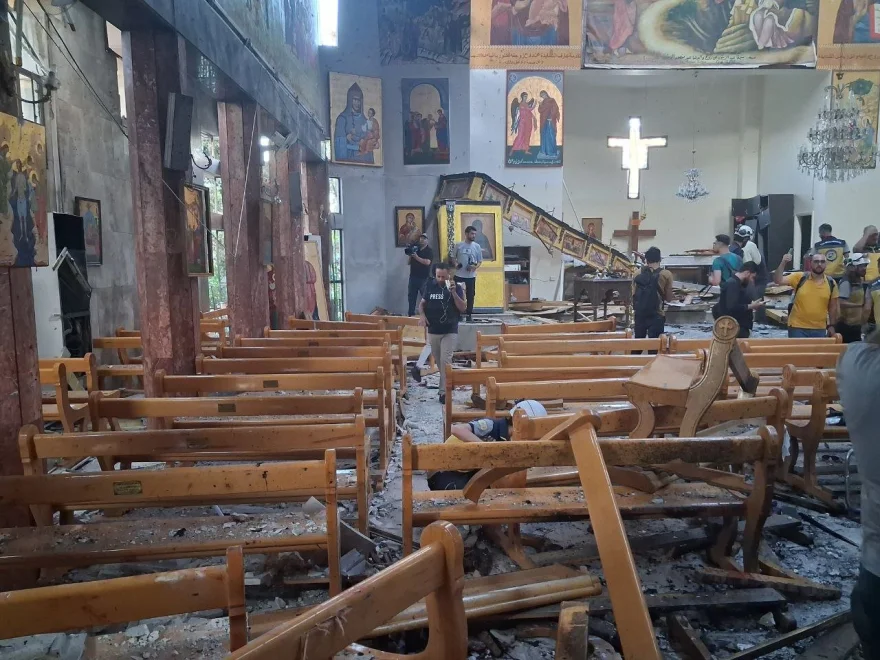
The Ottomans allowed them to build churches only on sites where ancient churches had already stood. While clearing the foundations of an old church in 1884, the settlers discovered the Madaba Mosaic Map, the oldest surviving map of the Holy Land. Today, it lies on the floor of a Greek Orthodox church built over it. That church, too, is dedicated to St. George.
The Christians who remained in Karak and its villages, such as Hamoud, continued living alongside their Muslim neighbors, sharing tribal structures and customs for almost a century and a half.
Let us also look at the issue geographically. The village of Hamoud, where the bloody attack took place, has just 284 residents. It was founded in 1900 by the Christian Al-Khalasa clan and has traditionally been associated with Jordan’s Christian community. It is also home to some of the last semi-nomadic Christian Bedouins on the planet and the only inhabited stone houses carved into caves.
Today, approximately 250,000 to 400,000 Christians live in Jordan, representing 2% to 3% of the population. There is no official religious census, which is why estimates vary.
The largest Christian community in the country is the Greek Orthodox one. It is followed by Roman Catholics (Latins), Greek Catholic Melkites, Protestants, Armenians and Syriac Orthodox Christians.
Although relatively small in population, Jordan’s Greek Orthodox community is quite influential, as its members hold important positions in the government and key state institutions.
Jordan’s Christian community falls under the jurisdiction of the Patriarchate of Jerusalem, and a number of Greek and Greek-speaking priests serve in the country.
Jordan also has religious tourism sites of great significance, such as the River Jordan, where Christ was baptized. But it is also — and this is important — the Custodian of the Muslim and Christian Holy Sites in Jerusalem, including the Al-Aqsa Mosque, a special role recognized by Israel under the 1994 treaty.
In this capacity, Jordan exercises spiritual and administrative oversight of these sites through the Waqf organization, although it does not have territorial sovereignty over them.
Demographically, the balance was once very different. In 1930, in what was then Transjordan, Christians accounted for approximately 20% of the population. Their absolute numbers have increased since then, but their proportion has collapsed for three reasons.
The first is the mass influx of Muslim refugees, mainly Palestinians after 1948 and 1967, followed later by Iraqis and Syrians. The second is the higher birth rate among Muslims. The third is the emigration of educated Christians to Europe, Canada, the United States and Australia.
The position of Christians in Jordan is considered one of the best in the Arab world. Parliament has 138 seats, nine of which are reserved for Christians: seven in local constituencies and two on national party lists.
Churches have their own ecclesiastical courts for family law matters, and religious holidays are celebrated publicly. Christian schools and hospitals serve Muslims equally.
There are, however, limits. Religion is recorded on official documents, conversion from Islam is not legally recognized, and proselytizing among Muslims is prohibited.
In everyday life, however, a Christian from Karak or Salt is first and foremost a member of their tribe and village. For Jordanians, Christians are above all fellow citizens. This is why the shock has been so profound, and why images of King Abdullah, a descendant of Muhammad, embracing and kissing the wounded, and Queen Rania crying as she hugs the victims’ relatives, do not seem unusual to Jordan’s overwhelmingly Muslim population.
Jordan is “accustomed” to jihadist violence. In 2015, the Islamic State burned Jordanian pilot Muath al-Kasasbeh alive. He was born and raised in Karak.
In December 2016, Islamists attacked Karak Castle and police stations, killing ten people, including a Canadian tourist. That same year, Christian journalist Nahed Hattar was murdered outside a courthouse in Amman, where he was standing trial over a cartoon considered offensive to Islam.
However, an organized attack on Christian worshippers inside a church had never before been recorded in the modern history of the kingdom. This is what makes the Hamoud attack different. For the community itself, the most alarming aspect is that the perpetrators were neighbors.
Syria: From one in ten to one in fifty
Before the 2011 civil war, Christians in Syria accounted for approximately 10% of the population, or 1.5 to 2 million people. Today, estimates put their share at approximately 2%, or around 300,000.
The European Union Agency for Asylum (EUAA) notes that there is no official figure and that more than three out of every four Christians have left the country.
In the Khabur Valley, a stronghold of the Assyrians, the Christian population has fallen from approximately 15,000 to just a few hundred.
Syria’s largest Christian community is the Greek Orthodox community of Antioch. Its members live mainly in Damascus, Homs, Hama, Aleppo, Latakia and the Valley of the Christians (Wadi al-Nasara), west of Homs, where approximately 20,000 families reside.
There are also Greek Catholics, Syriac Orthodox, Armenians, Assyrians, Maronites and Chaldeans. In Maaloula, north of Damascus, residents still speak a form of Aramaic, the language of Jesus.
The collective memory of Damascus’s Christians often returns to the summer of 1860. At the time, under Ottoman rule, the city’s Christian quarters were looted and thousands of people were killed within a few days.
A long period of relative security followed. Under the Assad family, Christians lived under an unwritten arrangement: political neutrality in exchange for freedom of worship. This led many opponents of the regime to regard them as aligned with it.
And so we arrive at 2010, an era when the war in Syria did not target Christians alone, but everyone. It killed hundreds of thousands of Syrians of all faiths. For a small community, however, every blow carried a disproportionate impact.
The Swedish Assyrian Observatory for Human Rights estimates that more than 4,000 Christians were killed during the years of the war.
Among the most significant incidents that marked the country’s Christian community was the abduction, in April 2013, of two bishops of Aleppo outside the city. One was Greek Orthodox Bishop Paul Yazigi, brother of the current Patriarch of Antioch, and the other was Syriac Orthodox Bishop Yohanna Ibrahim. Their fate remains unknown to this day.
That same year, jihadists led by the al-Nusra Front entered Maaloula. In December, Orthodox nuns from the Monastery of St. Thecla were abducted. They were released in March 2014.
In February 2015, the Islamic State attacked Assyrian villages in the Khabur Valley and abducted more than 200 people, the overwhelming majority of them Christians.
But violence is not the only explanation for why Christians have left the region. Sanctions, the collapse of the Syrian pound, conscription and electricity shortages also pushed young people toward Lebanon, Sweden, Germany and Canada.
Every family that left made the next one more isolated and more vulnerable.
The Prophet Elijah and the Valley of the Christians
In December 2024, the Assad regime fell and power passed to the Islamist organization Hayat Tahrir al-Sham (HTS) and Ahmed al-Sharaa, a former leader of an al-Qaeda affiliate.
The transitional government pledged to protect minorities, and a Christian woman was given a ministerial post. The first few months passed in an atmosphere of cautious expectation, which came to an end on the morning of Sunday, June 22, 2025.
At the Greek Orthodox Church of the Prophet Elijah — known to locals as “Mar Elias” — in the Dweila district of Damascus, an armed man opened fire during the Divine Liturgy and then detonated the explosives he was carrying.
The Health Ministry initially reported 25 dead and 63 injured. Subsequent death tolls put the number of fatalities at 30.
The Interior Ministry blamed the attack on the Islamic State, saying the suicide bomber was not Syrian. According to the authorities, he had arrived in Damascus from al-Hol camp, where families of Islamic State fighters are held.
Responsibility was claimed by a lesser-known group, Saraya Ansar al-Sunna, which denied being affiliated with ISIS. Analysts describe it as a pro-jihadist offshoot of ISIS, possibly formed by former HTS members who broke away.
At the funeral service for the victims, Patriarch John X addressed al-Sharaa directly. He said this was the first massacre of its kind in Syria since 1860. His words showed just how deeply the attack had affected the community’s collective memory.
After Damascus, the violence took the form of individual killings, abductions and acts of intimidation. The epicenter has been the Valley of the Christians and Christian villages in the countryside of Hama, where attacks have continued relentlessly.
On October 1, 2025, in Anaz, masked men on a motorcycle opened fire on young people outside the home of the community leader. Cousins Wissam and Shafiq Mansour were killed. A third young man was seriously injured.
Residents set fire to a General Security checkpoint and declared a general strike.
On February 20, 2026, Iman Mathanious Jrousi, 47, a teacher and mother of three from the Valley, was murdered with a gunshot to the head.
A few days later, in Sqaylabiyah, armed men from a neighboring Sunni town attacked the Christian town.
Families barricaded themselves inside their homes for hours. Residents subsequently staged demonstrations on March 28. The main church closed.
The following day, the patriarchs based in Damascus — Greek Orthodox, Syriac Orthodox and Greek Catholic — issued a joint statement. They called for security, control over weapons and equality among citizens.
A relative lull followed until July 8. On that day, Fadi al-Shaer, a Christian man, was abducted along with his daughter. Both were found dead.
On August 15, in Homs, Nader Tanous, who had recently returned to his homeland from Sweden and opened a hair salon, was shot dead while returning from work.
The case of Nader Tanous carries particular weight in the debate over the return of Syrian refugees from Europe. He was one of those who had decided to go back.
Then, on September 30, in Latakia, Georg Nemec was found murdered in his field, bringing the question of discrimination against Christians in these killings into focus.
Who is massacring Christians?
The answer to this question is… multifaceted, just like the network of extremist, jihadist and radical Islamist organizations.
There is no single perpetrator. Violence against Orthodox Christians in the two countries comes from four different sources, with a common thread of extremist Sunni Islamist ideology, the spread of radicalism, low levels of education and impunity.
In most cases — or at least the most extreme ones — the main suspect is someone we thought we had left behind: the Islamic State and its offshoots.
This terrorist organization, which is still working toward the creation of Islamic caliphates in countries that are sovereign today, has been blamed for the deadliest attack on a Christian church in Syria in recent years.
The bombing at the Church of the Prophet Elijah was attributed to ISIS by the Syrian government and claimed by Saraya Ansar al-Sunna. The same group has claimed attacks against Alawites and threatened the Druze, although its activities have largely been confined to Syrian territory.
Another source of violence is jihadist organizations that emerged from the chaos of the Syrian war. From 2011 to 2024, groups such as the al-Nusra Front and ISIS seized Christian villages, desecrated churches and abducted clergy and civilians. Some of their offshoots remain active.
The most dangerous phenomenon, however, at least so far, appears to be that of “lone wolves”: individual radicalized people who decide to carry out a massacre on their own or with a handful of like-minded accomplices, without caring whether they themselves end up dead.
Karak is an example of this category. Jordanian authorities speak of three relatives with takfiri beliefs, with no evidence of an organizational connection.
Jordanian analysts say they tend to believe that the perpetrators subscribe to ISIS ideology, although this connection has not been confirmed.
This is a major issue for Arab countries because their social cohesion is under threat. That is why the Jordanian government is focusing not only on exemplary punishment for the perpetrators, but also on examining the conditions that drive young people toward extremism, as well as hate speech and incitement.
What the Jordanian government has no knowledge of, however, is the activity of unidentified gunmen and local groups in transitional Syria. Here, the answers are less clear.
In most of the killings of Christians during 2025–2026, the perpetrators remain unidentified.
Minority advocacy organizations, such as Christian Solidarity International and Canada’s EALA, attribute some of the attacks to gunmen linked to the new security forces. They point out that these forces are staffed mainly by former Islamist fighters.
Al-Sharaa’s government attributes the incidents to “unknown assailants” and the general lack of security.
The picture differs depending on the observer. Advocacy organizations speak of systematic targeting. In its December 2025 guidance, the European Union Agency for Asylum records religiously motivated attacks in Damascus, Hama, Homs and Latakia. However, it assesses them as sporadic and not amounting to widespread persecution.
This gap between the two assessments lies at the heart of the uncertainty experienced by Syria’s Christians.
Another point is important. Christians are not the only targets. Alawites, Druze and Shiites have lost far more people in transitional Syria.
In Jordan, victims of jihadist violence have also included Muslim police officers and soldiers. All are targeted as “infidels”, accused of being “crypto-Christians”, “corrupted by the West” and other such “arguments” that serve as excuses for spilling human blood.
The result, of course, is what remains: in Syria, the number of Christians has already fallen to one-fifth or less of its former level in just fifteen years.
In Jordan, their numbers are small but stable. However, their sense of security has suffered the greatest blow in the kingdom’s modern history.
In Madaba, about an hour and a half north of Hamoud by road, the mosaic map on the floor of St. George’s Church still depicts Jerusalem, the River Jordan and the Dead Sea.
It was rediscovered by Christians from Karak who had fled a blood feud.
Almost 140 years later, the descendants of those who stayed are counting their dead in another Church of St. George.
Ask me anything
Explore related questions




