





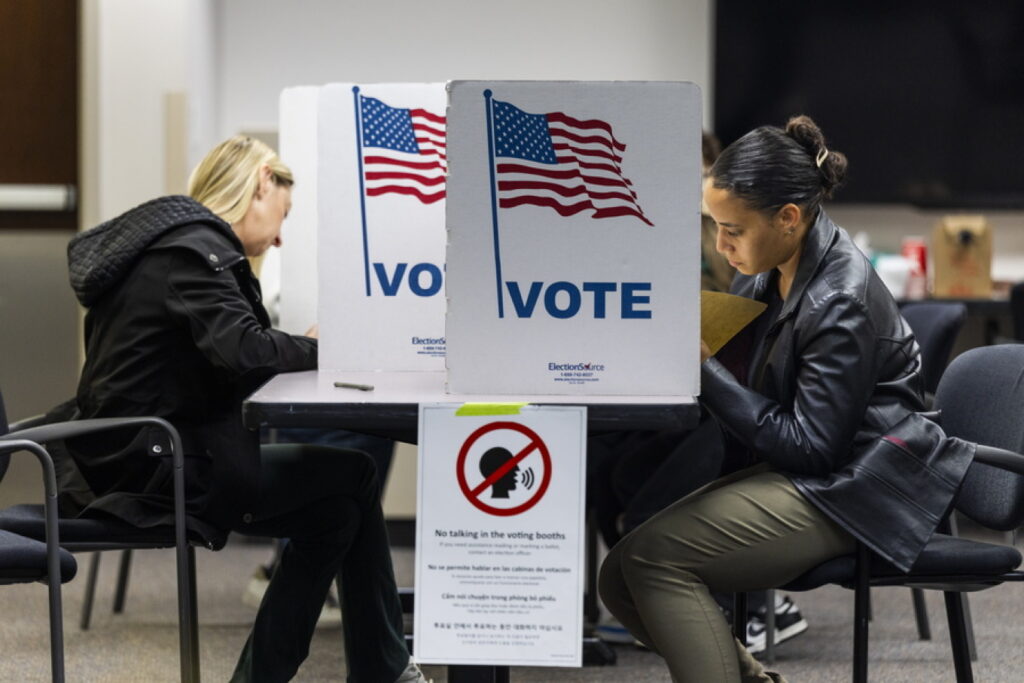
Millions of Americans are heading to the polls on Tuesday, 3 November, in crucial midterm elections that will determine control of Congress and shape US President Donald Trump’s ability to pursue his political agenda during the final two years of his presidency.
The election covers all 435 seats in the House of Representatives and 35 of the 100 seats in the Senate. Republicans currently control both chambers, although opinion polls suggest Democrats have an opportunity to regain the House, while the battle for the Senate remains more competitive.
As voting got under way, Trump launched a personal attack against Democratic Senate candidate Abdul El-Sayed in Michigan, urging voters to support his Republican opponent, Mike Rogers.
American voters will deliver a verdict on the first two years of President Donald Trump’s second term in the midterm elections, with polls and nonpartisan analysts favoring Democrats to wrest the House from Republicans while control of the Senate remains uncertain https://t.co/Ww7CGYxNpS
— Reuters (@Reuters) November 3, 2026
“Abdul El-Sayed hates Jews and hates Black people. Don’t feel bad, he also hates white people,” Trump alleged in a post on Truth Social.
“Only fools would vote for him in the US Senate election in Michigan! He will definitely, 100%, destroy you! Vote for Mike Rogers,” the US president added.
The accusations were made by Trump and have not been independently substantiated.
El-Sayed is contesting one of the closely watched Senate races. If elected, he could become the first Muslim senator in US history.
Trump urges Americans to keep the country great
In remarks broadcast by Fox News programme Fox & Friends, Trump appealed to voters to support the continuation of his administration’s policies.
“We must keep America great,” the president said.
He also claimed that the United States had restored its international standing under his leadership.
“They used to laugh at us. They thought we were fools. And now we’re on top. We’re the most popular country in the world, everyone respects us,” Trump said.
According to a White House official, the president will follow election night developments from the White House.
Nearly 60 million Americans voted early
Nearly 60 million Americans had already voted before polling stations opened on Tuesday, according to figures published by the University of Florida’s Election Lab.
By Monday evening, 58,677,062 votes had been recorded, including 31,897,521 cast in person during early voting and 26,779,541 postal ballots.
Polling stations have opened progressively across the country, with voting under way in at least 27 states by Tuesday afternoon.
The US Department of Justice has announced the deployment of approximately 1,000 election observers across all 50 states.
Flooding disrupts voting in Florida and Utah
Severe weather has complicated voting in several parts of the United States, with heavy rainfall and flooding affecting access to polling stations.
In Florida, authorities announced the relocation of polling locations because of flooding, with one update reporting 19 affected sites. Earlier information had identified 18 relocated polling stations across several counties, including Brevard, Highlands, Indian River, Martin, Okeechobee, Palm Beach and St Lucie.
The changes were announced shortly before voting began, as authorities sought to ensure the safety of election workers and voters.
In Utah, officials have authorised emergency electronic voting for residents unable to reach polling stations because of extensive flooding.
San Juan County, in the south-east of the state, has declared a state of emergency following damage to roads and transport infrastructure.
Utah Lieutenant Governor Deidre Henderson explained that the considerable distances between remote communities had made access particularly difficult.
“We already use this method for overseas voters, military personnel and people with disabilities. It is nothing new, we have done it before,” she told local broadcaster KSTU.
Residents whose email addresses are registered with election authorities will receive instructions electronically, while others can seek assistance through a dedicated state telephone service.
Five states could prove decisive in the Senate race
Attention is focused particularly on five Senate contests that could influence the balance of power in Congress.
In Alaska, Republican incumbent Dan Sullivan is seeking re-election against Democrat Mary Peltola and independent candidate Daniel J Sullivan.
In Maine, Republican Senator Susan Collins is seeking a sixth term against Democrat Troy Jackson.
Texas is hosting an open-seat contest between Democrat James Talarico and Republican Ken Paxton.
In Kansas, Democratic candidate and pastor Adam Hamilton is challenging Republican Senator Roger Marshall in a state traditionally considered a Republican stronghold.
Michigan is also attracting national attention, with Abdul El-Sayed facing Mike Rogers in a contest that has now drawn direct intervention from Trump.
Cost of living, immigration and the Iran war dominate voters’ concerns
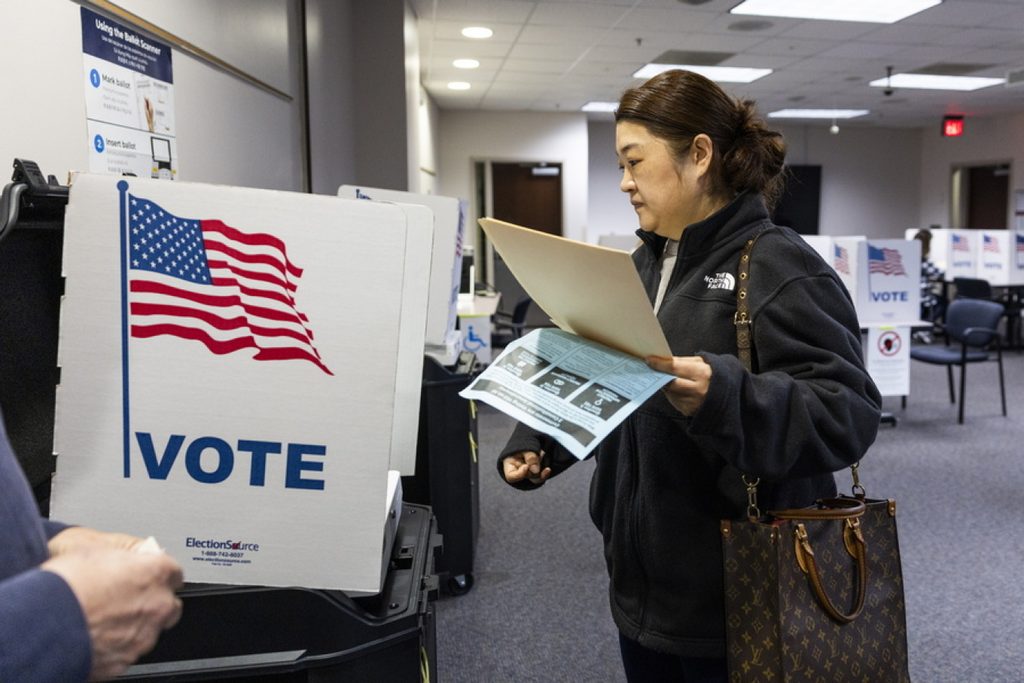
Five major issues have emerged during the election campaign: the cost of living, immigration, the war with Iran, healthcare and the development of data centres.
Rising energy prices, partly driven by tariffs and the economic consequences of the Iran conflict, have contributed to higher petrol prices and household expenses.
Republicans argue that Trump has fulfilled his promise to strengthen border security, pointing to a significant reduction in immigration figures. However, some voters have expressed concern about the severity of enforcement measures.
The war with Iran has also become increasingly controversial as its economic consequences affect American consumers, although some voters continue to support Trump’s decision to take military action.
Healthcare remains another major battleground. Democrats have focused on the high cost of health insurance, while Republicans have emphasised the administration’s efforts to lower prescription drug prices.
Meanwhile, opposition to the construction of new data centres has brought together voters from both sides of the political divide in several parts of the country.
NEW: President Trump has one final message for voters as they head to the polls: "We have to keep America great." Speaking on @foxandfriends, Trump says the U.S. has gone from being what he calls a "laughingstock" to the "hottest country in the world." "They thought we were fools. And we’re hot now. We’re the hottest country in the world where respected by everybody." Stay with Fox News Channel for the latest on the midterms.
— Fox News (@FoxNews) November 3, 2026
When will the election results be known?
The first polling stations are scheduled to close at approximately 1am on Wednesday, 4 November, Greek time, in parts of Indiana and Kentucky.
Polling stations will then close progressively across the country, with voting ending in California at 6am Greek time and the final polls in Alaska closing at approximately 8am.
Initial results are expected overnight, but several closely contested races may take days to resolve.
Postal ballots and provisional votes could substantially alter early projections, particularly in states where different categories of votes are counted at different stages.
US citizens vote in the midterm elections https://t.co/sXPEmNc6VD
— Reuters (@Reuters) November 3, 2026
One phenomenon election analysts are watching is the so-called “red mirage”, in which Republican candidates appear to lead in initial counts before later-counted postal ballots narrow or reverse the margin.
Election officials stress that changes in the lead during counting do not, in themselves, indicate electoral fraud.
In Georgia, a Senate race could proceed to a run-off on 1 December if no candidate secures the required majority. Louisiana also has provisions for a second round on 12 December if necessary.
The newly elected Congress is due to take office on 3 January 2027, determining the legislative balance of power for the remainder of Trump’s presidency.
Ask me anything
Explore related questions




