





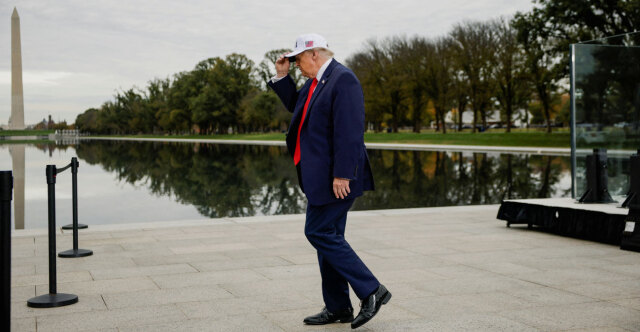
US President Donald Trump’s crushing defeat in the US midterm elections could mark the beginning of the end of his political era, according to an analysis by the New York Times, following the Democrats’ dramatic capture of both the Senate and the House of Representatives. However, the newspaper warns that the electoral backlash does not necessarily mean the collapse of Trumpism or the political movement the president has built over the past decade.
Throughout the campaign, Trump repeatedly encouraged Americans to treat the midterms as a personal referendum. On 47 occasions, he urged supporters to “pretend I’m on the ballot”, hoping his political appeal would mobilise Republican voters.
The electorate did precisely that, although the outcome was the opposite of what the president had intended.
The Democratic wave that swept across the country on Tuesday represented an extraordinary rejection of a deeply unpopular president who has dominated American politics for more than a decade. By deliberately making himself the central figure in the congressional elections, Trump ultimately exposed himself to the political consequences of their outcome, the New York Times argues.
The backlash extended well beyond traditional Democratic strongholds, reaching Republican territory and raising questions about the durability of the electoral coalition that carried Trump into the White House in both 2016 and 2024.
Voters who had previously supported his promise to challenge Washington’s political establishment appeared increasingly disillusioned by rising petrol prices, the seemingly endless war with Iran and allegations that Trump and members of his inner circle had profited personally from his presidency.
Some switched their allegiance to the Democrats, while others simply stayed at home.
According to the newspaper’s analysis early on Wednesday, the Democrats’ nationwide lead in the popular vote for the House of Representatives was on course to reach approximately 13 percentage points.
If confirmed, that would represent the largest margin achieved by either major party in a congressional election since at least 1976, exceeding even the Republican landslides of 1994 under Bill Clinton and 2010 under Barack Obama.
For the New York Times, the scale of the result suggests that Americans may be signalling the beginning of the end of the Trump era, despite the president having another two years in office and retaining considerable executive powers.
‘I wasn’t on the ballot’: Trump’s response to defeat
Trump moved quickly to distance himself from the Republican collapse, arguing that the outcome did not represent a personal rejection because he had not been a candidate.
“I wasn’t on the ticket, and because I wasn’t on the ticket, we couldn’t get enough people out to vote,” he told the New York Times in an interview on Tuesday evening.
The explanation was striking given his repeated appeals for voters to behave as though his name appeared on their ballot papers.
According to the newspaper, even many Republicans are likely to question that argument, considering the extent to which Trump had placed himself at the centre of the campaign.
His influence extended far beyond public appearances and endorsements. He shaped the party’s electoral strategy, selected candidates, determined its principal messages and demanded loyalty from Republican politicians who feared the consequences of challenging him.
How Trump’s personal decisions contributed to the Republican collapse
The New York Times identifies a series of decisions made by the president that ultimately damaged his party’s electoral prospects.
Trump’s decision to launch the war against Iran disrupted international energy markets, driving up petrol prices and intensifying the financial pressures already facing American households.
His administration’s tariff policies also contributed to higher consumer costs, undermining his repeated promises to make everyday life more affordable.
Immigration became another source of frustration. Although many voters had supported tougher border controls, some were disturbed by enforcement operations they regarded as excessively harsh, particularly when they targeted people who had lived in the United States for years.
At the same time, allegations concerning Trump’s business interests and personal enrichment fuelled concerns about corruption, which the president repeatedly dismissed rather than addressing directly.
His involvement in selecting Republican candidates also proved costly.
In Texas, Ken Paxton, whom Trump had backed over alternatives considered more electable, lost his Senate race. A similar defeat followed in South Carolina, where Darline Graham, another candidate personally supported by the president, failed to secure victory.
Both states had long been regarded as reliably Republican territory, making the results particularly damaging for Trump’s political authority.
The defeats illustrated a broader problem for the Republicans: candidates who demonstrated personal loyalty to the president were not necessarily capable of winning over the wider electorate.
Many Americans, the New York Times observes, felt that Trump had failed to deliver on the promises that persuaded them to support him.
They had expected lower prices and an end to America’s involvement in foreign wars. Instead, they faced expensive fuel, continuing military confrontation and growing financial uncertainty.
The final campaign appearance that exposed Trump’s political disconnect
The newspaper also highlights the president’s final campaign appearance as an illustration of how disconnected his political instincts had become from the concerns of ordinary voters.
Rather than using his last opportunity before polling day to explain how his administration would tackle the cost-of-living crisis, Trump delivered a speech dominated by references to seaweed, pipes and construction projects.
The appearance reflected his continuing preoccupation with personal building developments in Washington, despite warnings that such priorities were alienating voters.
The New York Times draws a pointed historical comparison, suggesting that the spectacle was rather like Richard Nixon choosing to deliver his final campaign speech outside the Watergate complex.
For an electorate increasingly concerned about household finances and government accountability, the episode reinforced the impression of a president focused on matters far removed from their immediate difficulties.
Is the MAGA movement beginning to unravel?
Despite the scale of the Republican defeat, the New York Times cautions against assuming that Trumpism has reached its final chapter.
Trump remains president until January 2029 and will retain significant influence over the Republican Party, its political priorities and the selection of its future leaders.
His allies also warn that predictions of his political demise have repeatedly proved premature.
“Trump’s critics have written his political obituary before, and every time they have been proved wrong,” said David McIntosh, president of the conservative economic advocacy organisation Club for Growth.
“The solution is for Republicans to return to our principles,” he added, arguing that such an approach could restore the party’s electoral fortunes in 2028.
American political history offers several examples of apparent electoral turning points that failed to produce lasting ideological change.
The Democratic wave following the Watergate scandal in 1974 appeared to herald a prolonged period of Republican weakness. Yet only six years later, Ronald Reagan won the presidency and reshaped the country’s political direction.
Similarly, Republican congressional landslides in 1994 and 2010 were widely interpreted as devastating blows to Bill Clinton and Barack Obama respectively. Both Democratic presidents subsequently recovered and secured comfortable re-election victories two years later.
Whether the 2026 results reflect a fundamental ideological realignment or a temporary backlash against an unpopular administration therefore remains uncertain.
Lynn Vavreck, a professor of American politics and public policy at the University of California, Los Angeles, identifies exceptionally high petrol prices as one of the most important factors behind the result.
She argues that voter dissatisfaction does not necessarily mean the MAGA electoral coalition is disintegrating.
“This doesn’t mean that the MAGA coalition is falling apart,” she said.
Asked whether Trump had lost some of his personal appeal, however, she acknowledged that the political enthusiasm surrounding him had diminished and that voters appeared less captivated by his leadership.
That distinction matters because the Republican Party has undergone a profound transformation during Trump’s political ascendancy.
The movement’s positions on immigration, identity and diversity have become central to its political character, while politicians demonstrating unquestioning loyalty to Trump have been rewarded and those exercising independence have frequently been marginalised.
Even if Trump’s personal influence is weakening, the ideological changes he has brought about may outlast his presidency.
Democrats face their own battle over what the victory means
For the Democrats, the sweeping midterm victory presents both an opportunity and a difficult strategic question.
Opposition to Trump proved sufficient to unite a broad electoral coalition and deliver control of both chambers of Congress. Whether that coalition can survive beyond a shared determination to oppose the president remains to be seen.
The party’s progressive wing is expected to argue that the results vindicate its approach and demonstrate the growing appeal of more ambitious left-wing policies.
Moderates, however, are likely to point to Democratic successes in traditionally conservative states such as Texas and Kansas as evidence that winning over disillusioned Republicans and independent voters remains essential.
The debate could prove decisive as the party prepares for the 2028 presidential election.
Rahm Emanuel, the former Chicago mayor and US ambassador who is considering a presidential bid, believes the most important development is the growing estrangement of Republicans who do not identify with the MAGA movement.
“The biggest news is that non-MAGA Republicans have left the Republican Party,” he said.
For Emanuel, the question is whether Democrats can transform their immediate electoral success into a more enduring political realignment.
He argues that the choices the party makes in 2027 will determine whether the 2026 landslide becomes a fleeting victory or the beginning of something more substantial.
The Democrats’ new congressional majorities will give them significant opportunities to challenge Trump’s legislative agenda, scrutinise his administration and influence the political debate during the final two years of his presidency.
Yet the New York Times’ central warning remains: an electoral defeat of historic proportions does not automatically bring an ideological movement to an end.
Trump’s personal standing may have suffered a devastating blow, but the political forces that enabled his rise remain deeply embedded in American public life.
The battle over what comes after Trump, both within the Republican Party and across the wider political landscape, may only just be beginning.
Ask me anything
Explore related questions




