





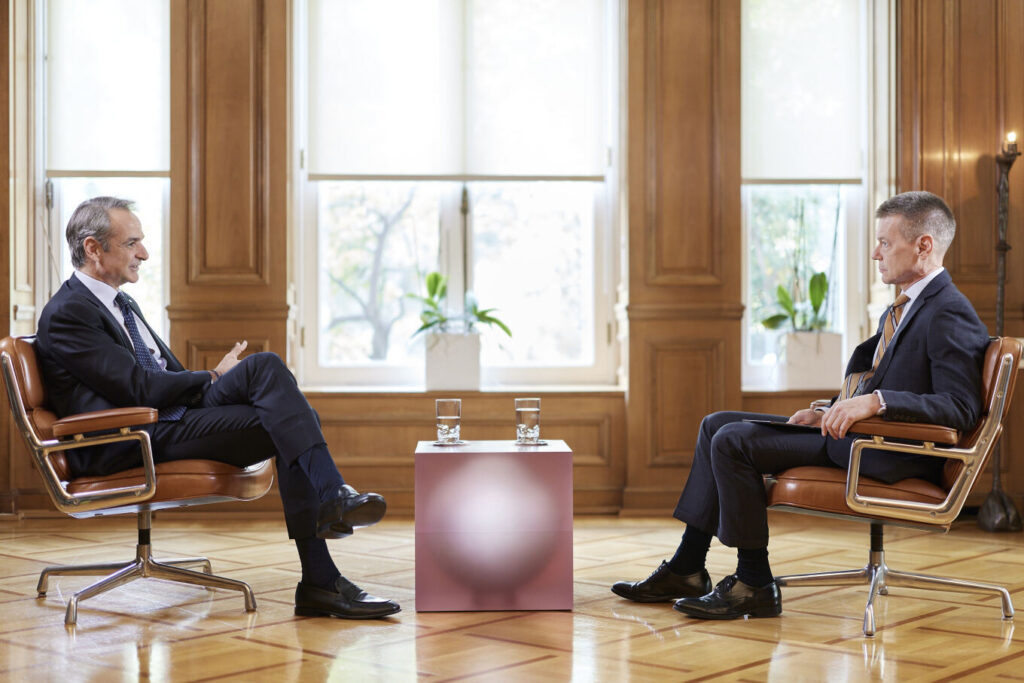
Prime Minister Kyriakos Mitsotakis has outlined his ambition to maintain economic growth at least twice the eurozone average in the coming years, with the aim of raising wages and disposable incomes, in an interview with The Wall Street Journal and journalist Gordon Fairclough, setting out the main priorities of his economic policy ahead of the 2027 general election.
The Prime Minister argued that Greece has restored its credibility in international financial markets, is recording stronger growth than the eurozone and is rapidly reducing its public debt. He acknowledged, however, that the country’s positive macroeconomic performance has not yet translated into improvements in citizens’ everyday lives to the extent he would like, conceding that wages remain relatively low and that the cost of living is the principal concern of Greek households.
“At the macroeconomic level, we are performing exceptionally well, but I want that to translate into a better life for ordinary citizens. Have we reached that point yet? The honest answer is no, we are not where I want us to be,” he said.
In the interview, which focused on the transformation of the Greek economy following the debt crisis and the lessons Europe could draw from that experience, Mitsotakis presented fiscal discipline and reforms as key drivers of the recovery. He also criticised the former SYRIZA-ANEL government over its handling of the crisis, while addressing the difficulties facing France and the risks posed by war, rising energy prices and turbulence in financial markets.
A new contract with voters ahead of the 2027 elections
Asked about his priorities for the coming period, the Prime Minister directly linked the government’s economic strategy to the 2027 general election. He said his proposal to voters involved a new period of growth, with particular emphasis on investment, employment and higher incomes.
“What I am proposing to the Greek people is a sort of new contract, under which we will set ourselves the goal of growing at a rate at least twice that of the rest of the eurozone,” he said. According to Mitsotakis, maintaining high growth rates is essential to reducing unemployment further and increasing disposable income.
He stressed, however, that this strategy must be driven by investment rather than a temporary boost in consumption.
Low wages and the cost-of-living crisis
One of the most significant exchanges came when The Wall Street Journal journalist pointed out that, despite the reduction in public debt, wages in Greece remain low and GDP has yet to return to pre-crisis levels. Mitsotakis acknowledged the observation but argued that earnings had increased substantially compared with 2019.
“You are right to point out that wages remain relatively low, but they are significantly higher than they were seven years ago,” he said. He nevertheless acknowledged that rising prices had diminished the real impact of wage increases.
“The cost-of-living crisis and the general increase in the prices of goods have made a large part of that increase invisible,” he said, describing the gap between rising nominal incomes and purchasing power. The Prime Minister identified the cost of living as the most important problem currently facing Greeks, stressing that there was no easy or immediate solution.
“The cost-of-living crisis is very real. It is the number one concern of Greeks. There is no magic solution,” he said. He explained that the government was seeking to address these pressures through targeted income-support measures and the gradual reduction of the tax burden on businesses and individuals.
According to Mitsotakis, primary budget surpluses allow Greece to finance such interventions without returning to austerity policies.
‘We borrow more cheaply than four G7 countries’
Discussing the performance of the Greek economy since 2019, the Prime Minister argued that the country had come a long way since the financial crisis. He recalled that Greece lost approximately a quarter of its GDP during the previous decade and was long regarded as an economy with limited prospects for reform.
“When we first came into office in 2019, Greece was still struggling after a decade of harsh austerity,” he said.
In his assessment, seven and a half years later, the picture has changed substantially, with Greece recording higher growth rates than the eurozone average, delivering successive primary surpluses and attracting significant foreign investment.
He placed particular emphasis on the reduction of public debt, arguing that Greece is cutting its debt at the fastest rate among OECD countries. As evidence of restored international market confidence, he pointed to the Greek government’s borrowing costs.
“At a time when global bond markets are in turmoil, Greece is borrowing at a lower interest rate than four of the seven G7 countries,” he said. Mitsotakis noted that such a development would have seemed inconceivable just a few years ago, when Greece was at the centre of Europe’s sovereign debt crisis.
He also stressed that fiscal consolidation was not an end in itself but a necessary condition for implementing social policies without creating new economic imbalances.
Investment beyond tourism and property
Asked whether Greece was succeeding in attracting investment beyond the traditional sectors of tourism and property, the Prime Minister argued that the country’s productive base was expanding. He acknowledged the considerable importance of tourism, noting that Greece welcomes more than 35 million visitors annually, but emphasised that investment opportunities extend well beyond the sector.
He identified renewable energy, agrifood, pharmaceuticals, logistics, shipping and technology as particularly promising industries.
His remarks reflect the government’s objective of developing a more diversified economy, capable of creating higher-value jobs and supporting growth across a broader range of industries.
Mitsotakis insisted that attracting investment remains a key instrument for bringing Greek incomes closer to those in other European countries.
‘Trust is built by delivering on your promises’
The Prime Minister also addressed the need to restore and maintain trust between citizens and the state. He noted that the financial crisis had left a deep mark on Greek society, affecting not only household finances but also the public’s relationship with political promises.
“The new contract must be based first and foremost on trust. Trust is built by focusing on accountability and ensuring that you can actually deliver what you promise citizens,” he said.
He argued that the government must acknowledge the difficulties facing society while avoiding promises that cannot be financed or implemented. He warned that the gap between political commitments and actual results undermines the credibility of governments.
“The temptation to overpromise and underdeliver is always there, but ultimately that is what breaks the social contract,” he said.
Criticism of the SYRIZA-ANEL government
Discussing the lessons of the financial crisis, Mitsotakis strongly criticised the former SYRIZA-ANEL coalition government, blaming it for prolonging Greece’s economic difficulties.
He argued that the hardship experienced by Greeks was compounded when, in the midst of the crisis, the country elected a radical-left government that allied itself with the far right and, according to Mitsotakis, promised solutions without a realistic economic foundation.
“The end result was that we almost ended up in complete disaster. That is how we unnecessarily prolonged the crisis by four years,” he said, presenting his assessment of the period of SYRIZA government.
The Prime Minister argued that the experience of the previous decade had made Greeks more cautious about policies based on excessive borrowing and unfunded spending commitments.
‘We will never return to an era when we borrowed beyond our means’
Speaking about fiscal discipline, the Prime Minister stressed that the crisis had left a lasting political and social legacy. He agreed with the journalist’s observation that Greek citizens had developed an unusually strong familiarity with concepts such as deficits, public debt and government budgets.
“Yes, because we experienced the pain. We now understand these issues, and I believe we will never return to a period when we borrowed beyond our means. That is my personal commitment,” he said.
Mitsotakis linked the reduction of public debt to responsibility towards younger generations, saying he wanted his children and future generations more broadly to inherit a smaller debt burden.
He also argued that meeting fiscal targets could require difficult political decisions. In some cases, he said, governments have a duty to explain to citizens that immediately satisfying certain demands could create greater problems in the future.
‘Reforms deliver results’: The election choice outlined by Mitsotakis
Asked what lessons other European countries could draw from Greece’s experience, the Prime Minister focused on the importance of reforms and the need for governments to accept the political costs involved in implementing them.
“The first lesson is that reforms deliver results. The difficult reforms you pursue as a politician do produce tangible outcomes,” he said. He acknowledged that the benefits take time to emerge and that governments often have to manage public opposition in the meantime.
Linking this experience to Greece’s forthcoming general election, Mitsotakis described the political choice in 2027 as one between “realistic hope” and “experimentation”.
The statement reflects the political argument with which the Prime Minister intends to defend the continuation of his government’s economic strategy, placing stability at the centre of his campaign at a time of international uncertainty.
Advice to France: ‘If austerity is necessary, implement it early in your term’
A significant part of the interview was devoted to the fiscal difficulties facing other European countries, with particular reference to France. The journalist asked Mitsotakis what advice he would offer French politicians, given Greece’s experience of the sovereign debt crisis.
The Prime Minister initially avoided presenting himself as an adviser to other governments, emphasising Greece’s close relations with France and his personal relationship with President Emmanuel Macron. He nevertheless noted that the next French government would eventually have to reduce the budget deficit. “Not because the European Union demands it, but because markets are unforgiving towards countries that fail to meet their fiscal targets,” he explained.
Asked how a government could secure public support for fiscal adjustment, he replied that such measures were always difficult and had painful consequences in the short term.
His advice was specific: if a government needs to introduce austerity, it should do so early.
“If you do need to implement austerity measures, make sure you do it at the beginning of your term,” he said, explaining that such policies need time to produce results.
War, energy prices and the risk of renewed inflationary pressures
In the final part of the interview, the Prime Minister was asked whether turbulence in international markets and rising energy costs could derail the Greek economy from its current course. Mitsotakis expressed confidence in the resilience of public finances, while acknowledging that external pressures could complicate economic policymaking.
“No, they will not knock us off course, but they will make things more difficult,” he said. He argued that citizens understood that the new economic pressures were linked to an international crisis that Greece had not caused.
He also pointed out that rising prices carry a significant political cost for governments because they directly affect disposable income and everyday life. Referring to recent electoral developments in the United States, he said that, in his assessment, even the American President and Vice President had acknowledged that the war had influenced the election results to some extent.
Mitsotakis expressed confidence that Greece would maintain fiscal balance, although he did not rule out further difficulties if the international situation deteriorated. “If things deteriorate again, which is not my forecast, but who knows what might happen, the situation will become more complicated for everyone,” he said.
The Prime Minister’s full interview with The Wall Street Journal
Gordon Fairclough: How would you say Greece has changed since the time of the financial crisis?
Kyriakos Mitsotakis: When we first came into office in 2019, Greece was still struggling after a decade of harsh austerity. We had lost 25% of our GDP and, frankly, there was not much hope for Greece. It was considered a country where implementing reforms was almost impossible. But I would say that, seven and a half years later, if you look at the overall progress we have made, I think what we have achieved is truly remarkable.
We are now a country that is growing at a much faster rate than the eurozone average. We are consistently delivering primary surpluses, our debt is declining at the fastest rate among OECD countries, we have restored Greece’s overall credibility, and we are attracting significant flows of foreign direct investment. All of this is reflected in the way markets treat us.
At a time when global bond markets are in turmoil, Greece is borrowing at a lower interest rate than four of the seven G7 countries. I do not think many people would have believed just a few years ago that such a thing would be possible.
At the same time, we are generating healthy primary surpluses that allow us to provide targeted support measures to help the Greek people cope with the cost-of-living crisis. The cost-of-living crisis is very real. It is the number one concern of Greeks.
There is no magic solution. However, at least we are in a position where we do not have to impose austerity measures, something many European countries are being forced to do, and we can offer targeted income support while continuing to focus on reducing the tax burden on Greek businesses and Greek citizens.
Gordon Fairclough: So you have brought the debt situation under control, but wages remain fairly low and GDP has not returned to pre-crisis levels. What do you need to do to strengthen growth?
Kyriakos Mitsotakis: You are right to point out that wages remain relatively low, but they are significantly higher than they were seven years ago. And if you look at the average wage, you will see that it has also risen substantially. Of course, the cost-of-living crisis and the general increase in the prices of goods have made a large part of that increase invisible.
So, when I look at my objectives for the coming years, and we have elections in 2027, what I am proposing to the Greek people is a sort of new contract, under which we will set ourselves the goal of growing at a rate at least twice that of the rest of the eurozone. That is how we can further reduce unemployment, increase wages and raise disposable income. Of course, this growth must be driven by investment.
Gordon Fairclough: Are you satisfied with the type of investment you are attracting? Is the portfolio broadening beyond property and tourism?
Kyriakos Mitsotakis: I think what you are pointing out is very important. Our economy is not dependent on just one sector. Of course, tourism is very important. We welcome more than 35 million visitors every year. They discover a very beautiful country that offers excellent services at prices which, in my view, remain very competitive.
But it is not just about tourism and property. It is about renewable energy, the agrifood sector, pharmaceuticals and logistics. Shipping is a sector which, as you know, is of great interest not only to Greece but also to foreign investors. And, of course, there is the technology sector.
Gordon Fairclough: How would you say the social contract between Greek citizens and the state has changed since the crisis?
Kyriakos Mitsotakis: Greeks went through a great deal during the crisis. And I think that pain was exacerbated to some extent by the fact that, in the middle of the crisis, we elected a populist radical-left government that allied itself with the far right and promised people magical solutions to their problems. The end result was that we almost ended up in complete disaster. That is how we unnecessarily prolonged the crisis by four years.
So Greeks are cautious. But the new contract must be based first and foremost on trust. Trust is built by focusing on accountability and ensuring that you can actually deliver what you promise citizens.
So, when I look at the economy, for example, what is my main challenge? At the macroeconomic level, we are performing exceptionally well, but I want that to translate into a better life for ordinary citizens. Have we reached that point yet? The honest answer is no, we are not where I want us to be.
But if I only talk about macroeconomics, if I only talk about differences in interest rates and the reports issued by credit rating agencies, I am overlooking the other part of the equation. So we must acknowledge that citizens are facing difficulties, but we must also ensure that what we tell them is genuinely realistic. Because the temptation to overpromise and underdeliver is always there, but ultimately that is what breaks the social contract and destroys the relationship of trust between government and citizens.
Gordon Fairclough: I must say that, from my conversations here with ordinary Greek citizens, I have the impression that the average Greek knows much more about budgets, deficits and fiscal policy than, for example, the average American.
Kyriakos Mitsotakis: Yes, because we experienced the pain. We now understand these issues, and I believe we will never return to a period when we borrowed beyond our means. That is my personal commitment. I am proud of the fact that we are reducing our debt so quickly, because the next generation, including my own children’s generation, will inherit a smaller debt burden than the one I inherited.
If that means that in certain cases I have to make painful decisions or tell citizens, “I understand the difficulties you are facing, I understand that you are asking for more, but if I were to satisfy those demands now, I would create greater difficulties in the future,” then I have a duty to be completely honest and explain that to them.
Gordon Fairclough: What lessons do you think other European countries can draw from Greece’s experience?
Kyriakos Mitsotakis: As you know, every country is different. But if I look back at what we have achieved, I would say the first lesson is that reforms deliver results. The difficult reforms you pursue as a politician really do produce tangible outcomes. However, you have to go through a period in which you must manage the political cost. Ultimately, you have to deliver results, because if you do not, citizens will look for an alternative.
I believe the real choice in the next elections is between realistic hope and experimentation, particularly at a time when stability is essential.
Gordon Fairclough: So what advice would you give your counterparts in France?
Kyriakos Mitsotakis: I do not like giving advice. We have excellent relations with France, as well as a personal relationship with the French President, Emmanuel Macron. However, I believe the next government will, at some point, certainly have to reduce the deficit. Not because the European Union demands it, but because markets are unforgiving towards countries that fail to meet their fiscal targets.
Gordon Fairclough: And how do you secure public support for such a policy?
Kyriakos Mitsotakis: Implementing austerity measures is never easy. Fortunately, we have left that period behind us. But if you do need to implement austerity measures, make sure you do it at the beginning of your term. That is the only advice I could offer, because these measures do produce results, but in the short term they have painful consequences.
Gordon Fairclough: You mentioned energy prices and the cost of living. Markets more generally are in turmoil. Are you concerned that all these difficulties could derail Greece from the course it is currently following?
Kyriakos Mitsotakis: No, they will not knock us off course, but they will make things more difficult. I think Greeks understand that this is a crisis we did not cause. There is a war. I believe even the President and Vice President of the United States acknowledged that the war had an impact, to some extent, on last week’s election results.
So yes, it will make things more difficult for us, because inflation carries a significant political cost for those in government. But it will not knock us off course. Fiscal balance will be maintained. Of course, if things deteriorate again, which is not my forecast, but who knows what might happen, the situation will become more complicated for everyone.
Ask me anything
Explore related questions




