





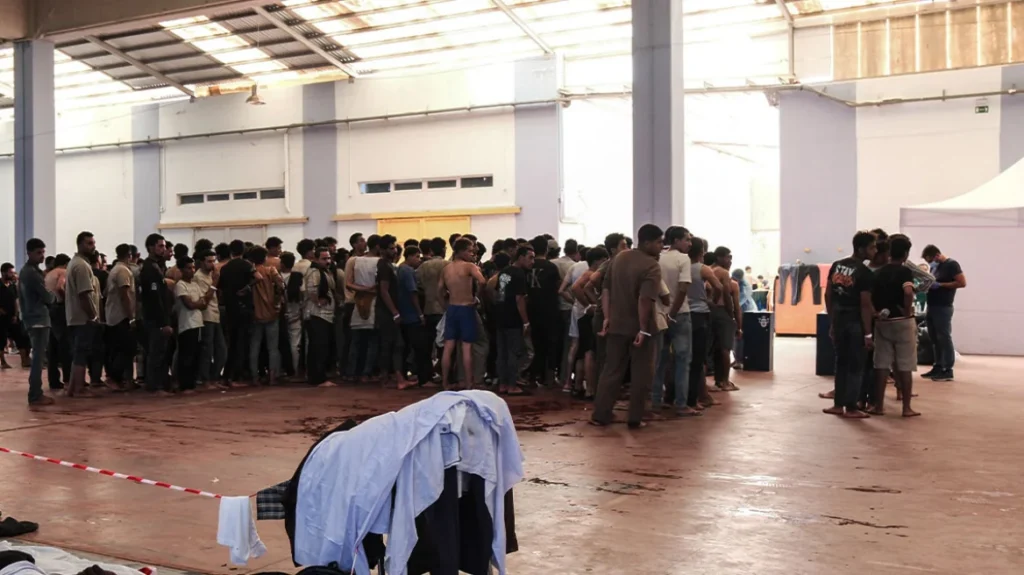
A new framework for managing illegal immigrants who do not have the right to remain in the European Union is taking shape with plans to establish the first joint Return Hub in Rwanda.
Greece, Germany, Austria, Denmark and the Netherlands announced on Monday (16 November), in Vienna, that the African country has now become their official negotiating partner for implementing the plan.
The new system will concern people whose asylum applications have been definitively rejected, but whose return to their countries of origin cannot be carried out for practical reasons. As protothema.gr revealed, the plan envisages open facilities in Rwanda, residence permits for those transferred there, and the possibility either of settling in the country or returning voluntarily to their country of origin.
The next step is the signing of a memorandum of cooperation in early January 2027.
What will change with the creation of the Return Hub?
The main change is that the five countries are seeking to acquire an additional option for managing migrants whose asylum applications have been definitively rejected but who cannot be returned to their countries of origin.
Until now, such cases have often resulted in prolonged unresolved situations, since a return decision exists but cannot be enforced. Under the proposed model, those concerned will be able, subject to specific conditions, to be transferred to Rwanda, where they will be granted legal residence status.
Which migrants will be affected?
The transfer to Rwanda will not apply to all illegal immigrants, nor to everyone who submits an asylum application.
According to the plan, three basic conditions must be met:
- They must be nationals of third countries who are present in Greece, Germany, Austria, Denmark or the Netherlands.
- Their asylum application must have been definitively rejected, meaning that they no longer have the right to remain.
- Their return to their country of origin must be impossible for practical or administrative reasons.
Such difficulties may arise when the person concerned does not cooperate with the authorities regarding their return, or when their country of origin does not cooperate with their readmission. Therefore, the mere rejection of an asylum application is not sufficient for someone to fall under the new system.
Who will be exempt from transfer?
Specific categories requiring enhanced protection are excluded from the plan. According to information obtained by protothema.gr, unaccompanied minors, families and individuals falling into the most serious vulnerability categories will not be transferred to Rwanda.
The precise conditions for inclusion and the exemption criteria will be specified during the consultations leading to the final agreement.
Will it be a closed detention center?
No, according to the model that has been presented. The Rwanda hub is designed to operate with open facilities rather than as a closed detention center.
Those transferred there are expected to receive residence permits from Rwanda, allowing them to remain legally in the African country. The possibility of legal residence is a fundamental feature of the plan and is linked to the options that will subsequently be made available to them.
What will those arriving in Rwanda be able to do?
Those concerned will have two options.
The first is to remain in Rwanda and integrate into local society. To this end, the creation of support programs is envisaged, including settlement incentives, language learning, insurance and social benefits, as well as access to social housing.
The second option is to return voluntarily to their country of origin. This possibility will also be available to those who initially choose to remain in Rwanda but subsequently change their minds.
The plan, therefore, is not limited to managing a deportation. It also provides the possibility for those transferred to build a new life in another country.
Why was Rwanda chosen?
According to the reasoning of the five European governments, Rwanda possesses characteristics considered suitable for implementing the plan. These include political stability, social cohesion, high rates of economic growth and the country’s experience in hosting refugee populations.
The participating governments believe that this experience can be utilised to develop settlement and social integration programs. At the same time, the cooperation forms part of Rwanda’s efforts to develop its international relations with European countries.
Is it a punitive measure?
The six parties present the proposed hub as an alternative prospect for people who have not been admitted to the European Union and cannot return to their own countries.
The political rationale behind the initiative is that transfer to Rwanda will offer a “second chance”, with legal residence and integration programs, instead of the prolonged uncertainty that arises when a return decision cannot be implemented.
This is the narrative put forward by the governments participating in the cooperation. The way in which the plan will be implemented, as well as the relevant safeguards, will have to be set out in the final framework.
When will transfers begin?
At present, there is no date for the start of transfers.
Monday’s announcement concerns the formal recognition of Rwanda as the negotiating partner of the five countries for the creation of the hub. The next step is the signing of a memorandum of cooperation in early January 2027.
In the meantime, technical consultations will have to proceed on the conditions for transfers, the facilities, funding and operational procedures.
The Greek government has set the goal of piloting the system during 2027. For Greece, the new model forms part of the efforts by the Ministry of Migration and Asylum, under Thanos Plevris, to increase the effectiveness of returns of migrants who no longer have a legal right to remain in the country.
Plevris: The return center in Rwanda will change European migration policy
Greece’s Minister of Migration and Asylum supported the creation of the Return Hub in a third country, stressing that the aim is to increase the number of returns of people who are not entitled to asylum in Europe and to tackle migrant-smuggling networks.
Thanos Plevris, speaking during a press conference on the creation of the return centre in Rwanda, described the initiative as a significant development for European migration policy, pointing out that countries of first arrival need more effective return mechanisms.
As he stated, those entitled to international protection should receive it in Europe, while those who do not meet the requirements for asylum should return to their countries of origin.
Ask me anything
Explore related questions




