





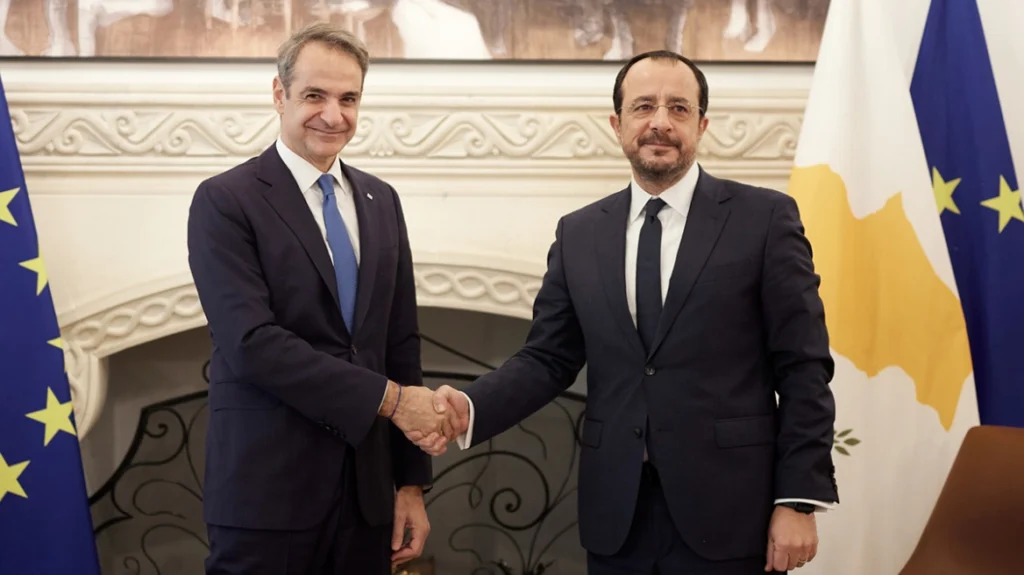
With the Greece–Cyprus electricity cable continuing to require delicate diplomatic handling, Kyriakos Mitsotakis and Nikos Christodoulides have chosen to project an image of normality and close coordination from Nicosia today. And they are doing so with almost two entire governments gathered around the same table. A total of 24 ministers and deputy ministers are participating in the 4th Intergovernmental Summit, at a time when the electricity interconnection remains at the centre of Turkish objections.
The meeting is taking place just days after seabed surveys resumed, a development that Athens and Nicosia have welcomed. At the same time, the large government presence in the Cypriot capital underscores the two sides’ intention to advance their cooperation on all fronts, without allowing the difficulties surrounding the major energy project to overshadow it.
The French key
During the private meeting between Mitsotakis and Christodoulides, the electricity cable is expected to play a leading role. The resumption of the surveys has improved the atmosphere, although the difficulties arising from Turkish claims have by no means disappeared.
The more active French involvement has also contributed to recent developments. The successive meetings in Dublin, the personal involvement of Emmanuel Macron and the participation of France’s Nexans in the project have strengthened Paris’s role. For Athens and Nicosia, the objective is to maintain this momentum, ensure that work continues and make further use of the European dimension of the interconnection project.
The Cyprus issue is also on the agenda of the two leaders, while a diplomatic clarification from Nicosia concerning the delimitation of maritime zones with Greece is also of interest. The Cypriot government spokesperson made clear that the matter is not included on the agenda, while taking care to reiterate that any decision will be made in close coordination with Athens. It was a carefully worded statement that leaves the outstanding issue of the Exclusive Economic Zone (EEZ) open, without creating expectations of immediate action.
Two governments
The large number of ministers from both governments demonstrates the importance Athens and Nicosia attach to today’s Summit. The Greek Prime Minister is accompanied by 13 ministers and deputy ministers, while another 11 government officials are participating on the Cypriot side.
The Greek delegation includes Foreign Minister George Gerapetritis and Minister of State Akis Skertsos, as well as ministers Michalis Chrysochoidis, George Floridis, Sofia Zacharaki, Lina Mendoni, Domna Michailidou, Olga Kefalogianni, Dimitris Papastergiou and Evangelos Tournas. Deputy ministers Marios Themistokleous, Kostas Karagounis and Stefanos Gkikas are also taking part.
Beyond its symbolic significance, the programme includes a series of parallel ministerial meetings. Artificial intelligence and civil protection are among the main priorities, while discussions also extend to healthcare, education, shipping, tourism and digital services. These are areas in which the two countries have already developed cooperation within the framework of the mechanism established in 2023.
Coordination ahead of Greece’s Presidency of the Council of the EU, scheduled for the second half of 2027, also occupies a prominent place, with Athens drawing on Nicosia’s recent experience.
The Summit will conclude with the signing of agreements, the issuance of a Joint Declaration and statements by the two leaders.
As far as the electricity cable is concerned, however, attention will remain focused on the next steps: the continuation of the surveys, European support for the project and, above all, the way in which Athens and Nicosia will manage Turkish objections.
Ask me anything
Explore related questions




