

×
GreekEnglish

×
  • Politics
  • Diaspora
  • World
  • Lifestyle
  • Travel
  • Culture
  • Sports
  • Cooking
Saturday
17
Jan 2026
weather symbol
Athens 10°C
  • Home
  • Politics
  • Economy
  • World
  • Diaspora
  • Lifestyle
  • Travel
  • Culture
  • Sports
  • Mediterranean Cooking
  • Weather
Contact follow Protothema:
Powered by Cloudevo
> World

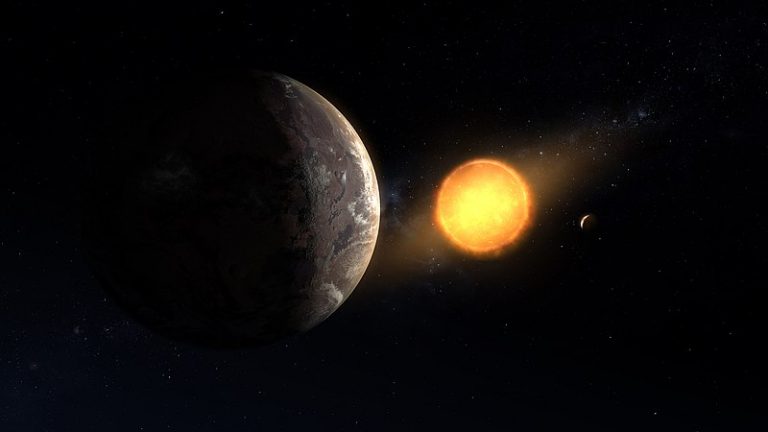
An exoplanet the size of Neptune discovered 32 lightyears from Earth

AU Mic is a young star between 20 and 30 million years old

Newsroom June 25 09:02

An exoplanet the size of Neptune has been discovered around the young star AU Microscopii, thanks in part to the work of Jonathan Gagné, a former iREx Banting postdoctoral researcher who is now a scientific advisor at the Rio Tinto Alcan Planetarium.

Astrophysicists have been searching for exoplanets in this system, a unique laboratory for studying planetary formation, for more than a decade. The breakthrough, announced today in Nature, was made possible in part by NASA’s TESS and Spitzer space telescopes.

also read 

Leroy Merlin opens new store

>Related articles

Erich von Däniken, Swiss bestselling author who linked ancient civilizations to extraterrestrials, dies at 90

Sick astronaut on mission – NASA considers early return of International Space Station crew

Who were the predators on Earth before the dinosaurs

Located about 32 lightyears from Earth, AU Microscopii, or AU Mic, is a young star between 20 and 30 million years old, which is about 180 times younger than our own Sun. In the 2000s, it was found to still be surrounded by a large disc of debris, a remnant of its formation. Since then, astrophysicists have been actively searching for planets around AU Mic, since it is within such discs of dust and gas that they form.

“AU Mic is a small star, with only about 50 per cent of the Sun’s mass,” said Gagné, who participated in the observations and data processing. These stars generally have very strong magnetic fields, which make them very active. That explains in part why it took nearly 15 years to detect the exoplanet, called AU Mic b. The numerous spots and eruptions on the surface of AU Mic hampered its detection, which was already complicated by the presence of the disc.”

more at eurakalert.org

Ask me anything

Explore related questions

#discovery#earth#exoplanet#Neptune#space
> More World

Follow en.protothema.gr on Google News and be the first to know all the news

See all the latest News from Greece and the World, the moment they happen, at en.protothema.gr

> Latest Stories

One dead after train–bus collision at the Port of Hamburg – see photos

January 16, 2026

President of Air Traffic Controllers: Another communications blackout possible in the near future

January 16, 2026

Trump threatens tariffs against those who oppose U.S. plans for Greenland

January 16, 2026

X is down, thousands report problems

January 16, 2026

“Her father cut her hair because she asked to go to a hair salon, they never gave her money”: New testimonies about Laura

January 16, 2026

Rama persists after rant at Greek journalist and questions the link between “Greek speakers” and Plato and Aristotle

January 16, 2026

CIA chief in Venezuela meets with Rodriguez

January 16, 2026

Less alcohol and lower speeds with the new Highway Code and strict fines

January 16, 2026
All News

> World

One dead after train–bus collision at the Port of Hamburg – see photos

Ten people were injured in the collision, including the bus driver, who is in critical condition

January 16, 2026

Trump threatens tariffs against those who oppose U.S. plans for Greenland

January 16, 2026

X is down, thousands report problems

January 16, 2026

Rama persists after rant at Greek journalist and questions the link between “Greek speakers” and Plato and Aristotle

January 16, 2026

CIA chief in Venezuela meets with Rodriguez

January 16, 2026
Homepage
PERSONAL DATA PROTECTION POLICY COOKIES POLICY TERM OF USE
Powered by Cloudevo
Copyright © 2026 Πρώτο Θέμα



