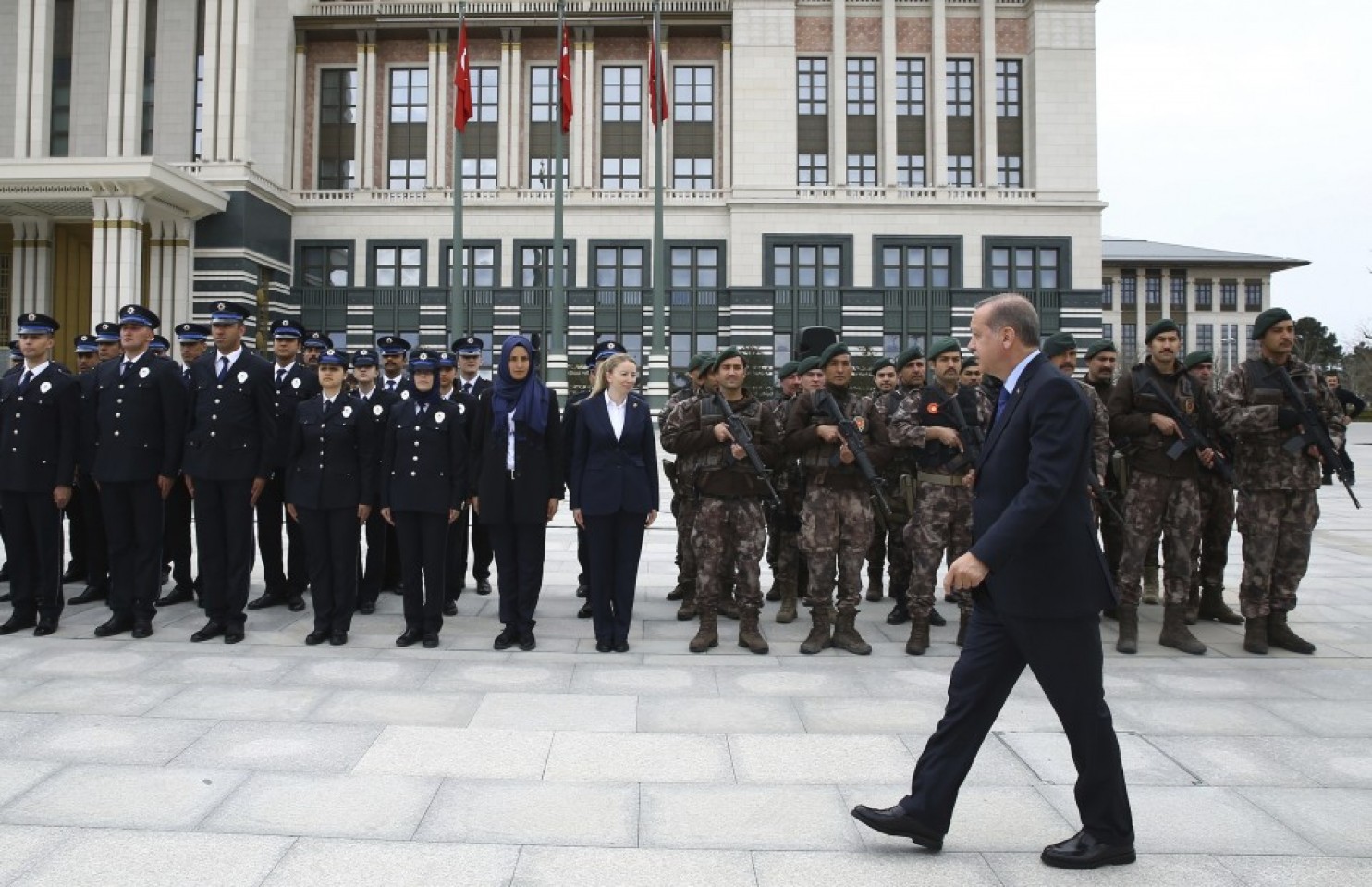
On April 16, Turkish voters will be casting votes in the most consequential referendum of modern Turkish history. President Recep Tayyip Erdogan and his ruling Justice and Development Party (AKP) are urging Turks to vote “yes” to constitutional changes that will change Turkey from a parliamentary system to a presidential one.
The new system has no parallel in the modern world. It eviscerates the power of both the legislative and judicial branches of the government in favor of the executive, which will be concentrated in the hands of one person. That person is none other than Erdogan, who has already been in power continuously since 2003, first as prime minister and then president.
Not surprisingly, the referendum is turning out to be deeply divisive. The government has made use of all of its prerogatives to press its message and smother the naysayers. The Turkish media, 90 percent of which is directly or indirectly controlled by the government, has been thoroughly intimidated. At least 81 journalists have been jailed. Social media, the only remaining arena for critics, is strictly monitored. A tweet, especially one criticizing Erdogan, can easily land you in prison. Many news sites have been banned, and citizens who campaign against the changes are also subject to arrest.
The proposed constitutional changes have been tailored to Erdogan. The hitherto nonpartisan president would now be allowed to lead his party even as he runs the country. He would appoint cabinet members who would be accountable only to him and not to parliament. He would have the option of appointing one or more vice presidents, who, again, would not report to lawmakers. He would also appoint all senior civil servants and would have the power to directly and indirectly select almost all judges on the high judicial bodies, including the constitutional court.
There are other hidden gems in the constitutional proposal. One is a tiny two-word amendment to the powers of the State Supervisory Board, a presidential body that oversees the activities of public and private bodies, including unions, business chambers, football clubs and non-profit organizations. The amendment would give the board prosecutorial powers over these institutions, meaning that the president would have wide authority to police civil society.
And though the president would be limited to two five-year terms starting in 2019, when the changes take effect, a loophole would allow him to win a third mandate if national elections were held before the end of the president’s second term. The new constitution, if approved, would almost automatically allow the incumbent to run for a third term. A quick back-of-the-envelope calculation shows that Erdogan could have an additional 14 years at the helm starting two years from now.
The government is making use of all the advantages at its disposal to silence the opposition. Even so, the contest is too close to call. It appears that Erdogan and the AKP are panicking. The president and his entourage are accusing the referendum’s opponents of treason. A variety of official pretexts are being used to deny the right to campaign to politicians who oppose the changes. When European governments blocked the AKP’s efforts to gin up support for the referendum among the large Turkish diaspora, Erdogan and his entourage responded with tirades against Holland and Germany. Accusing both countries of Nazism, the AKP demonstrated the risks it was willing to take to stoke the fires of anti-Westernism in its pursuit of a “yes” vote. “If Europe continues this way,” Erdogan declared, “no European in any part of the world can walk safely on the streets.” After Holland denied him landing rights in the country, Foreign Minister Mevlut Cavusoglu referred to it as “the capital of fascism.” These remarks have caused irreparable damage to the long-term relationship between Turkey and the European Union. It is difficult to see how the Europeans will be able to take the Turks seriously.
The consequences for Turkey are simple: A “no” vote could potentially unleash a period of profound uncertainty and instability. By contrast, a “yes” vote would institutionalize a populist authoritarian system that risks cataclysmic collapse, similar to what is currently happening in Venezuela, except that Turkey is far more important. In either case, there would be a crisis. A “no” vote would result in an immediate shock to Erdogan and his AKP, potentially allowing for a search for alternative leadership. A “yes” vote would simply postpone the reckoning until much later.
Paradoxically, the same European and U.S. leaders who are now being maligned by the Turkish authorities are afraid of the potential instability a rejection of the new system would engender. They are, therefore, quietly rooting for Erdogan to win with a convincing majority. The chances are that they, together with the rest of Turkey, will be surprised. Turks have a tendency to buck the system when they feel that the rules of the game are unfair or that they are being bullied by their leaders. No one should assume that the vote will turn out the way Erdogan has planned.
Ask me anything
Explore related questions