





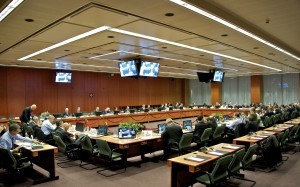
The European partners have not forgotten their commitment to help Greece with debt relief measures, but the measures to be implemented will be decided in October.
Greek Finance Minister Yannis Stournaras set formally the issue for discussion at the Eurogroup meeting, which is recorded in the official communiqué, but without referring any details of possible scenarios.
Europeans partners do not speak openly about what to do in fear of the reactions might be caused in their countries, while reminding to Greece that regardless the election results in Greece, there will be no debt relief measures if the program is not followed accurately.
The next milestones that will determine the fate of Greek debt relief, as they also arise from the reports of Eurogroup’s President Mr. Dijsselbloem, will be the following:
– In June Troika will come to Athens for 1-2 months to start reviewing the Greek program.
– Until September they will deliver the findings of the review mentioning whether Greece fully complies with the requirements and objectives of the adjustment programme. They will also present scenarios for the dynamic and sustainability of Greek debt.
– The bank stress tests will also be completed by the European Central Bank. The results will be announced in October .
– All the above will form the basis of discussions at an international level and the proposals on what would be the possible measures for the Greek debt relief and what would be the consequences.
“If and when”
In their statement the representatives of the European governments are deliberately obscure many parameters of solution of the issue.
The “Euro area Member States reaffirm their commitment to provide adequate support”, but they set a time limitation which is “until Greece regains full market access” and a precondition that “Greece fully complies with the requirements and objectives of the adjustment programme”. They also pass the buck to Troika auditors stating that “the relative merits of possible debt sustainability measures, as stated by the Eurogroup on 27 November 2012, will be considered in the context of the next review.”.
The measures for the sustainability of Greek debt will be considered at the next review of the program, said the president of the Eurogroup, Mr Dijsselbloem, who did not talk clearly on the issue. He only said that they will be waiting for the final conclusions derived from the next review of the program in order to see if there is an issue of debt sustainability, the size of it, when it can be achieved and if it can be achieved.
How banks affect
“There are some issues that should be considered and another issue is the state of the banks,” said Mr Dijsselbloem during the press conference. “The audit on Greek banks will show the amount of funds to be kept on standby or that are no longer necessary for Financial Stability Fund. This process will be carried out in the upcoming months, the results are expected to be announced in October and will show the amount of funds available, which will give more information on debt sustainability”.
The full text of the Eurogroup statement on Greece follows:
“The Eurogroup welcomes the recent positive macroeconomic developments in the Greek economy. The renewed growth prospects for Greece reflect the remarkable adjustment efforts undertaken by the Greek citizens and authorities. The economic adjustment programme is starting to pay off and is proving to be a cornerstone for Greece’s return to sustainable and balanced growth. Fiscal performance continues to be strong, as reflected in the primary surplus for 2013 as defined in the programme.
Moreover, the recent return of the Hellenic Republic and of Greek banks to the international capital markets is an encouraging sign of increasing market confidence and is an important first step towards regaining broader market access. Fully implementing the reforms of the programme will be crucial to that end.
We further welcome that the Greek authorities have complied with the prior actions required for the first EFSF disbursement of the current review. The EFSF Board of Directors approved the disbursement of EUR 6.3 billion, which took place on 28 April. The IMF Executive Board is foreseen to decide in June on the IMF disbursement of around EUR 3.6 billion linked to the review. We call on the authorities to carry the current positive reform momentum forward to maintain the programme on track and avoid accumulating delays.
As foreseen under the programme, the significant adjustment made allows the Greek economy to enter now a new phase, moving from stabilisation and recovery to sustainable growth. The long-term strategy to foster growth presented to us by the Greek authorities shows a clear ownership and determination to continue the reform path. The Eurogroup supports this strategy that builds on the adjustment programme by stepping up policies that raise private investment, facilitate economic activity and eventually lead to more job creation. We invite Greece to develop a more detailed action plan consistent with the existing programme.
Against this background, the Eurogroup welcomes the progress made by the European Commission and the Greek authorities with the preparation of the Partnership Agreement for the European Structural and Investment Funds. In the next seven years, these funds will provide around EUR 19 billion of co-financing transfers for the Greek economy with the aim to create a competitive, dynamic and inclusive economy, driven by entrepreneurship and innovation. Moreover, the Greek government has expressed the ambition to attract and facilitate private investment. In this context, the recently established Institution for Growth will help to pool financial resources from private and public organisations to provide financing to SMEs and for public investment projects.
The Eurogroup also welcomes the contribution to programme implementation provided by technical assistance to Greece under the coordination of the Task Force for Greece (TFGR). We stress the need for a continuation and stepping up of technical assistance in support of growth-related reforms (including via fighting tax evasion and corruption and supporting capacity building of national public administration). Euro area Member States will assess their possibilities for getting into closer partnerships with Greece in this regard. We encourage Greece to make use of the new funding arrangement for technical assistance beyond 2014. We recommend Greece, in coordination with the Commission (including the Task Force for Greece) to provide an overview of external financing and technical support available and to reflect on the potential role of relevant international financial institutions in providing their expertise and, where applicable, funds.
Euro area Member States reaffirm their commitment to provide adequate support until Greece regains full market access, provided Greece fully complies with the requirements and objectives of the adjustment programme. The relative merits of possible debt sustainability measures, as stated by the Eurogroup on 27 November 2012, will be considered in the context of the next review.”.
Ask me anything
Explore related questions




