





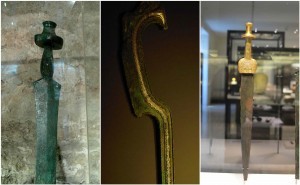
Bronze Age swords appear from around the 1700 BC, in the Black Sea region and the Aegean, as a further development of the dagger. From an early time the swords reach lengths in excess of 100 cm.
The technology to produce blades of such lengths appears to have been developed in the Aegean, using alloys of copper and tin or arsenic, around 1700 BC. Typical Bronze Age swords had lengths of roughly between 60 and 80 cm, while weapons significantly shorter than 60 cm also continued to be made, but are variously categorized as “short swords” or as daggers.
Before 1400 BC or so, swords remain mostly limited to the Aegean and south eastern Europe, but they become more widespread in the final centuries of the 2nd millennium, to Central Europe and Britain, to the Near East, Central Asia, Northern India and to China.
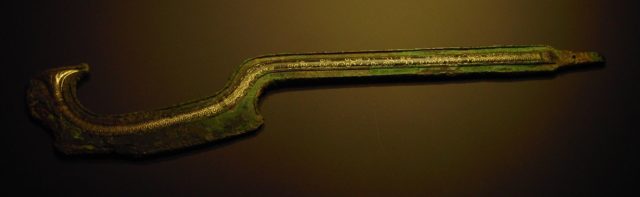
(18th century BC Khopesh, Shechem, West Bank – blade decorations with electrum inlays)
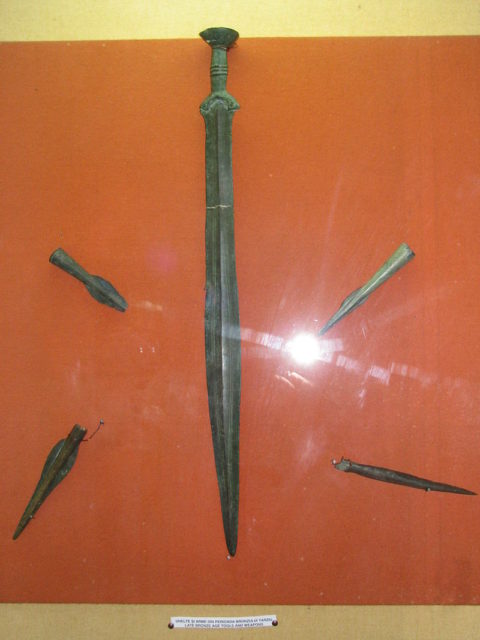
(Alba Iulia National Museum of the Union 2011)
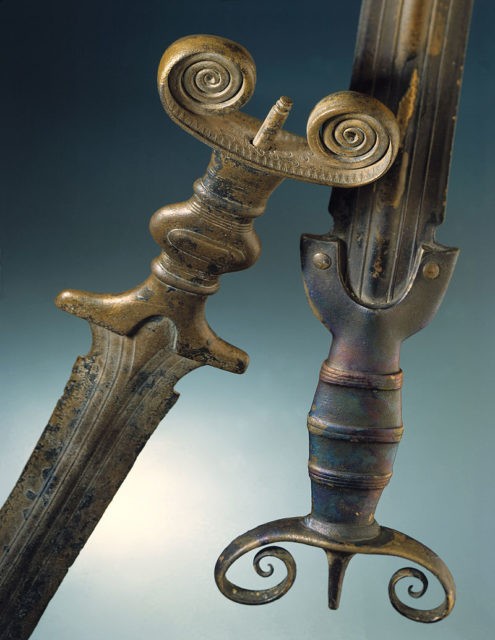
(Antenna swords of the Hallstatt B period (c. 10th century BC), found near Lake Neuchâte)
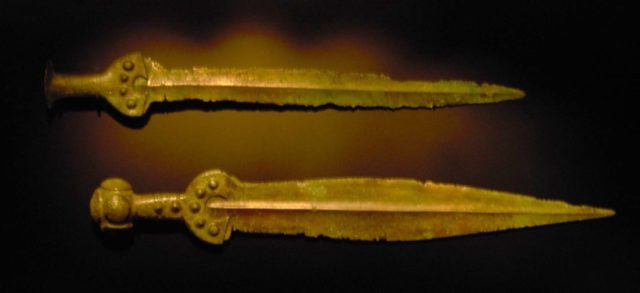
(Apa-type swords 17th century BC)
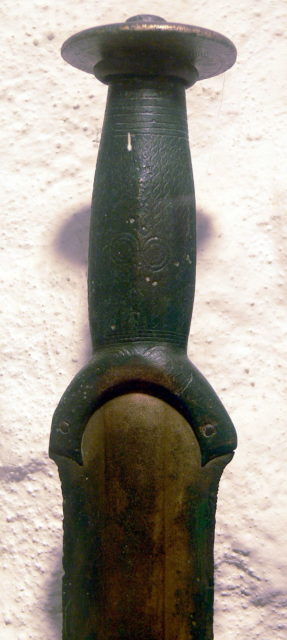
(Archaeological museum Gunzenhausen -Bavaria. Bronze Age sword ( 1300 BC ), type Riegsee – handle)
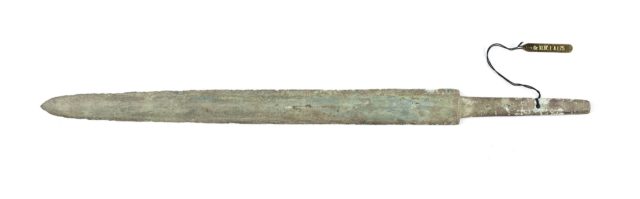
(Bronssvärd Hallwyl Museum)
The Minoan and Mycenaean (Middle to Late Aegean Bronze Age) swords are classified in types labeled A to H following Sandars (1961, 1963), the “Sandars typology”. Types A and B (Tab-tang) are the earliest from about the 17th to 16th centuries, types C (Horned swords) and D (Cross swords) from the 15th century, types E and F (T-hilt swords) from the 13th and 12th. The 13th to 12th centuries also see a revival of the “Horned” type, classified as types G and H. Type H swords are associated with the Sea Peoples and were found in Anatolia (Pergamon and Greece. Contemporary with types E to H is the so-called Naue II type, imported from south-eastern Europe.
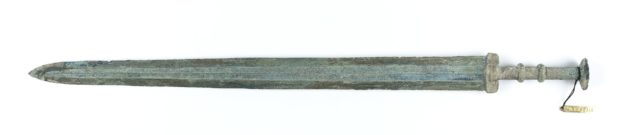
(Hallwyl Museum)
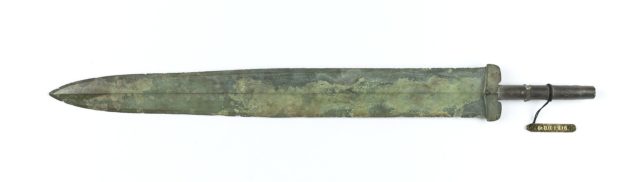
(Bronssvärd, Sweden)
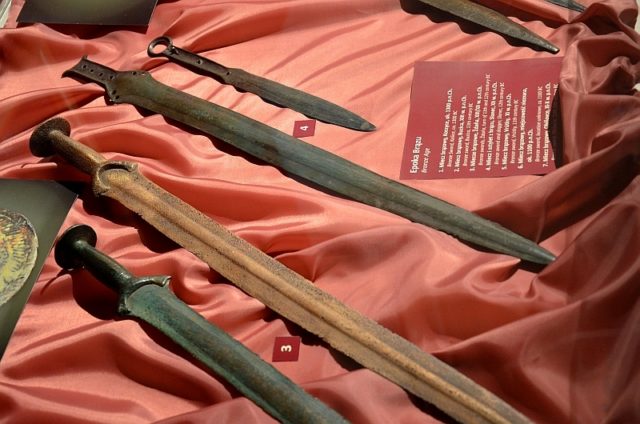
(Bronze Age jewellery of the Carpathian Basin)
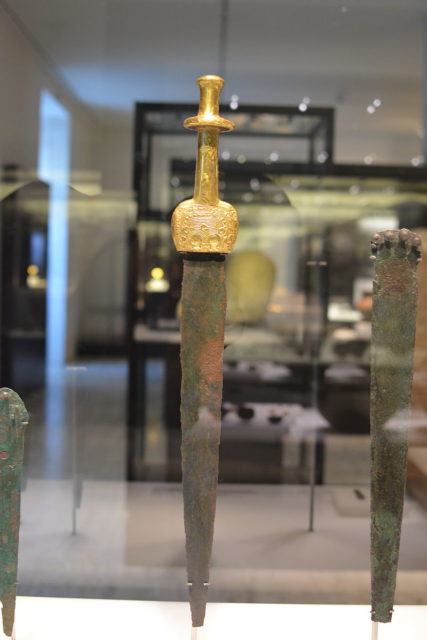
(Bronze age sword Espada de Guadalajara -Bronce Pleno-)
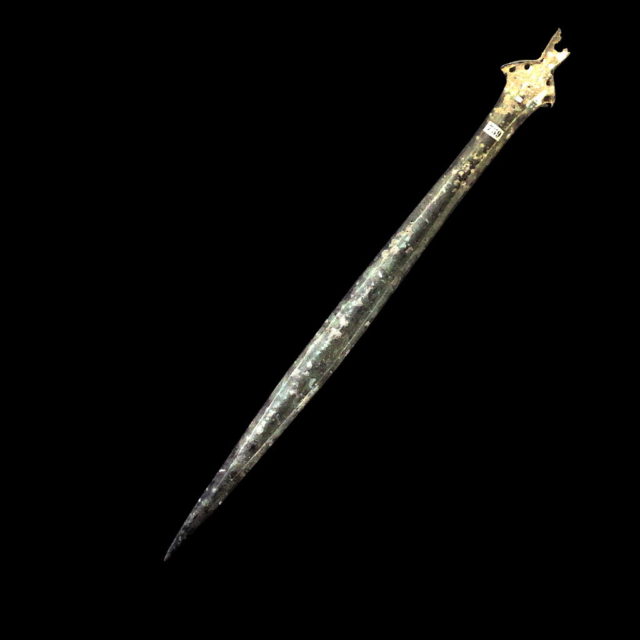
(Bronze sword from the Gallo-Roman Museum of Lyon)
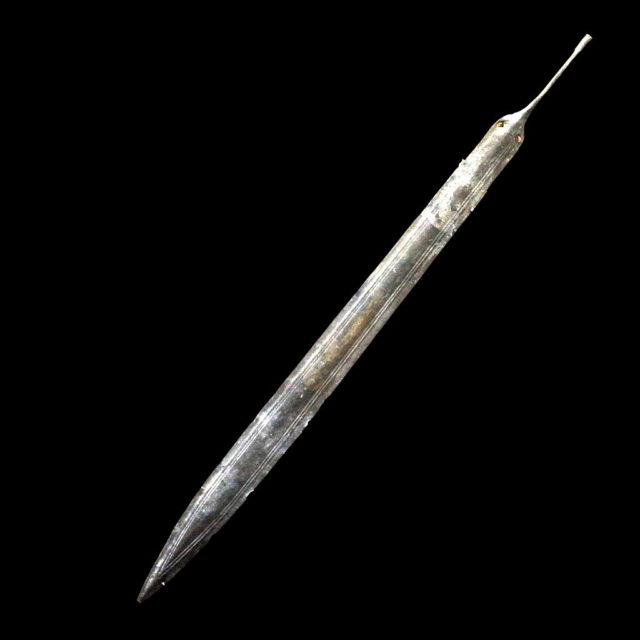
(Bronze sword from the Gallo-Roman Museum of Lyon)
One of the most important, and longest-lasting, types of prehistoric European swords was the Naue II type (named for Julius Naue who first described them), also known asGriffzungenschwert or “grip-tongue sword”. It first appears in c. the 13th century BC in Northern Italy (or a general Urnfield background), and survived well into the Iron Age, with a life-span of about seven centuries, until the 6th century BC. During its lifetime, metallurgy changed from bronze to iron, but not its basic design. Naue II swords were exported from Europe to the Aegean, and as far afield as Ugarit, beginning about 1200 BC, i.e. just a few decades before the final collapse of the palace cultures in the Bronze Age collapse. Naue II swords could be as long as 85 cm, but most specimens fall into the 60 to 70 cm range.
Swords from the Nordic Bronze Age appear from ca. the 13th century BC, often showing characteristic spiral patterns. The early Nordic swords are also comparatively short, a specimen discovered in 1912 in near Bragby, Uppland, Sweden, dated to about 1800 to 1500 BC, was just over 60 cm long. This sword was, however classified as of the Hajdúsámson-Apa type, and was presumably imported. The Vreta Kloster sword discovered in 1897 (dated 1600 to 1500 BC) has a blade length (the hilt is missing) of 46 cm.
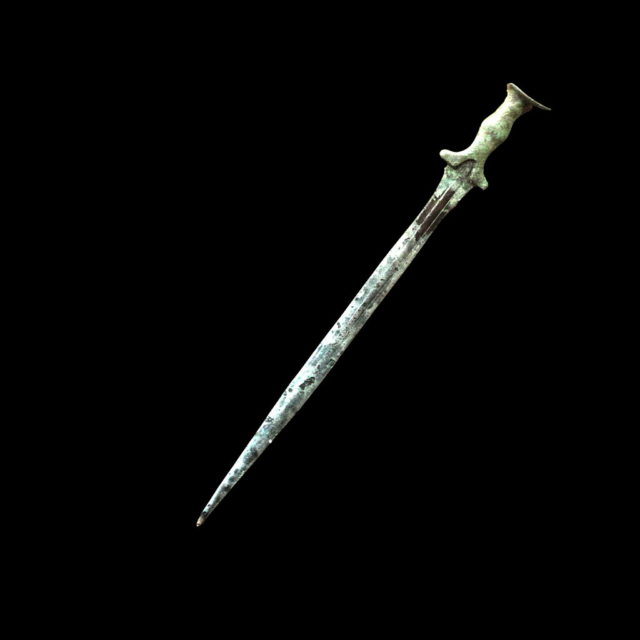
(Bronze sword from the Gallo-Roman Museum of Lyon)
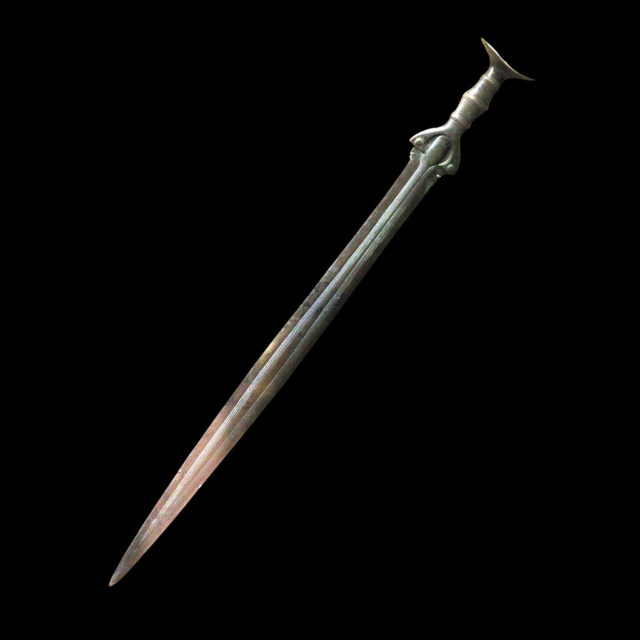
(Bronze sword from the Gallo-Roman Museum of Lyon)
Ask me anything
Explore related questions




