





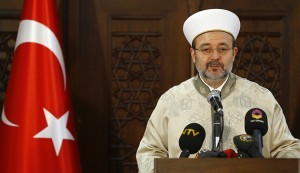
On June 31, Mehmet Gormez, a Turkish cleric who headed the Directorate of Religious Affairs (Diyanet), a government department that runs more than 85,000 mosques, bid farewell to his post he had occupied since 2010. Gormez’s term didn’t end until 2020, which is why his early departure triggered a heated discussion in the media and on social media. As with most other changes in the state bureaucracy, many people believed that the departure of the erudite theologian had something to do with President Recep Tayyip Erdogan’s plans to single-handedly build a “New Turkey.”
A few facts about the Diyanet: It is a government body whose budget exceeds many key government ministries, such as the Foreign Ministry, and whose influence over society is significant. Created back in Mustafa Kemal Ataturk’s time (1923-1938) as a key institution of the Turkish Republic, the Diyanet has always controlled all mosques in Turkey, paying the salaries of the imams and also supervising the content of their sermons. Since the 1960s, its influence even spread to Europe, as it opened hundreds of mosques in countries like Germany with substantial Turkish immigrant communities.
The Diyanet itself is governed by top-down dictates of the state. The head of the institution is appointed by the president and can be changed at will. Various Diyanet heads have been dismissed throughout the past century when they failed to comply with the instructions of the government. This hierarchical structure is one of the reasons why Turkey’s self-styled “secularism” does not imply a wall separating between the state and religion. It rather implies the state’s total control over religion.
The Diyanet’s story with Mehmet Gormez, who was an academic theologian before becoming a cleric, began in 2003 when he was made deputy president by the organization’s then newly appointed head, Ali Bardakoglu, another academic-turned-cleric. Both Bardakoglu and Gormez came from the more reformist strain within Turkey’s pool of theologians, holding the conviction that “Muslimhood” needs a “renewal” in the modern age. One step toward that goal was the “Hadith Project,” which revised and contextualized the medieval collections of the sayings of Prophet Muhammad. The project began in 2008 under the leadership of Gormez and was completed five years later.
In 2010, the Erdogan government replaced Bardakoglu with Gormez for reasons that remained unclear. In the next seven years, Gormez became quite an active Diyanet head, with public appearances both in Turkey and abroad. He delivered the first sermon in Turkey in the Kurdish language, and he also gave the first sermon by a Turkish scholar at Al-Aqsa Mosque in Jerusalem. He launched a scholarly refutation of the Islamic State, criticized the conservatives who did not want women and children in the mosques, and mobilized the public announcement systems of minarets against the military coup attempt on the fateful night of July 15, 2016.
In the eyes of most people in the Turkish opposition, Gormez was just another pillar of the Erdogan regime. In the eyes of the staunchest defenders of the same regime, however, Gormez was just not staunch — and not obedient — enough. This became evident earlier this year, when daily Turkiye, a pro-Islamic newspaper that lately has become one of the bastions of the most ferocious Erdoganists, began slamming Gormez for being soft on the Gulenists, which amounts to the ultimate political heresy in today’s Turkey.
Al-Monitor sources in Ankara suggested that the campaign against Gormez was spearheaded by the notorious “Pelicanists.” The term comes from the mysterious “Pelican Brief” blog, which was the trigger to the ousting of Prime Minister Ahmet Davutoglu back in May 2016. Since then, “Pelicanists” has become the code word for the hard-core Erdoganists who lash out against not only the critics of Erdogan but also his softer supporters who supposedly show signs of “treason.” “They want to replace the people with 98% loyalty,” as an insider once told me, “with people with 110% loyalty.”
A few articles in the Turkish media also offered the same explanation for Gormez’s departure, which was apparently based not on his own request, as it was officially announced, but on a decision from the very top. One article was by Hakan Albayrak, an Islamist writer who is supportive of the government but who also has the rare spine to criticize it. Gormez was dismissed, he wrote in his column in daily Karar, because he “did not take certain steps without consulting the commission of scholars.” Because of this, Albayrak added, Gormez was ultimately found “not very fit for practical use.”
It seems that Gormez was also dismissed because his views on Islam were found to be too “reformist” and “modernist” compared to the more rigid and conservative circles that are becoming growingly assertive in the “New Turkey.” A famous voice from this conservative camp, a fiery preacher named Ahmet Mahmut Unlu, condemned Gormez “as the worst head of the Diyanet ever” and expressed the hope that he would be replaced with “someone loyal to Ahl al-Sunna.” The term is the Arabic word for Sunni Islam, and it is used in Turkey often to designate a pure, unreformed form of it. Other conservative Islamist figures shared this point of view in social media and vowed that the new head of the directorate must be “a defender of Ahl al-Sunna.”
At this point, it is actually not clear who will replace Gormez as the head of the Diyanet. What matters, however, is not just the leader but the very mission of the institution. In his noteworthy farewell speech, Gormez pointed to this issue. It must be decided, he said, “Whether this deep-rooted institution is a purely bureaucratic body or whether it represents the scholarship tradition that guides our religious-spiritual life.” And there are few reasons today to think that the powers that be prefer anything other than “a purely bureaucratic body.”
Ask me anything
Explore related questions




