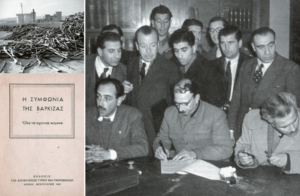
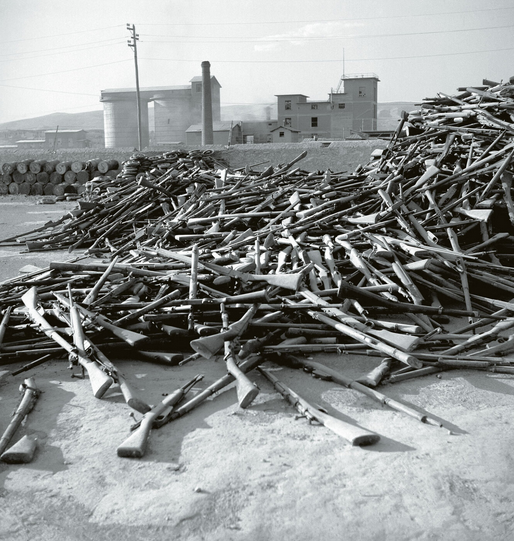
“With tears, on their knees, they placed their weapon on the ground after first kissing it, as if it were their mother, their sister, their lover,” writes Nikos Tsironis, a communist and former guerrilla fighter, in his memoirs. In his eyes, the moment when ELAS is disarmed as a result of the Varkiza Agreement is traumatic: “They placed their weapon down with such care that you would think, yes, this was the most precious and sacred thing they possessed. In the square, as well as in two or three other locations in the city, the fighters were to surrender their weapons to committees of ELAS officers. And after receiving their discharge papers, they were to walk back home, returning to their families. And so it happened. I will never forget the scenes we witnessed, the sights our eyes beheld. Scenes of unparalleled grandeur and overwhelming emotion.
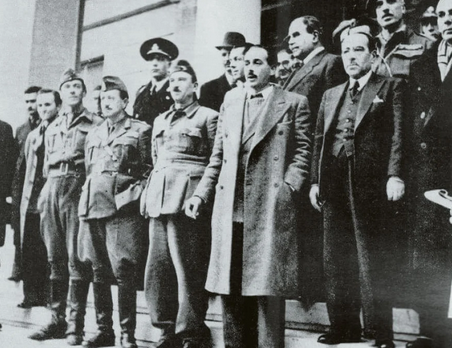
With tears, all of them, comrades, men and women, the eagles of the mountains and the plains, pleaded, even at the last moment, for the decision to be reversed. And the leaders, the captains, faced with this magnificent spectacle, astonished, until then unaware of the majestic army and people they had been leading, lowered their heads, powerless to change anything. We were all shaken. The sight of the warriors, now unarmed, carrying a bag with a little bread and olives as they returned to their villages, tore at our hearts. When they realized the presence of the two generals, Bakirtzis and Vafiadis, they broke into tears, into lamentations, and amidst their sobs, words could be distinguished—‘why?’, ‘unjust’. And then, then we too burst into tears.”

Swept away by the weight of the moment, which for him, as a leftist, was deeply painful—the disarmament and self-dissolution of ELAS—Nikos Tsironis overlooks other highly significant aspects of the event. Such as the fact that the disarmament was not at all what he believed he saw unfolding before him, as the ultimate, objectively, humiliation for any warrior since the dawn of human violence. The surrender of weapons was not merely one of the obligations undertaken by EAM under the nine terms of the Varkiza Agreement. It was also part of a staged act, a simulated compliance with Varkiza on the part of the battlefield-defeated EAM/ELAS and, fundamentally, the KKE. In reality, almost simultaneously with the signing of the Agreement, the KKE leadership was ordering the mass concealment of weapons and ammunition in anticipation of further involvement in hostilities.
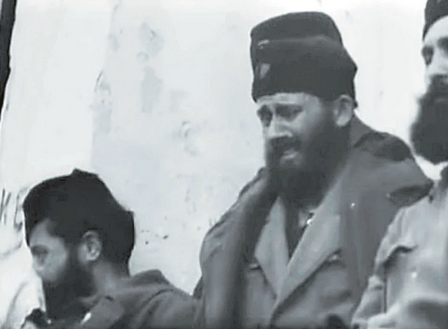
In his dramatic description, Tsironis includes the figure of Markos Vafiadis, the future warlord of the Democratic Army and prime minister of the government formed by the KKE in the mountains. Who, incidentally, in the third volume of his chaotic memoirs, reveals that “we surrendered all the weapons allocated to us under the terms of the Varkiza Agreement. And the surplus weapons we had in our storage, we hid them (we had already hidden them before the ‘Truce’ Agreement (i.e., in January ’45) in comrades’ houses, in secret hideouts built into ceilings, floors, courtyards, etc.
We began these preparations and the concealment of our surplus weapons as early as November 1944. And we kept weapons in the mountains—indeed, more than in the cities, and perhaps more than we surrendered under the Varkiza Agreement. But it is also true that we were only able to utilize a portion of all those weapons in our hideouts. There were various reasons, including the fact that the comrades who knew the hideouts were no longer alive. But the main reason was that after Varkiza, many of our hideouts were discovered, both in the cities and in the mountains.”
The game with the weapons
However one interprets it, whatever impact it had on the subsequent course of events when the next round of civil conflict began in 1946-49, the methodical concealment by the KKE—signing Varkiza with one hand while hiding weapons with the other—was of massive scale. According to Ilias Nikolakopoulos, a scholar explicitly aligned with the Left, the weapons that were never surrendered were sufficient for 20,000 guerrillas. Others estimate that the hidden weapons were even more.
For instance, Solon Grigoriadis estimated that the weapons numbered 40,000 pieces. And Chris Woodhouse, who cannot be accused of lacking objectivity and accuracy—on the contrary, he is as close to an authority as possible on Greek history from WWII onward—records a spectacular volume of military equipment in the hands of leftist guerrillas, far exceeding even the estimates of various researchers on the subject: “According to figures provided by the communists themselves, the British supplied them with 3,300 rifles and light automatics, compared to the 41,500 that were surrendered in early 1945. Beyond war spoils and supplies from the black market, it was claimed that by June 1943, ELAS had gained control of most of the light weaponry that the Greek Army had avoided surrendering to the Germans and Italians. Another significant influx of material followed in October ’43, when the weapons of the Pinerolo Division were seized after Italy’s surrender, etc.”
With this action, from the outset, the Varkiza Agreement had been violated—this time from the Left. Of course, it would almost immediately be violated from the Right as well: historians, regardless of ideological leanings, agree that the “White Terror” was real, that it was not a mere ideological fabrication of the Left, used either to justify the shift to armed struggle in ’46 or to gain international sympathy and support. It was a wave of extreme, blind anti-communism that swept through the countryside and cities for about a year, from February ’45 to March ’46, and which the British historian David Close aptly calls “the Right’s vendetta.” In the sense that the persecution of the defeated leftists took the form of vengeance and punishment for the Left’s violence during the occupation’s civil war and the December events.
Right-Wing Violence
The “White Terror” remains one of the darkest and most controversial phenomena of the post-war period, directly linked to Varkiza. There are countless studies on the subject, and many contradictions between them. However, reliable evidence is scarce. What is certain, though, is that this time the victims were those who were or were perceived to be leftists. The perpetrators of the atrocities were various paramilitary groups, with the most famous and active allegedly being the “X” organization of the Cypriot lieutenant colonel Georgios Grivas.
These gangs ravaged much of Greece, at least with the tolerance of the government and the British, sometimes even with their blatant cooperation. Nonetheless, the question that remains under dispute is the eternal “who started the unjust actions?” – the Right or the Left?
Indicatively, the Public Prosecutor’s Office of Larissa on April 12, 1945 sent a confidential memorandum to the Ministry of Justice. It stated that “the arrival of the National Guard (15th Battalion) significantly improved the situation, but the National Guard was installed in certain areas, and its conduct was impeccable. It proved to be the opponent of the extreme Left and, through certain actions, presented itself as a class police force. Thus, it engaged in unjustified damages, illegal arrests, and the abuse of EAM-communists. Unofficially, it collaborated with local royalist organizations, infiltrated by individuals who had demonstrated at least national dishonor during the occupation, and collaborated with the armed nationalist group of the former bandit Sourlas, who was rampant in Farsala, etc.”
Even members of the Plastiras government, such as the Minister of Public Works and Transport, retired Major General Loukas Sakellaropoulos, had no hesitation in expressing his true beliefs: “I do not recognize any agreement. I am inspired by the feeling of revenge and wherever I find an EAMite, I will hunt them down. If I were a military judge, I would cut their throat. Since I am a minister, I will dismiss them.”
Military Academy of Boulkes
Apart from the concealment of weapons, the leadership of the KKE undertook another activity that clearly contravened the letter and spirit of the Varkiza Agreement: it relocated a large number of EAM fighters to a peculiar expatriate community in Yugoslavia, in an abandoned village by the Danube River, the infamous Boulkes. This place developed into an autonomous community, like a self-managed and almost independent village-state, with its own administration, functions, media (newspaper “Voice of Boulkes”), and even currency.
Over time, as the community of exiled Greek leftists began to consume itself with violent incidents, including murders and violent crimes, what exactly Boulkes was has become shrouded in myth. Furthermore, opinions on how it was used by the KKE are divided. Some downplay its role as a military camp and academy, while others describe firsthand the training program of the fighters who were sent back to Greece for the new round of the civil war.
Among those in the first category is, for example, Angelos Tsekeris, who states that although “after Varkiza about 6,000 EAM fighters gathered there, the Right’s version that Boulkes housed EAM reserves preparing for the next round cannot be historically confirmed.”
In complete contrast, Christos Kainourgiou (Vrasidas), an officer in the Democratic Army during the Civil War, gives a completely different, lived experience: “Boulkes had turned into a true forge of struggle.
Here, revolutionary characters were shaped and galvanized. Systematically, daily, and methodically, suitable political and spiritual nourishment was provided for an inevitable clash in our country. A military school operated with four-month training. In this school, permanent and reserve officers with remarkable action in the Greco-Italian War of ’40 and the National Resistance ’41-’44 trained and taught. It was this ‘military academy’ that the sad troubadours of the Right spoke about in the UN Security Council. Hundreds of officers and political commissars, over various periods, joined the DSE with Boulkes as their base and emerged as worthy leaders.”
The Vari Agreement
The Varkiza Agreement, in practice, is a mosaic made up of contradictions and paradoxes. After all, it couldn’t have been anything else, since it was an agreement that was never upheld by any side. An agreement with a misleading label, at the very least, since it was not concluded in Varkiza, but in Vari, in the summer residence of an industrialist, Petros Kanellopoulos. Even this, however, is not entirely accurate: In the “Kanellopoulos villa” in Vari, negotiations took place for about 10 days between the EAM and the then national government, which, however, was a puppet show, a series of puppets hanging in the hands of the British. In this regard, Woodhouse writes simply and cynically that “until 1947, the British government appointed and dismissed Greek prime ministers with almost no sensitivity to constitutional norms. British experts dictated the policy in the areas of national economy and finance, defense and foreign relations, security and law and order, trade unionism and employment.” This view, with the expected gradations in the hue and intensity of the assessments, is expressed by the majority of historians. “The British ambassador in 1945, as later commented by a diplomat,” writes for example David Close, “held a position that resembled that of the governor of a colony.”
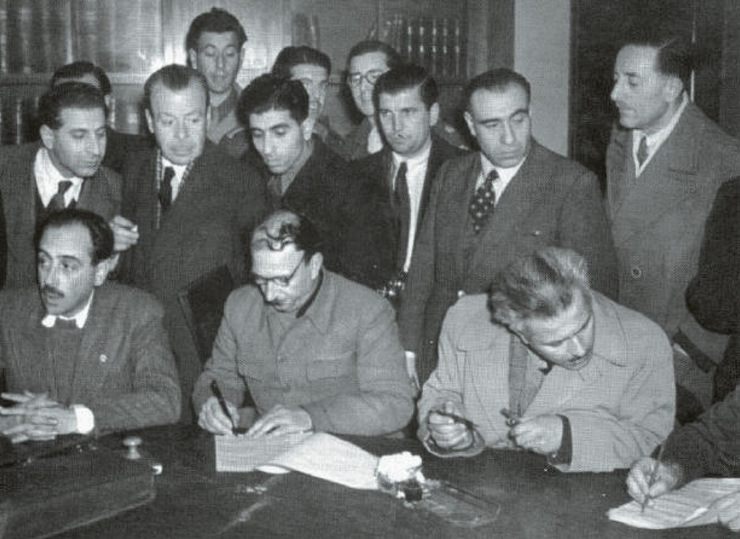
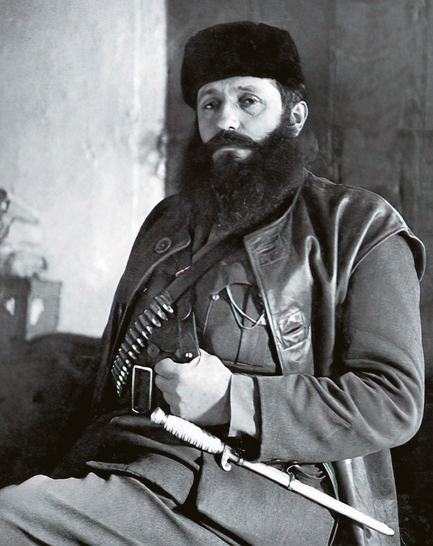
In any case, the final document of the infamous agreement was signed at the Ministry of Foreign Affairs, in the center of Athens, and not in Vari or Varkiza, on February 12, 1945. And four days later, the order for the disarmament of the ELAS would be given jointly by its leaders, General Stefanos Sarafis and Aris Velouchiotis. He would be the first and most infamous denier of this agreement, raising an insurgency not only against the bourgeois state that was struggling to be formed in Athens, but also against his own party, the KKE. Velouchiotis would pay with his life and the systematic slander of his communist reputation for his opposition to the Varkiza Agreement, which he considered disgraceful and treasonous to the Left—hence Aris’ exclamation “we were betrayed!”. However, the official KKE considered Velouchiotis a traitor because he deviated from the party line and insisted on the doctrine that “the war should continue.” Regardless of the fact that a year later, the leadership of the KKE under Zaharíadis would adopt Aris’ doctrine and, with yet another flip-flop, would label comrades Giorgis Siantos and Mitsos Partsalidis as traitors.
These, together with Ilias Tsirimokos of the People’s Democracy Union that collaborated with the EAM, were the ones who ratified the Varkiza Agreement with their signature. At that time, the natural leader of the KKE and chosen by Joseph Stalin, the KKE’s ally, Nikos Zachariadis, was still imprisoned by the Nazis in Dachau and his fate was unknown. The government which the three denounced had been hastily assembled in the early days of ’45, under the exceptional conditions created by the December events of 1944 and at the behest of the British. Its head was General Nikolaos Plastiras, appointed by the Archbishop of Athens and All Greece, Damaskinos, who had been granted royal powers as regent, since King George II remained outside Greece. In any case, in April 1945, the British would replace the rigid Plastiras with Rear Admiral Petros Voulgaris as interim prime minister, with the mission to expedite the holding of free national elections.
In summary, the agreement provided for the following in its respective articles: 1. the creation of a democratic state with full respect for individual freedoms, 2. the lifting of martial law, 3. amnesty for political crimes committed after 3/12/44—though criminal offenses under common law were excluded, 4. the unconditional release of all those arrested by ELAS, 5. the creation of a new National Army, 6. the demobilization of ELAS and its total disarmament, 7. the cleansing of public services from collaborators and Nazi collaborators, 8. a similar cleansing of the security forces, and 9. the conduct of a referendum on the form of government in Greece, as well as the holding of elections under the supervision of an international delegation of observers.
It is obvious that most of the articles of the agreement bound the Greek state, while only two bound the EAM. Even so, the Left was in turmoil, especially over the issue of hostages, and the ambiguity surrounding how political crimes were distinguished from criminal offenses in the case of citizens with known left-wing beliefs. These people continued to be excluded from much of the social and economic life, not being accepted as employees in the public sector, being asked for a certificate of social beliefs, etc. Also, within the KKE, there was intense discontent, and severe criticisms were launched against the negotiators, as many communists considered that the Varkiza amnesty only applied to the party leadership, while the mass of ordinary members remained unprotected and exposed to mistreatment by the “class enemy.”
Aris and the Betrayal
Nikos Tsirounis, in his aforementioned memoirs, expresses the dominant view of the party base in the KKE. He describes Varkiza as “the most unjust and cursed agreement that our leadership (i.e., the KKE) could have signed. We literally lost. We couldn’t believe that leaders had signed such an agreement. We, the simple people, the soldiers, with our own judgment, immediately felt that what our people had signed wasn’t an agreement, but a real unconditional surrender.”
Tsirounis feels betrayed by his own party, believing that the KKE should not have surrendered at Varkiza to the opposing side—meaning the provisional government that had been formed after the December events—and, of course, to the force that truly held power in Greece at that time, the British. However, in his bitterness and disappointment over the excessive meekness of the KKE leadership, Nikos Tsirounis—like the majority of his like-minded comrades—overlooked a primary element: that the ELAS, as the military wing of the EAM coalition, with the KKE as its core, had been defeated in battle. At least in formal terms, as would happen at the conclusion of any armed conflict, the defeated side cannot impose its terms for the future situation.
Especially in the case of Varkiza, the KKE had chosen to betray the agreement it had signed, preventively, one might say, awaiting the violent revenge from the Right, the “White Terror,” etc. In a way, however, the KKE betrayed unsuspecting people like Tsirounis, who had no idea of the designs and maneuvers of the party leadership. Yet, it seems that this leadership also had no clear and precise goal when it signed the Varkiza Agreement. In contrast to Aris Velouchiotis, who, despite his obsession with the war, proves in hindsight to have been the most perceptive and astute analyst of the developments.
The unparalleled political insight of Velouchiotis, at least among his KKE comrades, is highlighted by historian Nikos Papadatos as follows: “Aris disagreed from the very beginning with the Agreement, which not only surrendered the weapons of ELAS but also compromised on the issue of general, unconditional amnesty. He was heard saying to Siantos: ‘Giorgis, we shouldn’t execute the Agreement, because we’ll bury the popular movement. We’ll be gathering murdered fighters every day.’ Siantos: ‘Yes, Thanasis. But I can’t dishonor my signature.’ Aris: ‘If you care about your signature, Giorgis, we’ll say that ELAS made a revolution and abolished you. Siantos: ‘That can’t happen, Thanasis. The terms of the Agreement will be executed.'”
Then, in March 1945, Velouchiotis wrote a letter to the KKE, in which he criticized the party leadership for its naive hopes for support from Stalin’s USSR: “The Yalta conference and the agreement should not give you any illusions that it can influence so much as to steer the country’s wheel, which you let the British hold firmly in their hands. The Soviet Union, as you should know, cannot conduct ‘Greek’ politics to intervene actively in the Greek drama. For it conducts a policy of world revolution and is not willing in the least to jeopardize it for this small percentage of humanity called Greeks, who themselves—through their leaders—led them to new slavery. There may be a ‘clear exhortation’ from the Russian comrades to the KKE for the signing of the Varkiza Agreement. However, this changes nothing. After your numerous serious tactical mistakes, since early 1943 and their criminal culmination in the Athens Battle, the Russian comrades lost their trust and were forced, so that you wouldn’t lead the country and its people to greater destruction, to ‘advise’ you to retreat and sign the Varkiza Agreement.”
V for Varkiza?
“The Varkiza Agreement was never going to be honored by either side, neither by the KKE and the EAM coalition of parties, nor by the bourgeois state, with the short-lived post-December governments that alternated in power like seasonal decorations, depending on the preferences of the British factor.
From this perspective, the fundamental paradox of the agreement lies in the fact that while it was violated from the very beginning, it influenced, more than any other, the modern history of Greece. An additional paradoxical aspect is that while Varkiza continues to inflame passions on both sides, it remains largely unknown. It is characteristic, as much as it is improbably curious, that the minutes of the talks preceding the final signing have not been published to this day. They have not been found – although it is more likely they never existed. However, the essence does not change, nor do the deeper causes that inevitably led to the Varkiza Agreement.
The primary cause was the incurable intolerance of the bourgeois state – together with the foreign guardian – towards the domestic communist Left, something that, of course, was equally true in reverse. But the catalyst for the failure was the stubborn refusal of the Left to accept that it had been defeated in the Battle of Athens. This stance is both certified by the minutes of the negotiations between the EAM and the British for the January 1945 truce. On the other hand, the rejection of defeat would soon prove to be, right after Varkiza, the womb of the civil wars that followed.
As for the agreement itself as a milestone, it is now completing 80 years as stillborn and at the same time one of the most discussed and controversial – even traumatic, especially for the Left – agreements. One that has never ceased to surface in public discourse. In 2008, for instance, along with a modern revival of the December events following the murder of Alexandros Grigoropoulos in Exarchia, one of the slogans of a burning Athens was “Varkiza’s end!”
Obviously, in the context and political scenery of 2008, the slogan was completely meaningless. But even so, the ghost of Varkiza made its presence once again felt, in its peculiar, timeless, and mysteriously unchanging form. As an agreement that did nothing but not end mutual suspicion, the total lack of trust between the communist Left and the established state. As Sthathis Kalyvas and Nikos Marantzidis assert, “The Varkiza Agreement reflected the balance of power after the Battle of Athens. The KKE was defeated, found itself outside the government, was forced to disarm its party army, the ELAS, and to dissolve the state it had created during the Occupation through the EAM.
However, although the defeat was crushing, it was not total, as it still had significant leverage, and the British did not want to continue the war outside of Athens. The KKE could aim to stay in the political game of parliamentary democracy, even if not from a dominant position […] About a year later, however, the KKE chose the path of a new armed conflict.”
Ask me anything
Explore related questions