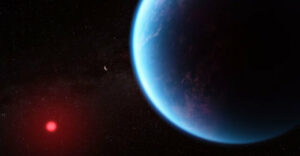
Scientists have discovered a giant, gas planet orbiting a small red dwarf, a rare combination that astrophysicists are struggling to explain.
The star TOI-6894 looks a lot like others in the Galaxy. It’s a red dwarf, a star of very small size, brightness and mass, just 20% of our Sun. Planetary scientists have long assumed that such stars do not provide the necessary conditions for the formation and “hosting” of giant planets.
But an international team of astronomers has spotted the undeniable signature of a gas planet orbiting the tiny TOI-6894, according to a study published today in the journal Nature Astronomy.
TOI-6894 is the smallest star known to scientists that has such a colossus orbiting it. The giant planet, dubbed TOI-6894b, has a radius slightly larger than that of Saturn but only half its mass. It makes one complete revolution around its star every 3.36 days.
To discover it, scientists made observations using photometric data from the Transiting exoplanet survey satellite (TESS) as part of their search for giant exoplanets orbiting dwarf stars. The existence of TOI-6894b was subsequently confirmed by ground-based telescopes, notably the Very Large Telescope (VLT) in Chile.
“Most stars in our Galaxy are small like this one, with little mass, and we didn’t think until now that they could be accompanied by giant gaseous planets,” said one of the study’s authors, Warwick University professor Daniel Bayliss, explaining that scientists should revise their estimates of the number of giant planets in the galaxy.
“It’s an intriguing discovery. We don’t really understand how a star with such a low mass can form a giant planet! That’s one of the goals of our exoplanet research: by finding planetary systems different from our own, we can run simulations and better understand the formation of our own,” noted Vincent Van Eylen, a researcher at the Mallard Space Science Laboratory in Britain.
The dominant theory for the formation of planets is that of accretion. The process begins in the protoplanetary disk, a concentration of gas and dust that revolves around a newborn star. The new planet is formed by the gradual accumulation of matter. As it grows, it attracts gases that form a dense atmosphere and becomes a gaseous planet.
According to this theory, however, the formation of giant planets is more difficult around low-mass stars, because the amount of gas and dust in the protoplanetary disk is too limited to initiate this process.
An alternative theory explains the formation of these planets by invoking gravitational instability. The protoplanetary disk can become unstable due to its own gravity and fragment, with the gas and dust then forming a planet.
The available data, however, do not allow the formation of TOI-6894b to be explained on the basis of this theory. The origin of the planet may be shed light on the origin of the planet by a detailed study of its atmosphere, which could provide valuable clues about the size and structure of its core.
This atmosphere interests astronomers for other reasons as well: although most giant, gaseous exoplanets identified to date are “hot” like Jupiter, with temperatures ranging between 1000-2000 Kelvin (726-1726 degrees Celsius), TOI-6894b is unusually “cold” since its temperature does not exceed 420 Kelvin (146.85°C). Scientists also believe that its atmosphere is dominated by methane.
The planet’s atmosphere will be studied by the James Webb Space Telescope over the next 12 months.
Ask me anything
Explore related questions