





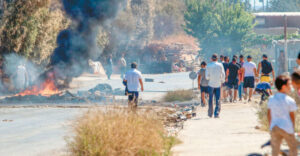
The sceptre in domestic crime and in particular in so-called everyday crime is held by Roma gangs. As the most recent Annual Report of the Greek Police on Organized Crime shows, thefts and burglaries at a rate of over 53% are committed by Roma gangs and even record “turnovers” of millions. According to the report, which analyses data from the gangs dismantled by the authorities, about two out of three are made up of Greek citizens. However, 70% of them are Roma.
The participation of Roma in crime remains disproportionately high compared to their share in the general population, which obliges the EL.AΣ. to develop special action plans to break the viciousness of camps that are hotbeds of lawlessness. What is often found is that Roma are arrested, released depending on how they are treated by the justice system, and return to their criminal activities.
The conclusions of the report confirm those of previous reports, as Roma consistently constitute the main group committing crimes against property, theft, and burglary.
Crimes in 2023
Property crime is a key activity in the so-called “petty crime”, as it is not generally considered a serious crime, but it increases the insecurity index of citizens. The recent report analysing statistical data for 2023 finds a halt to the downward trend in crimes against property recorded in the years 2020-2021, mainly due to measures to restrict the movement of citizens because of the coronavirus then, and we are back around the levels of 2019.
In 2023, there were 62,868 thefts, 2,781 burglaries and 19,223 motor vehicle thefts. Organised criminal groups were responsible for a proportion of these (10% for robberies, 4% for burglaries, and 2% for vehicle thefts). However, as the report points out, “this percentage relates to verified crime cases. It is estimated that this percentage is likely to be considerably higher, as in many cases it is becoming difficult for law enforcement authorities to link criminals to criminal groups due to a lack of sufficient evidence”. And it is likely, we add, that there are criminal groups which it has not been possible for the police and other relevant authorities to dismantle. The estimated profit of the criminals was at least 18,117,500 euros.
In 2023, a greater targeting was observed in homes (44.85% of the total), shops and businesses (18.85% of the total), wheeled vehicles (16.56% of the total, with a large number of thefts of spare parts from private vehicles), and public places (10.46% of the total). The remaining 9.27% of the total is made up of miscellaneous thefts, mainly of various types of metal objects.
Gangs dismantled
In 2023, the EL.AS. 194 criminal groups. They consisted of a total of 962 members. Most of them (131) “dealt” with theft-burglary, 39 with robberies and 24 with theft of motor vehicles. The majority of the criminal groups were domestic (65.46% of the total) and homogeneous (72% of the total). According to the National Police, homogeneous criminal organisations are those where the vast majority of their members have the same nationality.
A homogeneous or heterogeneous criminal group is one that, unlike a homogeneous one, its members have different nationalities. An indigenous criminal group is one in which the vast majority of its members have Greek citizenship. Non-Indigenous is one that, unlike the indigenous group, its members do not have Greek citizenship. Indigenous and Non-Indigenous is the group whose approximately half of its members have Greek citizenship and the other half do not.
According to the official data of the National Police on criminal organizations, it is found that “the majority of indigenous groups (70% of the total) were groups with Roma members”.
In simple terms, this means that of the 194 criminal organisations dismantled by the National Police in 2023, about 125 (65.46% of them) were domestic. 70% of these 125 organizations, about 88, had Roma members.
As the EL.AS. Stresses, there are probably other crimes committed by these organizations, but there is no evidence of them. 29.53% of the criminal groups are also involved in other illegal acts: drug trafficking, forgery and money laundering (19.69% of the total).
But which countries do the members of these criminal organisations come from? The main ones are: Greece, Albania, Albania, Georgia, Pakistan, Bulgaria, Bulgaria, Romania, North Macedonia, Iraq, Iran, Bosnia-Herzegovina, Colombia, Serbia, Syria, Algeria, Armenia, Spain, Kazakhstan, Kosovo, and Russia.
Theft-burglary
In the criminal groups of theft-burglaries, domestic ones have the main role (66.41% of the total), followed by foreign ones (23.66% of the total), while a percentage of 9.93% is “mixed” (domestic and foreign).
Among the foreign groups, Albanian (pure or not, which applies to all the groups we will mention) is dominant with 60.98% of the total, followed at a wide distance by the Georgian (9.76% of the total), Romanian (7.32%), and Pakistani (4.88%). They are followed by criminal groups from Algeria, Bosnia-Herzegovina, Iran, Spain, Colombia, Kosovo, and Cuba, each with 2.44%.
“Among the Greek groups, the dominant groups are those with an overwhelming majority of Roma members (81% of domestic groups).” Finally, in the Greek groups, “criminal groups with members of expatriates from countries of the former USSR are also detected in a small percentage (1% of the total).”
The choice of the targets of the criminal groups is particularly interesting: in the field of theft-burglary: 55.99% of all houses, 19.07% of all businesses (mainly supermarkets, mini-markets, convenience stores and kiosks, petrol stations, pharmacies, bakeries, gambling shops, etc.).etc.), public places and on the street at 12.08% of the total (mainly against tourists, public transport passengers, elderly people, migrants etc.) and metal objects at 8.67% of the total (mainly theft of metal from companies, transformers, car catalytic converters etc.).
The report goes on to describe in detail the activities of the criminal theft-burglary groups and concludes with the very interesting fact that, as it was established, the majority of the members of these groups, namely 75.18%, had a criminal past.
Who uses violence
Greek criminal robbery groups play a dominant role in criminal groups (76.32% of all groups were overwhelmingly composed of nationals). “Here too, the participation of Roma people is still strong (54.05% of all members of domestic groups were made up of Roma members). In addition, domestic groups also include expatriates from countries of the former USSR (12.96%), but to a lesser extent than the Roma. Among foreign groups, Albanian groups are the most numerous (73.78%), followed by Serbian and Iraqi groups (11.11% each).
These groups are usually small (86.84% of them had up to five members), and only 13.16% had between six and twelve members. Members of these groups often inflict injuries on their victims to reveal possible hiding places of money and valuables. The violence is mainly physical (in 49.82% of cases), but often includes threats using guns, knives, screwdrivers, electricity discharge devices, etc. It was found that 63.51% of the members of these groups arrested had a criminal history.
Finally, let us also look at the activities of criminal groups that steal and traffic wheeled vehicles. Greek domestic groups are dominant (62.50%), “with the participation of Roma groups in a smaller proportion (27.82%) compared to other property crimes”. There is also participation of expatriates from countries of the former USSR (mainly Kazakhstan and Russia), at 6.82%. As regards foreigners involved in wheeled vehicle thefts, Albanians are the first (48% of all foreigners), followed by nationals of North Macedonia (24% of all foreigners), Syria (12% of all), Georgia (8%), Iraq and Ukraine (4% each).
87.50% of the groups had up to five members and only 12.50% had between six and twelve members. As found, 54.13% of all members of these criminal groups had a criminal history (mostly of property crimes). The majority of the groups (76.40%) were involved in theft of private cars. This is followed by theft of electric skates (7.87%), motorcycles and motorbikes (7.12%), private cars and motorcycles (also 7.12%), and finally theft of machinery and spare parts (1.50%). Of particular interest is the fact that 70.83% of those arrested for vehicle theft have exceptional expertise so that, by using special software and laptops, they can neutralize the vehicles’ immobilizers and GPS systems.
The criminal groups of vehicle thieves have a large network of collaborators (lamp shops, scrap yards, forgers, etc.), thanks to whom they can alter the data of a vehicle or dismantle it by selling it for spare parts. According to the EL.AS report, the stolen vehicles are traded either intact, driven by members of the groups (accompanied by forged licences and registration plates and/or falsified chassis numbers) to other countries (Republic of North Macedonia, Turkey, Middle Eastern countries, Albania, France), or they are dismantled and traded as spare parts on the domestic and international market (mainly Greece and Albania) in trucks (usually accompanied by forged registration data and/or freight documents).
Ask me anything
Explore related questions




