





The eastern Ukrainian region of Donbas, long the center of Russian claims and the most difficult “puzzle” for Kyiv and its allies, has returned prominently to the spotlight in recent weeks as negotiations intensify over a possible agreement to end the war in Ukraine.
Donbas, which includes the Ukrainian regions of Donetsk and Luhansk, was an industrial hub during the Soviet era, with coal mines, steelworks, and extensive agricultural production. The region also has fertile farmland, strategically important rivers, and a coastline with direct access to the Sea of Azov.
Historically, Donbas is considered the most “Russian” region of Ukraine, with a significant Russian-speaking population. Even a decade ago, a large portion of the population expressed distrust or alienation from the central government in Kyiv. From there, in 2014, Vladimir Putin began his operation to destabilize Ukraine following the annexation of Crimea. Armed pro-Russian forces, many equipped with tanks, quickly seized the cities of Donetsk and Luhansk from an unprepared and demoralized Ukrainian army.
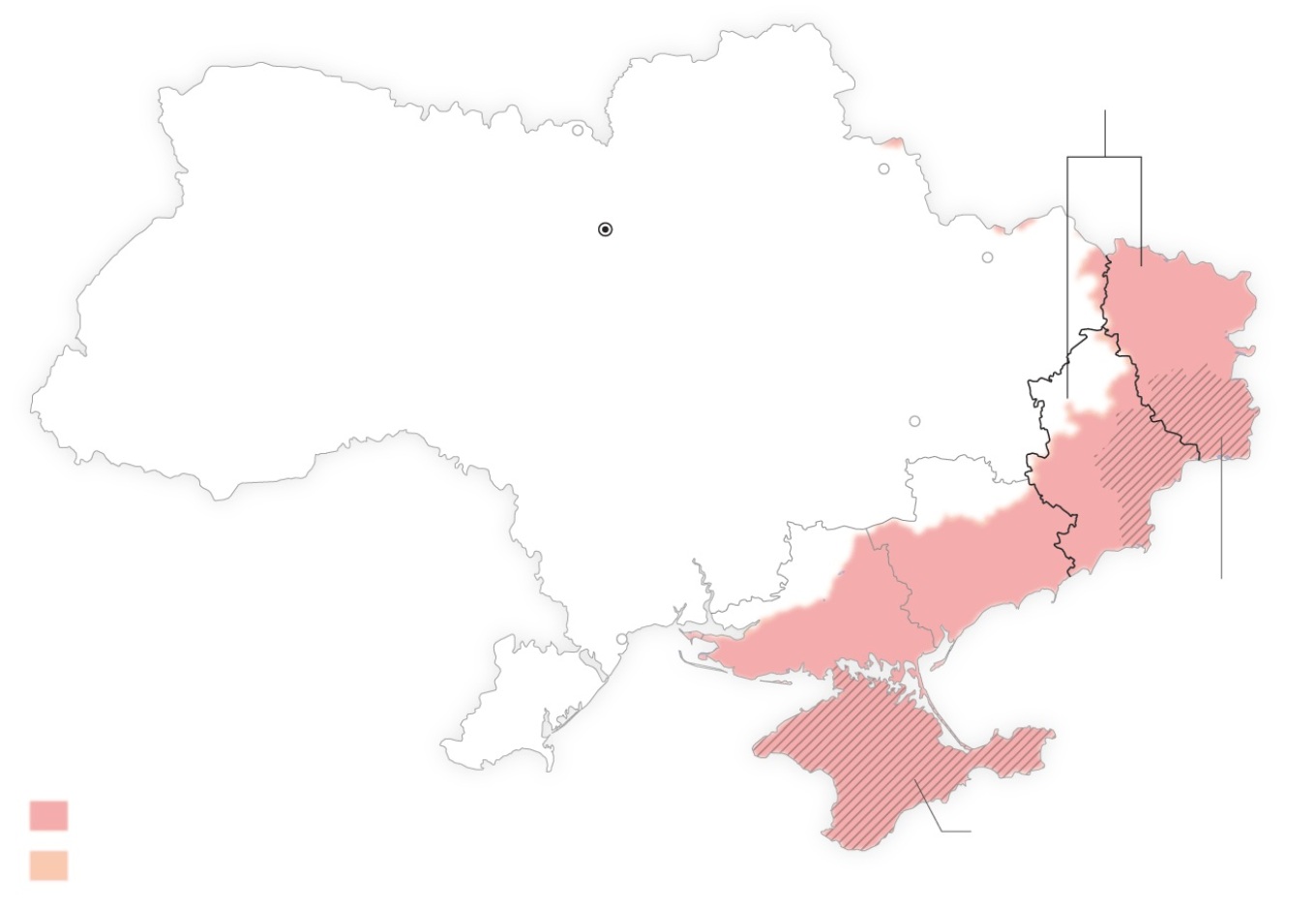
Highlighted in pink, the areas occupied by Russians in southeastern Ukraine
For almost eight years, the region experienced intense clashes between pro-Russian separatists and Ukrainian forces, with more than 14,000 deaths, according to Ukrainian data. Since 2014, at least 1.5 million Ukrainians have left Donbas, while over three million are estimated to live under Russian control. Moscow has issued hundreds of thousands of Russian passports to residents of the separatist areas.
On the eve of the full-scale invasion in 2022, Putin recognized the self-proclaimed “People’s Republics” of Luhansk and Donetsk as independent regions, citing “genocide” of four million people. A few months later, Moscow proceeded with the unilateral and illegal annexation of these areas, along with the Zaporizhzhia and Kherson regions, despite not controlling these areas entirely.
For the Kremlin, there is a fundamental difference between a military withdrawal from territories, as happened in northern Ukraine in 2022, and abandoning areas that have been officially incorporated into “Mother Russia.” For Putin, who adheres to the vision of a “Great Russia,” such a step is inconceivable.
Donbas: The region – Putin’s object of desire and the epicenter of the war in Ukraine
Analysts estimate that at the current pace, Russian forces will need several more years to complete the occupation of the annexed regions. Meanwhile, Ukraine’s chances of reclaiming most of them are considered limited: almost all of Luhansk and over 70% of Donetsk are under Russian control. However, Kyiv still maintains control over a “fortified arc” of industrial cities, railways, and road hubs – Sloviansk, Kramatorsk, and Kostiantynivka – which pose a serious obstacle to Russian forces.
For Volodymyr Zelensky, fully abandoning Donetsk would be political suicide. About three-quarters of Ukrainians reject ceding any land to Russia, according to polls. Furthermore, abandoning these areas would leave the vast plains of central Ukraine exposed to a new Russian attack and would constitute an unconstitutional concession of territory.
For Kyiv’s European allies, ceding territory would violate a key principle: that aggression cannot be rewarded with territorial gains and that Ukrainian sovereignty must be protected.
As in 2014, Donbas remains the core of Putin’s ambitions in Ukraine – and the greatest test for Europe as it seeks to uphold a rules-based international order.
Ask me anything
Explore related questions




