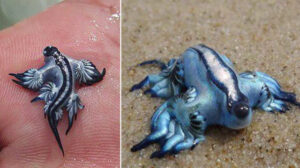
Alarm has been raised in Spain in recent days after the appearance of rare and dangerous marine creatures, known as “blue dragons,” along the Costa Blanca coast. Authorities in Guardamar del Segura, north of Torrevieja, decided to temporarily ban swimming across an 11-kilometer stretch, raising black flags on the beaches.
According to the Daily Mail, after two blue dragons were spotted on Vivers beach, the mayor of Guardamar del Segura, Jose Luis Saez, announced the swimming ban, urging citizens to stay away from the creatures, even though their size does not exceed 3.8 centimeters. “Despite their small size and striking color, they are dangerous and should not be touched, not even with gloves,” he stressed.
Watch video:
He warned: “If you see one of these creatures, notify lifeguards and the authorities. If you are stung, wash the affected area with seawater and go to the nearest first-aid station or health center.”
Meanwhile, the municipality launched a preventive operation to detect possible specimens carried by sea currents, while local police and lifeguards closely monitored the situation.
Aviso importante. En las últimas horas han aparecido ejemplares de Dragón Azul (Glaucus atlanticus) en #GuardamarDelSegura (#Alicante). Por seguridad, prohibido el baño en las playas del municipio hasta nueva orden. El contacto con este animal marino es peligroso y doloroso. pic.twitter.com/IJQnD8DtTq
— MeteOrihuela (@MeteOrihuela) August 20, 2025
Despite the ban, several bathers ignored the instructions and entered the sea, risking heavy fines. Vivers beach, though less crowded than usual, still saw visitors who failed to comply with safety measures.
What is the “blue dragon of the sea”?
The blue dragon of the sea, also known as Glaucus atlanticus (a type of sea slug), is one of the rarest marine animals. It lives in tropical waters, most often off the southeastern coast of South Africa, the eastern coasts of Australia, the shores of Mozambique, and parts of the European coastline. Its size does not exceed 3 centimeters, and it is notable for its striking blue coloration.
Its stingers are venomous. The venom, which it acquires from other poisonous animals such as jellyfish, can even be lethal. It has rightly been called “the most beautiful killer in the ocean.”
Spanish beachgoers banned from swimming after sightings of poisonous 'blue dragon'https://t.co/WpvFYEl9Rw
— ITV News (@itvnews) August 21, 2025
It usually floats at the sea’s surface and moves with the help of a special gas-filled sac that acts as a natural float and propels its movement in the ocean.
Contact with a blue dragon can cause severe pain, nausea, vomiting, and in some cases, serious allergic reactions—particularly in children, people with respiratory or cardiac conditions, and those who suffer multiple stings.
Ask me anything
Explore related questions