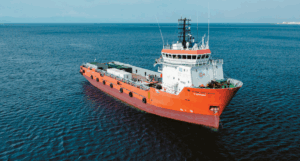
It is highly doubtful whether there exists anywhere in the world another ship with a mission comparable to that of Typhoon, owned by the Athanasios C. Laskaridis Charitable Foundation. A 72-meter vessel with a crew of 35 people, it remains continuously at sea year-round, cleaning the most remote and inaccessible shores throughout Greece. It may now sound simple and almost self-evident for our country, as the Typhoon Project has already been active for six years. Yet, in practice, the entire operation is far from simple—a fact one fully realizes only when stepping aboard the vessel and taking part in a coastal cleanup mission, such as on the small island of Dokos near Hydra.
The Results
In just a few hours, the Typhoon team collected 500 kilograms of waste from a single beach—ranging from tiny fragments of plastic that require painstaking, piece-by-piece collection “with tweezers,” to half-buried tractor tires. Everything is gathered into large sacks and transported by inflatable boats back to the Typhoon’s deck, where the materials are sorted by type, photographed, counted, weighed, and compressed to reduce their volume. They are then stacked and stored on board, awaiting offloading whenever the vessel docks at a port.
This work never stops. For the Typhoon’s multinational crew—Greeks, Russians, Ukrainians, and Indonesians—there are no holidays or days off, only continuous patrols in Greek waters. Each tour of duty lasts six months. Meanwhile, tons of waste accumulate every year on the remote stretches of Greece’s vast coastline—proof enough that the Typhoon Project is, in essence, a “mission impossible.”
Nevertheless, the project’s achievements over the past six years are impressive. As a fully private and costly initiative funded exclusively by the Athanasios C. Laskaridis Charitable Foundation, it has made a major contribution to cleaning Greece’s coastal environment. Since 2019, the Typhoon Project has carried out 4,886 coastal cleanups. Over 288,000 hours of fieldwork have removed more than 22 million individual pieces of debris—amounting to 903 tons and 45,000 cubic meters in volume, equivalent to 13 giant Airbus aircraft or 18 Olympic-sized swimming pools.
A Sign of Hope
The Typhoon Project is a personal undertaking of Athanasios C. Laskaridis himself—the man who conceived it, funds it entirely, and systematically monitors the findings in terms of both quantity and variety. The project also includes scientific recording and study of marine litter, creating the largest and most comprehensive database on coastal pollution in the Mediterranean. This unique data is utilized by universities and research institutions in Greece and abroad, including the Universities of Patras and the Aegean and the Technical University of Crete, which maintain constant collaboration with Typhoon, effectively turning it into a mobile research center.
Cleaning the coasts free of charge represents a major contribution to public health, as inorganic materials that polymerize in nature eventually enter the food chain and end up on our tables. At the same time, the Typhoon Project is a relentless battle on multiple fronts. The most dangerous adversary is public indifference toward environmental protection—a reality reflected in the findings: millions of disposable straws and cups, toys, plastic bottles, Styrofoam, ropes, as well as furniture, tires, and construction materials polluting the coasts and inland areas.
Yet, in many cases, the Typhoon’s return to previously cleaned beaches brings encouraging signs of change: about 80% of those beaches remain free of waste even a year later. In places such as Ios, Ithaca, and Naxos, the improvement reached 100%; in Crete, 78%; and on Mount Athos, 88%.
A Collective Effort
Expressing the spirit and philosophy of the Typhoon Project, the Executive Director of the Athanasios C. Laskaridis Charitable Foundation, Peggy Xirotagarou, notes:
“The sea is part of our identity, and its protection is our shared responsibility. With Typhoon, we demonstrate in practice that change is possible. Beaches that were once covered in waste are beginning to recover. It’s a challenge we meet every day—with respect for the environment and faith in the power of collective effort. We do everything we can to turn off the tap of pollution, while also helping, to the extent possible, shape a broader strategy to raise awareness in Greek society about what we throw away and where. And, of course, the key is volunteers. No one who has joined us in the field—who has picked up trash with us from nature—ever throws anything away carelessly again.”
Ask me anything
Explore related questions