





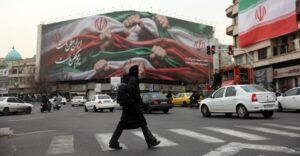
After a week of the biggest nationwide protests in years, the streets of Iran have fallen silent. Not by venting the pent-up anger of the Iranian people, but by repression.
A resident of Tehran, speaking to Western media, likened the climate to the days of Nowruz – the Iranian New Year – when the city empties and shops shut down early. Only now there’s no sign of celebration. Just an uneasy silence. Daily life goes on under the shadow of a bloody crackdown and with the possibility of another military confrontation with the United States hanging in the balance.
Next month, the Islamic Republic marks 47 years since the revolution that gave birth to it. Platforms will be erected, revolutionary songs will be sung, and organized crowds will appear. But in the corridors of power in Tehran, the mood will be anything but jubilant. The regime faces the most serious threat to its survival.
It may have suppressed the latest wave of protests by the usual methods. But the underlying causes that brought people to the streets remain firmly in society.
How we got here
Last Thursday and Friday are already being recorded as pivotal moments in modern Iranian history.
Economic protests in the bazaars of Tehran suddenly turned into an open challenge to the regime. Protesters across the country chanted “death to the dictator”, called for the fall of the Islamic Republic, and – for the first time with such intensity – some even spoke of the return of Reza Pahlavi, the son of the last Shah.
The brutality of the response shows a regime wounded by last summer’s war with Israel and the US, weakened regionally, and unwilling to compromise. The unprecedented digital blackout has isolated the country from the outside world. The true extent of the crackdown remains murky. Over 2,400 deaths are recorded, with the true size of the new blood “stain” remaining unknown – for now and perhaps forever.
The shadow of a conflict with the US
In recent weeks, US President Donald Trump repeatedly threatened strikes if Tehran continued the violence. On Thursday, however, he hinted that the killings had stopped – opening a window of de-escalation.
At the same time, Gulf countries lobbied strongly to avoid a military conflict, warning of serious security and economic repercussions for the region. For now, diplomacy is sounding louder than the drums of war.
But the threat has not disappeared. U.S. military moves in the region are a reminder that the possibility of a strike remains on the table.
Diplomacy from a position of weakness
If Washington and Tehran return to talks, Iran will do so from the worst possible position. U.S. bombing has severely damaged its key nuclear facilities. Its regional allies have been largely neutralized.
Iran still maintains a stockpile of highly enriched uranium. But the blow is both material and symbolic. In a new negotiation, the U.S. side is expected to take a hard line, expanding the agenda to missiles and armed organizations that Tehran supports.
Therein lies the limit. For the Iranian establishment, these issues are considered non-negotiable. Retreat would be tantamount to political capitulation. Despite the setbacks, the regime has shown considerable resilience to concerted and multifaceted pressures, and an agreement in this context, even with the US “gun” on the negotiating table, is probably in the realm of the unlikely.
A social contract that collapsed
The latest uprising has revealed something deeper. The social contract between the state and society has finally cracked. The regime has failed to deliver security, prosperity, and freedoms. And it has shown again that it is ready to kill to survive.
For many Iranians, nothing short of radical change will suffice. The problem is that organized internal opposition has been crushed for years by the apparatus of Ali Khamenei. Any transition, if there is one, is more likely to come from rifts within the power system itself – not from the weakened reform wing.
With no clear alternative
Outside the borders, the picture is equally blurred. The exiled opposition forces remain fragmented. Reza Pahlavi re-emerges as a potential symbol, but remains a divisive figure, with no clear plan for change that does not rely on foreign intervention.
Uncertainty weighs on society. With it comes the fear that a collapse of the regime could lead to the disintegration of the country, in a society with strong ethnic and regional tensions.
Most likely, the protests will return. As in 1979, change – if it comes – will not be instantaneous but the result of long attrition.
The line has already been crossed. The point of no return may have been reached.
Ask me anything
Explore related questions




