





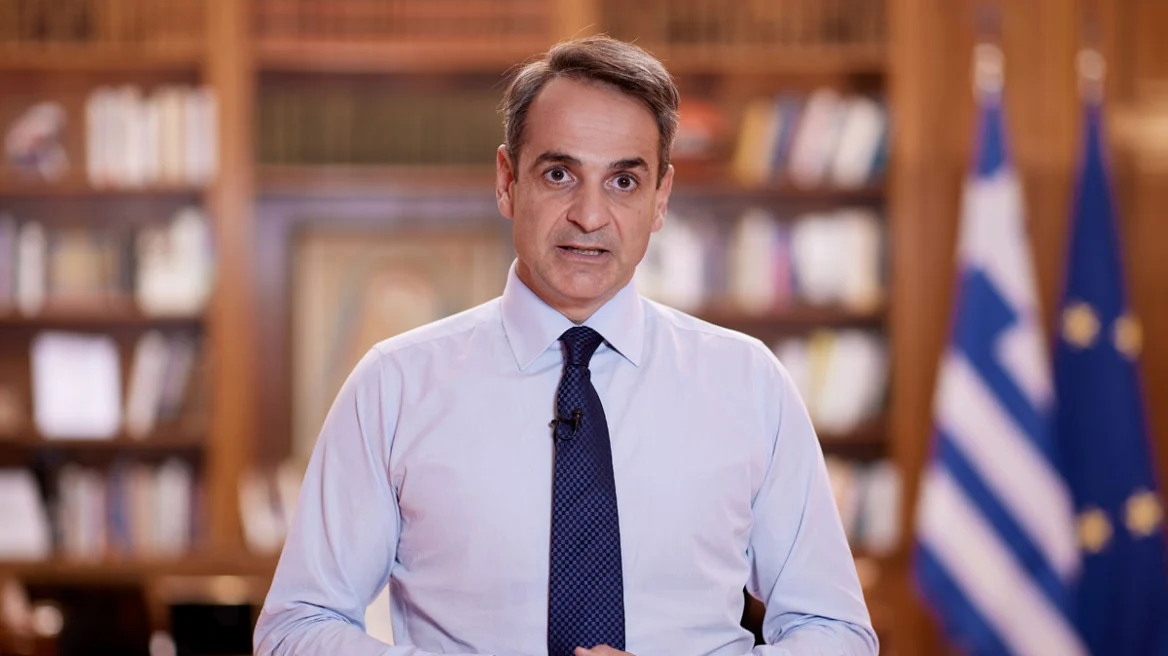
Shortly after the traditional “morning coffee” meeting at the Maximos Mansion, the Prime Minister’s televised address will take place. The ruling party’s proposal will be presented in March. The goal is to establish the parliamentary pre-revision committee by April.
Time is counting down for Kyriakos Mitsotakis to launch the procedures for revising the Constitution. It is a difficult undertaking, requiring consensus amid political fragmentation and intense hostility. Nevertheless, Mr. Mitsotakis is determined to outline constitutional priorities that he believes align with the demands of the times, while the full proposal of New Democracy (ND) will be presented in the coming weeks.
Today, shortly after the “morning coffee” meeting at the Maximos Mansion, Mr. Mitsotakis is expected to set the tone with a televised address and outline his priorities. The timetable will be presented during the 12:30 briefing by government spokesperson Pavlos Marinakis, while in an interview to be recorded at midday and broadcast at 21:00 on SKAI, Mr. Mitsotakis will speak more extensively—among other issues—about his plan for constitutional revision.
According to the timetable revealed by Proto Thema, simultaneously with his televised message, Mr. Mitsotakis will send a letter to New Democracy MPs, asking them to submit proposals by February. In March, the ruling party’s proposal will be presented to establish the parliamentary pre-revision committee by April so that work can begin immediately.
It is recalled that in either the pre-revision Parliament or the revision Parliament, a three-fifths majority (180 MPs) is required in order to amend a constitutional article. It is considered certain that Mr. Mitsotakis will send a message of cooperation to other political forces, which will also constitute a message of responsibility to opposition parties. His focus is primarily on PASOK.
The Task Force
Foreign Minister Giorgos Gerapetritis already has a coordinating role in the effort and has held relevant contacts, while remaining in close coordination with the Prime Minister’s Secretary General, Stelios Koutnatzis, who is also a professor of Public Law. ND’s rapporteur in the parliamentary committee expected to be established will be former minister Evripidis Stylianidis, who in recent days also discussed the matter with Kyriakos Mitsotakis. A first meeting of ND’s constitutional revision team is expected to take place on Tuesday.
Also involved in the discussion is Theodoros Roussopoulos, the new president of the ND party congress Organizing Committee and former president of the Parliamentary Assembly of the Council of Europe. A few days ago, he submitted a question to the Venice Commission regarding Article 86—which is expected to be at the center of the revision process—seeking information on how political immunity is handled in other European countries. From the Maximos Mansion, State Minister Akis Skertsos, Deputy Minister to the Prime Minister Giorgos Mylonakis, and government spokesperson Pavlos Marinakis are also playing key roles in the discussion.
The Framework of the Revision
ND’s proposal, as reported by Proto Thema, is expected to be particularly ambitious, with more than 70 articles of the current Constitution coming under review. Regarding Article 86, the newspaper has reported for weeks that one option under discussion—though not a foregone conclusion—is to make mandatory the establishment of the three-member advisory body of prosecutors provided for in Article 5(2) of Law 3126/2003, so that it can act before the Plenary of Parliament decides on forming a preliminary investigation committee. In any case, Mr. Mitsotakis has spoken in favor of a substantive revision of the article, though not its complete abolition.
ND also believes the time has come to revise Article 16, following the Council of State’s approval of the Pierrakakis law on non-state, non-profit universities. Under review as well are Article 103 concerning the tenure of civil servants, Article 24 on environmental protection, and Article 90 on the method of selecting the leadership of the judiciary, including the possible strengthening of judges’ input relative to decisions by Parliament and the Cabinet.
Defense Minister Nikos Dendias yesterday intervened in favor of decoupling the selection of judicial leadership from the Cabinet, while Article 30—regarding the election of the President of the Republic for a single six-year term—is also heading toward revision.
ND’s intention, however, is to broaden the agenda of the discussion, based on the assessment that the 1975 Constitution reflects the realities of the 20th century. Therefore, the constitutional text needs to be purged of outdated provisions and strengthened in light of challenges such as climate change and artificial intelligence. According to information from Proto Thema, the majority is also inclined to put the following issues on the table:
- the inclusion of rules ensuring fiscal balance and sustainability,
- the constitutional enshrinement of the State’s obligation to ensure affordable housing,
- The introduction of a mechanism for preventive review of the constitutionality of passed legislation, in order to avoid court rulings that come many years later and overturn citizens’ legitimate expectations, as often happens today.
Ask me anything
Explore related questions




