





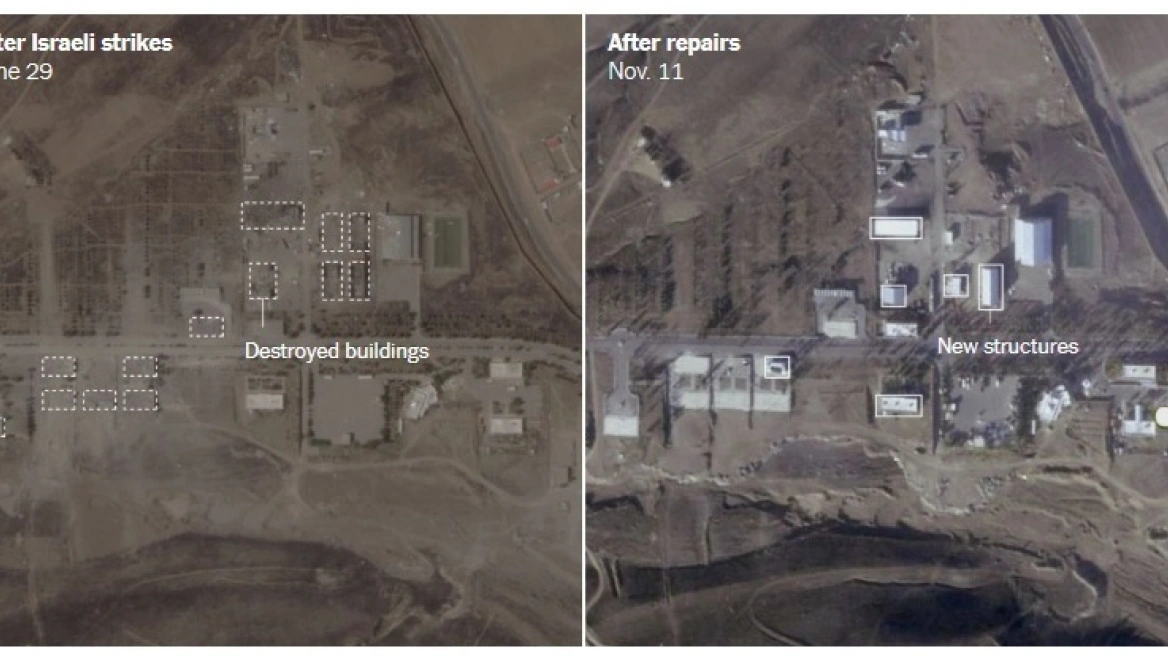
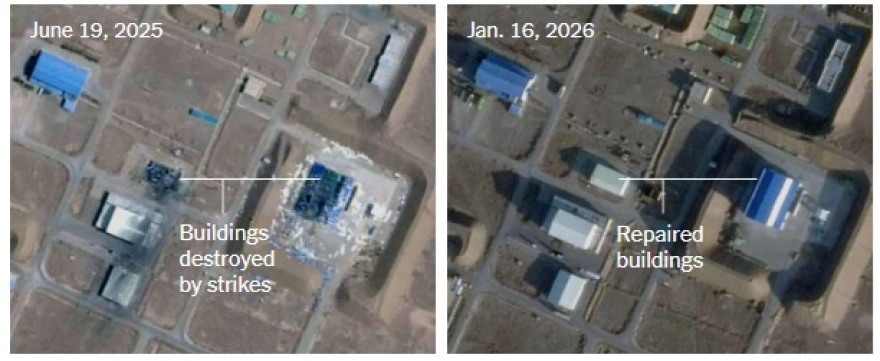
Iran appears to have moved ahead with rapid repairs at several ballistic missile facilities that were damaged by strikes over the summer. At the same time, however, it has carried out only limited repairs at key nuclear installations that were hit by attacks by Israel and the United States during the 12-day war, according to an analysis of satellite imagery conducted by The New York Times.
The differing pace of restoration at critical facilities offers indications of Tehran’s military priorities, at a time when the United States is concentrating forces near Iran and U.S. President Donald Trump is considering the possibility of new military action. In the event of an American attack, Iran is expected to respond with ballistic missiles, targeting Israel as well as U.S. military assets and allied bases in the region.
Meanwhile, talks between the United States and Iran have been underway in Oman since Friday afternoon, in an effort to avert a new conflict. Although the scope of the discussions was not immediately clear, Tehran’s nuclear program is expected to be at the center of the talks.
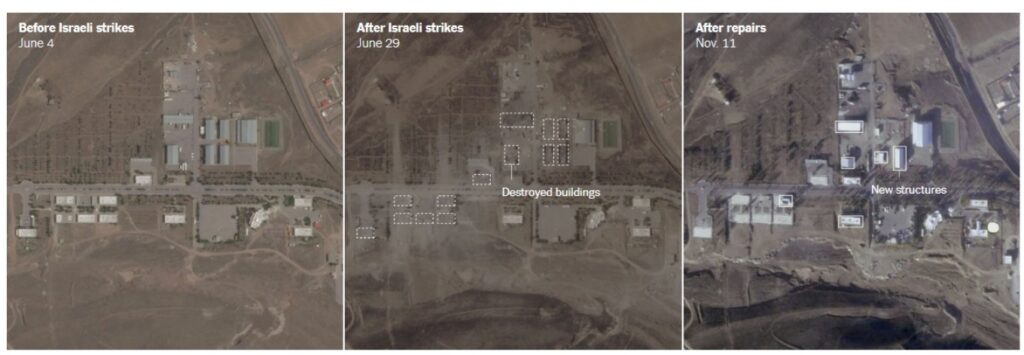
The New York Times analysis, which was based on an examination of satellite images from about two dozen sites struck by Israel or the United States last June, was confirmed by experts who closely monitor Iran’s nuclear and missile programs. According to the newspaper, construction or repair work was identified at more than half of these locations.
Experts note, however, that the full extent of the repairs remains unclear, as satellite snapshots provide only a view of above-ground activity. The data examined by the New York Times show that at several missile facilities, repairs began shortly after the strikes, indicating that missile production is a short-term priority for Tehran.
“The threat to Israel and to U.S. bases and allies in the region with missile attacks is one of the few options Iran has to deter repeated strikes on its nuclear facilities,” John P. Caves, an adviser at the National Defense University in Washington, said in an email.
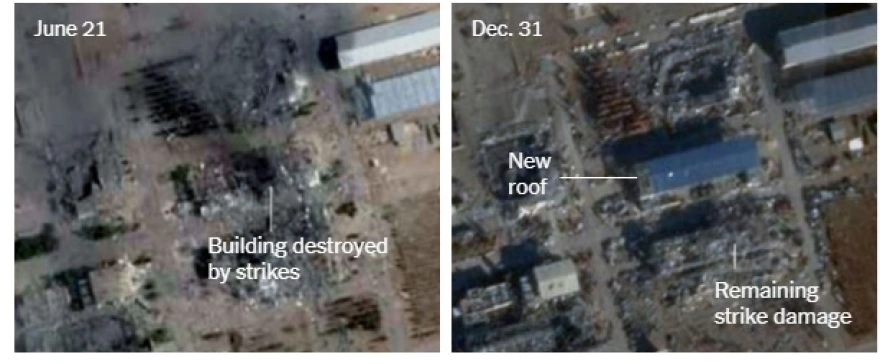
By contrast, experts say that images from Iran’s heavily damaged major nuclear facilities show only partial repairs and reinforcement of infrastructure, with related work accelerating only in recent months. Western and Israeli officials have not identified clear signs that Iran has made substantial progress in restoring its ability to enrich nuclear fuel or to build a nuclear warhead.
Replenishing the missile arsenal
Satellite images analyzed by the Times show that repair work has been carried out in recent months at at least 12 missile facilities, including production plants. Intelligence assessments indicate that Iran has largely reconstituted its ballistic missile program following the June attacks.
“The emphasis placed on rebuilding the missile program stands in contrast to the state of the nuclear program,” said Sam Lair, a research associate at the James Martin Center for Nonproliferation Studies in Monterey, California.
He added that the missile testing facility in Shahroud appears to have been restored particularly quickly and is believed to have returned to operation within a few months of the strikes. When snowfall occurred last month, the facility’s roads were promptly cleared and snow melted quickly from rooftops, suggesting active operations.
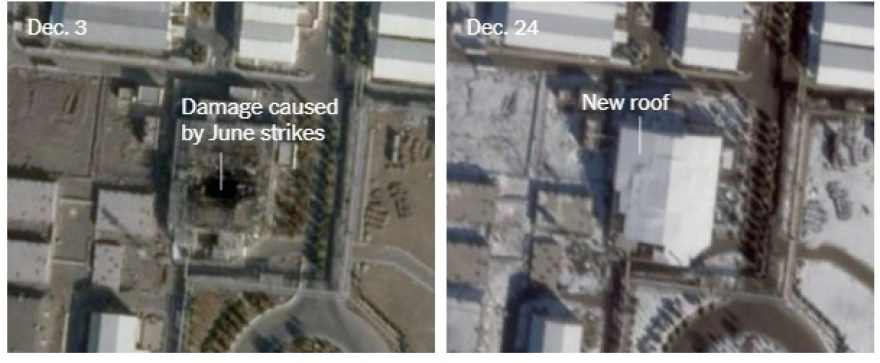
The U.S. National Security Strategy, published in November, states that the strikes “significantly undermined Iran’s nuclear program.” Nevertheless, experts note that despite some visible work, the three main enrichment facilities — Isfahan, Natanz, and Fordow — appear to remain out of operation.
Since December, Iran has installed roofs on two of the facilities, making it difficult to assess whether work is taking place inside them. Many of the above-ground damages caused in June remain visible.
At the Natanz complex, about 225 kilometers south of Tehran and considered Iran’s main uranium enrichment center, the damage that was visible in early December has now been covered by a white structure on the roof. The damaged building has been identified as a pilot fuel enrichment plant by the Institute for Science and International Security.
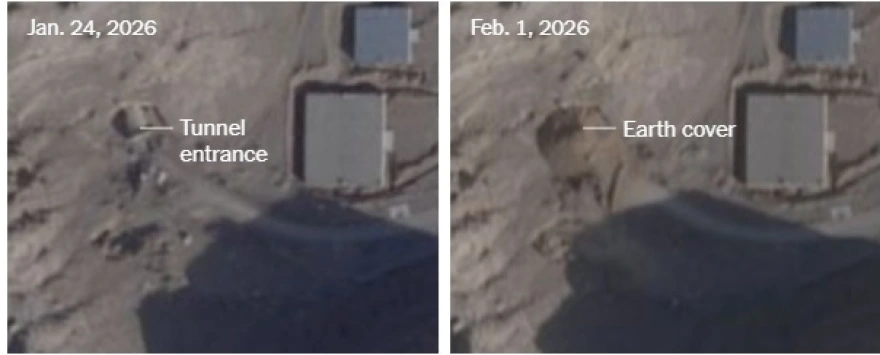
At the Isfahan nuclear complex, strikes destroyed several above-ground buildings, including uranium conversion facilities. A December satellite image shows the damaged buildings covered with roofing. Less than a mile away, new barriers were installed at the entrance to an underground tunnel complex which, according to some experts, could house a clandestine enrichment facility.
At the same time, at a new underground site known as Pickaxe Mountain, less than two miles from Natanz, tunnel entrances have been reinforced in recent months.
Joseph Rodgers, a researcher at the Center for Strategic and International Studies, said that until recently, activity around the nuclear facilities appeared to focus mainly on damage assessment and infrastructure stabilization, such as debris removal and crater filling. He added that the crackdown launched by the Iranian government against suspected espionage after the June strikes has also disrupted the nuclear program.
Warnings about uranium stockpiles
Rodgers warned, however, that Iran still possesses a stockpile of enriched uranium, the material closest to being converted into fuel for a nuclear weapon. According to U.S. and Israeli intelligence assessments, the enriched uranium that was buried at the three facilities struck in June remains in place and has not been moved.
In a report published last week, the Institute for Science and International Security noted increased activity at the Isfahan nuclear complex in recent days, mainly involving the covering of tunnel entrances with fresh earth. The institute’s president, David Albright, said that the accumulation of soil is likely being done “in anticipation of an attack, which would mean there is something valuable there,” possibly enriched uranium.
“It is not clear exactly what Iran is doing,” he said, adding, however, that “suspicions are growing that it is reconstituting a program capable of leading to the construction of nuclear weapons,” while clarifying that “we do not believe this is an immediate or imminent danger.”
A notable development is also recorded at the Parchin military complex, southeast of Tehran, where Iran has conducted tests of powerful explosives that can be used as detonators for nuclear warheads. Satellite images from recent months show that a large cylindrical chamber approximately 45 meters long has recently been constructed at the site. The facility was not hit in June, but it had been targeted by Israel in 2024 and has been reinforced with defensive measures such as anti-aircraft artillery, according to a recent report by the Institute for Science and International Security.
“Although the purpose of the new facility cannot be determined from the images, the new construction suggests its strategic importance,” the report concludes.
Ask me anything
Explore related questions




