





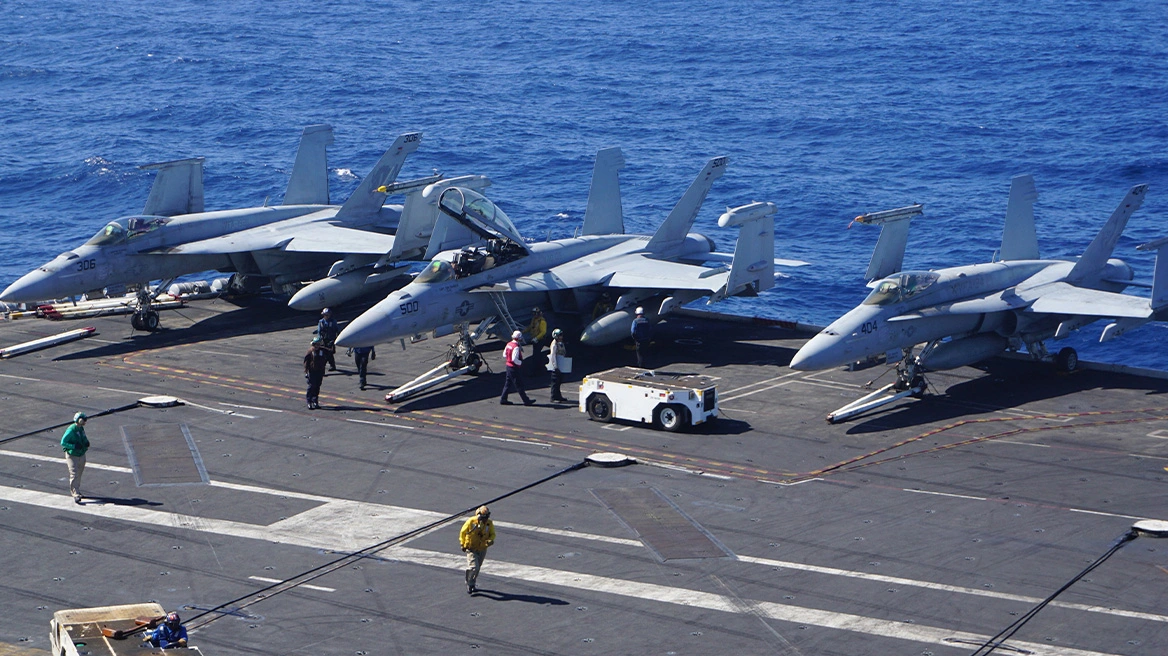
When Donald Trump boasted in January that an American “armada” was heading toward Iran, he directly compared it to the force used by the U.S. military in the lightning operation shortly after New Year’s Day in Venezuela to arrest Nicolás Maduro, saying it would be “able to accomplish its mission quickly, with speed and violence.”
Today, as the US President considers various options toward the Iranian government—including limited strikes—experts warn that an attack on Iran would be far more complex than the operation in Caracas and could potentially entangle the United States in a prolonged conflict.
Iran’s leadership has extensive military capabilities at its disposal and a network of regional proxy forces that could help sustain resistance against Washington.
Unlike the swift operation in Caracas, Trump is reportedly considering potentially broader military action without publicly specifying exactly what he aims to achieve. However, he has made clear that he wants to prevent Iran from acquiring a nuclear weapon and that regime change would be “the best thing” that could happen.
“There is no low-cost, easy and ‘clean’ military option in the case of Iran,” said Ali Vaez of the International Crisis Group in comments to The New York Times. “There is a real risk of American lives being lost,” he added, noting that this would weigh heavily in Trump’s calculations, “especially in an election year.”
Iran Has the Means to Retaliate
As it turned out, Venezuela’s airspace was relatively unprotected before the U.S. strike in January. The situation in Iran is different. The Islamic Republic possesses one of the largest and most diverse missile arsenals in the Middle East, according to regional experts. This includes drones and anti-ship weapons, although the current size of its missile stockpile remains unclear after the 12-day war with Israel in June.
Iran’s medium-range ballistic missiles can travel more than 1,200 miles (1,900 km), putting U.S. bases as far as western Turkey and across the Middle East—including Israel and Gulf states—within range.
On Saturday, Iranian state media reported that Iran tested, for the first time, a sea-based air defense missile with a range exceeding 93 miles (about 150 km), as part of military exercises conducted last week in the Strait of Hormuz.
Tehran’s strategy “is to escalate quickly and export instability across multiple fronts, so that costs are spread out and pain is shared,” said Sanam Vakil of Chatham House.
Gulf states hosting several U.S. bases fear that any American strike could trigger retaliation against them.
In January, Saudi Arabia and United Arab Emirates—both close U.S. allies—said they would not allow the United States to use their airspace for attacks. Experts note that this stance may ultimately not shield them from Iranian reprisals.
An Iranian counterattack could also target major cities in Israel. The Israeli military used advanced interception systems to shoot down most Iranian missiles during the June war. However, stockpiles have been depleted after more than two years of repelling attacks by Hamas from Gaza and Hezbollah from Lebanon, according to intelligence officials.
Vakil estimated that Iranian officials likely believe the “fear factor” of a broader regional war would serve as a deterrent to Trump.
Iran’s “Axis of Resistance” Can Threaten U.S. Forces and Allies
Iran maintains an “axis of resistance” made up of proxy forces across the Middle East, including the Houthis in Yemen and Hezbollah in Lebanon. It has built and armed these groups to expand its influence and challenge regional adversaries.
Although many of these proxies have been significantly weakened after clashes with Israel, they could retaliate against U.S. forces and allies, opening multiple fronts and broadening the conflict beyond Iran’s borders.
At least one pro-Iranian group in Iraq has pledged to support Tehran in the event of a U.S. attack, with its leaders warning they could order “martyrdom operations” as part of a wider confrontation. Experts also note that the Houthis could resume targeting commercial vessels in the Red Sea, as they did in late 2023 in support of Hamas in its war with Israel.
Iran-backed groups “know it is better for them to remain united than to be left isolated,” Vaez said. “If the mothership sinks, they are all left alone.”
Iran’s Regime Has Deep Roots
Iran’s government is a theocracy in which the supreme leader is the ultimate authority, enforced by the Islamic Revolutionary Guard Corps, a powerful armed body estimated at around 150,000 members tasked with safeguarding and advancing the regime’s authoritarian agenda.
In Venezuela, the United States arrested Maduro and his wife in a tightly coordinated operation lasting just over two hours. In Iran, however, removing the government and toppling the supreme leader would not be a matter of hours. Real power in Iran is ideology-driven, backed by political hardliners, and reinforced by a complex structure that has solidified over nearly half a century.
Vakil noted that “a Venezuela-style copy-paste operation may be much harder to execute successfully if the objective is to neutralize the heads of power.”
It remains unclear whether there would be a comparable figure like Delcy Rodríguez—Maduro’s vice president and current interim leader of Venezuela—with whom U.S. officials could cooperate if Iran’s supreme leader were removed.
Moreover, Tehran lies about 400 miles (640 km) inland from the Persian Gulf, making it far more difficult for U.S. forces to directly approach and capture Iranian leaders compared to the operation in Caracas, which is roughly 10 miles (16 km) from the Caribbean Sea, experts point out.
Economic Consequences Would Be Severe and Widespread
Iran has previously threatened that if attacked, it would close the Strait of Hormuz, disrupting one of the world’s most important energy shipping routes. Roughly one-fifth of global oil and liquefied natural gas passes through this corridor.
Any disruption would send energy prices soaring, said Claire Jungman, head of shipping risk and intelligence at Vortexa, a company that tracks global oil and energy trade.
Iranian forces have conducted live-fire drills in the Strait in recent days, which some experts interpret as a signal that they could shut down the 90-mile (145 km) waterway in the event of war. Closing it would also hurt Iran itself, limiting its ability to export oil to key customers such as China.
“It would be like bringing the roof down on its own head,” Vaez said.
Ask me anything
Explore related questions




