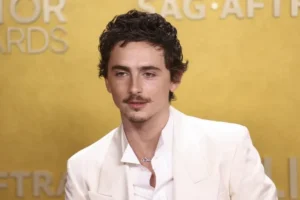
In an interview with Matthew McConaughey at the University of Texas, Timothée Chalamet, while discussing efforts to preserve the art of cinema, made a remark about opera that many considered at best unfortunate:
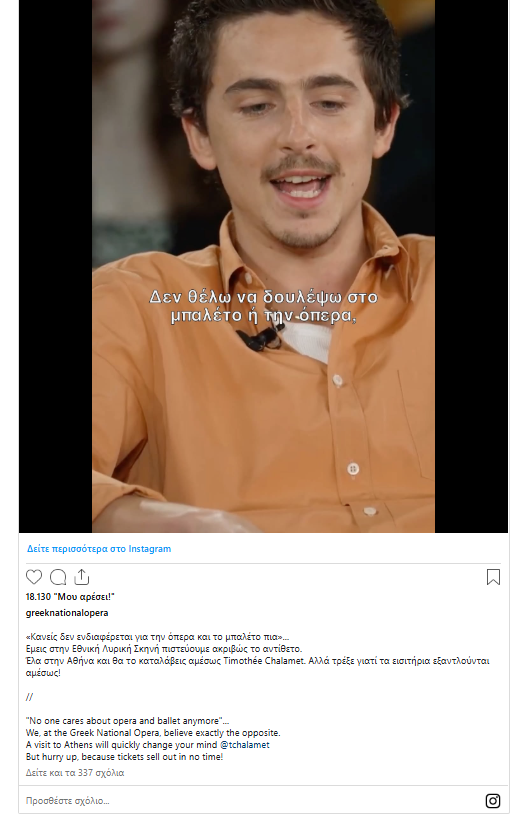
“I wouldn’t want to work in ballet or opera or something like that where everyone says, ‘Let’s try to keep this thing alive even though no one cares anymore.’”
He even added—making his initial statement worse—“with all due respect to the people of ballet and opera,” and joked that it had “cost him about 14 cents in tickets,” emphasizing how little interest he believes people have. But it turns out people do care. The reaction from people in the arts was immediate and intense.
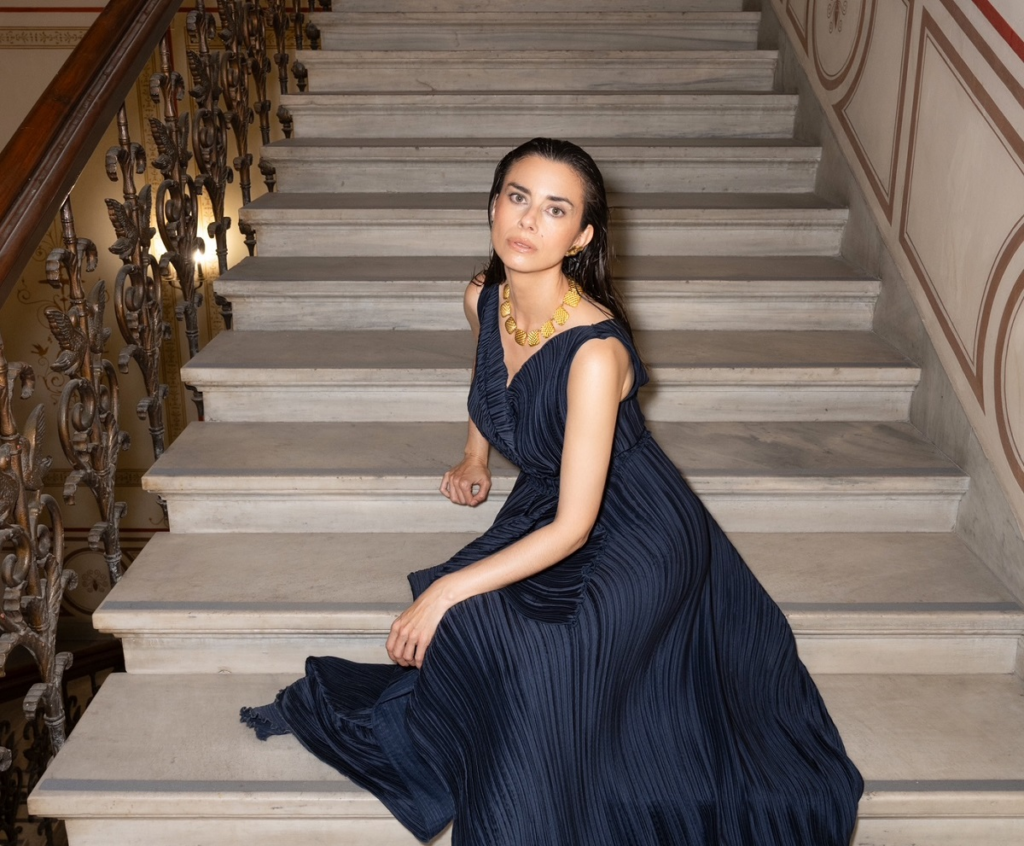
Among the first to respond was Greek-Canadian soprano Soula Parasidis. She decided to comment after noticing opera singers from around the world suddenly paying attention to the Oscar-nominated actor who claimed that opera and ballet no longer interest the public.
“For four hundred years, people have been announcing the death of opera,” she says. Across Europe, many organizations that traditionally support classical music and opera are under serious financial pressure.
Even Vienna—long considered the cultural capital of classical music—recently announced austerity measures affecting its cultural institutions. Museums dedicated to composers such as Franz Schubert, Joseph Haydn and Johann Strauss II have temporarily closed as part of budget cuts. A similar direction is being followed in France, she adds, where the 2025 national budget includes around $150 million in cuts to cultural spending as part of a broader effort to reduce public deficits.
However, Parasidis clarifies that none of this means opera is disappearing. Rather, it shows that the traditional European model—based largely on state support for the arts—is under pressure.
Meanwhile, something different is happening across the Atlantic. In the United States, opera companies have long relied less on government funding and more on private sponsorship, donors and partnerships with local communities. This system has its weaknesses but has also encouraged experimentation and, in some cases, real development.
A useful example is the Boston Lyric Opera. As it approaches its 50th anniversary, it is expanding its programming, opening new venues in its home city of Boston and securing a place among opera companies worldwide with budgets exceeding $15 million. In recent seasons it has welcomed more than 22,000 spectators, while attendance among people aged 18–34 has tripled since 2019.
These figures do not indicate a booming industry, Parasidis admits. But they do suggest that reports about the decline of opera are often exaggerated.
She also notes another small trend, at least from her perspective. According to data from Opera America, more than half of first-time opera attendees are under the age of 45. Meanwhile, her own analytics on Instagram show that 72% of her audience falls into the same age group.
Another topic raised during the discussion between Chalamet and McConaughey was concern about the role of artificial intelligence and whether it might eventually replace actors. Advice was reportedly given to performers to legally protect their voices and likeness so they cannot be used without permission.
“In opera, we rarely have such concerns,” Parasidis says. “It’s hard to imagine an AI singer performing Giuseppe Verdi or an AI dancer performing Swan Lake. Opera and ballet are rooted in physical presence, breath, risk and physical endurance. Their value comes precisely from the fact that the audience watches something unfold in real time, without a safety net and without an ‘edit’ button.”
As technology advances, she adds, this distinction becomes even clearer. Artificial intelligence dramatically increases the supply of cultural content that can be reproduced at almost no cost. Music, images, scripts, voices and videos can be generated instantly. When such supply grows, experiences that cannot be replicated often become more valuable.
Something similar has happened in the music industry: as streaming reduced the value of recorded songs, the economic importance of live performances increased. Opera, she argues, represents the most extreme version of this logic.
Parasidis stresses that she is not trying to diminish the value of pop culture, which “sets the rhythm of the present and often captures the spirit of a generation.” But high art operates on a different timescale.
“Opera, ballet and symphonic music were not created to feed the daily news cycle,” she says. “They are institutions of cultural memory that evolve slowly and endure for centuries.”
Opera and ballet, she adds, exist largely outside the race of AI-driven imitation of pop culture. They remain beyond the mediation of screens, far from algorithms and synthetic voices.
“Art forms that require the disciplined human body to perform live acquire a different kind of rarity. Ironically, the supposed lack of ‘trendiness’ in opera and ballet has also protected them from the technological upheaval that has already reshaped other creative industries. No venture capitalist is in a hurry to automate Giuseppe Verdi.”
This raises a simpler question, she concludes: perhaps opera is not outdated at all—perhaps Timothée Chalamet is simply too inexperienced to understand that art which endures measures time in centuries, not in annual award ceremonies.
“Does anyone really remember who won the Best Actor Oscar in 1968? Probably not. But everyone still knows who Wolfgang Amadeus Mozart is. And we would bet that will remain true forever.”
Ask me anything
Explore related questions