





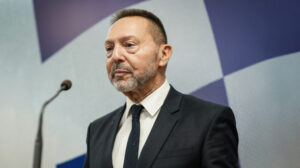
Yannis Stournaras provided an overall assessment of the course of the Greek economy, analyzing the challenges of 2026 and future prospects amid international uncertainty.
Speaking to the SKAI radio station, he described 2025 as one of the best years for the Greek economy, with growth reaching 2.1%—significantly higher than the European average—and public finances showing an excellent picture, with reduced debt and strong primary surpluses.
However, he pointed out that inflation remained higher than in Europe (2.9% compared to 2.1%), attributing this to “excess demand” generated by tourism (45 million visitors in a country of 10 million people).
For 2026, the Governor expressed reservations due to the escalation of war in the Middle East. He forecast a slight slowdown in growth to 1.9%, assuming the crisis de-escalates soon, while stressing that risks remain tilted to the downside.
Investments remain a key driver of the economy, with projected growth of 8.8%. Yannis Stournaras highlighted the synergy between the private sector, banks, and the Recovery Fund, while easing concerns about a potential “cliff effect” after the fund ends, noting that EU programs will continue to provide similar support. He also emphasized that investments have risen significantly from 11% of GDP in 2019 to 18% today.
Responding to criticism about Greeks’ low purchasing power, he acknowledged that convergence with Europe is a slow process due to the “deep footprint” of the previous crisis. However, he noted that GDP per capita in purchasing power terms has increased from 64% in 2019 to around 68–69%.
According to him, the solution lies not in reducing demand but in strengthening supply and productivity. He clarified that productivity does not mean longer working hours, but better public services, faster justice delivery, reduced bureaucracy, and investments in capital equipment and education.
He made special reference to the primary sector, citing the Netherlands as an example, which is 4–5 times more productive than Greece in agriculture due to technology (such as greenhouses), urging Greek producers to adopt successful models and cooperatives.
Regarding the shadow economy, he said that digital transactions and POS systems have significantly reduced it, though it still stands at 20–21% of GDP (compared to 15–16% in the EU). He stressed that fully tackling tax evasion—especially in fuels—requires complete implementation of input-output monitoring systems.
Concluding, Yannis Stournaras reiterated the need for governments to complete their full four-year term. He described political stability as the country’s most important intangible asset, emphasizing that early elections shorten a government’s effective time and create instability at a moment when external crises require swift decision-making.
“Especially now that the situation in the Middle East has escalated, we need a government capable of making decisions, primarily to address external crises—and perhaps the most difficult challenges are still ahead in the case of the Middle East,” he concluded, sending a message about safeguarding the economy through institutional stability.
Ask me anything
Explore related questions




