





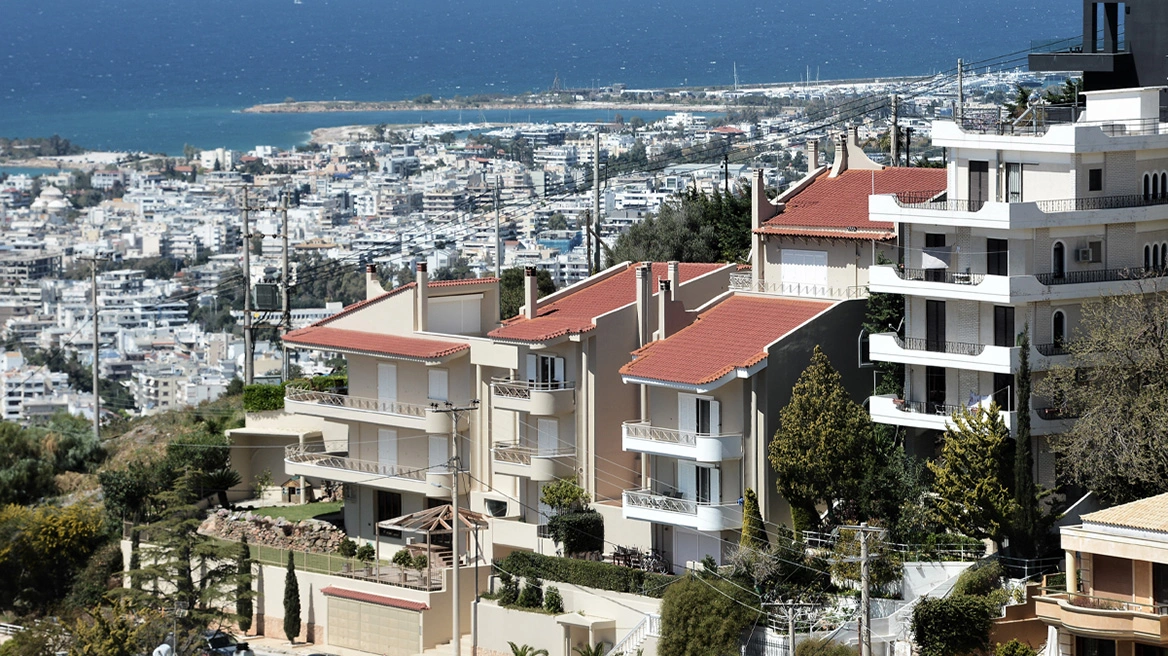
In Greece, workers supporting families are now required to cover housing costs that have reached the levels of European capitals, while incomes remain stagnant and do not keep pace with rising prices. High costs and the way the real estate market operates have created a new reality, where housing absorbs the largest part of monthly income. The result? The average rent now amounts to almost an entire monthly salary.
This picture is clearly reflected in a study by KEFiM, based on Eurostat data. In 2024, the average monthly rent in Athens stood at €1,050 for a one-bedroom apartment and €1,400 for a two-bedroom apartment—levels very close to the average of European capitals (€1,120 and €1,514 respectively).
For larger homes, prices rise further:
- €2,100 for three-bedroom apartments
- €2,300 for maisonettes
- up to €3,050 for detached houses
The averages across European capitals are similar:
- €1,120 (1 bedroom)
- €1,514 (2 bedrooms)
- €2,056 (3 bedrooms)
- €2,342 (maisonettes)
- €3,115 (houses)
However, the real burden becomes clear when compared to income. With an average salary of about €1,496:
- A small apartment consumes 70.2% of income
- A two-bedroom apartment reaches 93.6%
By contrast, in European capitals, the corresponding figures are much lower: about 33.8% and 45.6%.
The “myth” that rent increases simply follow inflation has now been debunked. According to KEFiM, rents have been rising faster—between 5% and 10% annually—while inflation remains around 3%.
So how do families cope when almost an entire salary goes to rent? The answer lies in everyday reality:
- Either one person takes on additional work
- Or both partners work to cover basic housing costs
Greece has among the highest rent increases in the EU. In 2025, it recorded the second-highest rise (+10.1%), behind Croatia (+17.6%). Other countries include Hungary (+9.8%), Bulgaria (+9.6%), and Romania (+8.2%), while lower increases were seen in Italy, France, and Finland.
Athens is now priced similarly to cities with much higher salaries:
- Madrid (~€1,700)
- Rome (~€1,650)
- Vienna (~€1,600)
More expensive markets still exist (e.g. Paris ~€2,500, Dublin ~€2,600, Copenhagen and Stockholm even higher), but the gap has narrowed significantly—especially when income levels are considered.
In practice, an average 80–90 sq.m. apartment in Athens typically rents for €850–€1,100. Higher figures mainly reflect newer or renovated properties, where most transactions take place.
An important note: Eurostat uses gross annual salaries divided into 12 months. In Greece, however, salaries are paid over 14 months, and net income is lower, meaning the real burden may be even heavier. Even so, the overall picture does not change significantly.
Finally, housing prices in Greece over the past 25 years show a full cycle:
- Sharp increase (2000–2007)
- Major decline (–44% until 2017 during the crisis)
- Strong rebound since 2018
In Athens, prices have risen by about 95% by 2025, now exceeding pre-crisis levels.
Ask me anything
Explore related questions




