





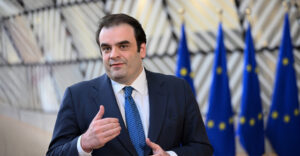
The risk of the current crisis turning into one of the most serious global energy crises was warned by the Minister of National Economy and Finance and President of the Eurogroup, Kyriakos Pierrakakis, noting that the evolution of the situation will largely depend on the duration of the turmoil in international energy markets.
Kyriakos Pierrakakis, speaking with Alfred Kammer, IMF Director for Europe, at a public event at the Fund’s headquarters entitled “Europe under pressure. Ensuring growth and resilience in a more fragile world, he stressed that uncertainty and the duration of the crisis are critical variables in the intensity of the economic impact on Europe.
He said the scope of the crisis may exceed previous historical norms, noting that “if the Straits remain closed for a long period of time, (the crisis) has the potential to become the biggest energy crisis in history“. In this light, he pointed out that during the oil crises of the 1970s, the loss of supply amounted to about 10 million barrels per day, compared with about 13 million today.
With this in mind, the Eurogroup president stressed that the effects are already visible in energy prices and costs for households. He particularly stressed the importance of targeting support measures towards the most vulnerable, noting that the effectiveness of intervention depends on the proper allocation of limited resources in conditions of uncertainty. “We must do everything we can to support, especially the most vulnerable people”, he stressed.
Referring to the Greek experience, he noted that the government had implemented targeted measures, such as fuel subsidies for households and interventions to support businesses, avoiding horizontal and untargeted tax cuts, which would have a more permanent fiscal footprint. On the cost of the interventions, he noted that currently the measures are running at around 0.2% of GDP, compared to around 2.5% in the 2022 crisis. In this context, he stressed that the challenge for governments is to balance fiscal discipline and social support, especially in an environment of economic uncertainty, rising interest rates, and high public debt.
He went on to note that Europe appears more resilient than during the energy crisis of 2022, due to the greater diversification of energy sources and the investments made in infrastructure since then. Regarding the structural picture of the European energy market, he noted that we still import about 57% of our energy, which makes the European economy vulnerable to external shocks. This fact, he argued, makes it necessary to accelerate investments in networks, storage systems, and energy interconnections.
He made special reference to the need to promote energy integration, stressing that “the promotion of a full Energy Union in Europe will have an immediate and positive impact, not only on energy, but also on competitiveness as a whole.” At the same time, he underlined that “47% of electricity production now comes from renewable sources,” noting, however, that this progress does not negate the need for further investment in infrastructure.
At the same time, the Minister of National Economy and Finance expressed concern about attempts to slow down the green transition in some member states, noting that the energy crisis could be either a drag or an accelerator of reforms, depending on the policy options adopted.
Regarding the medium-term growth prospects in Europe, the Eurogroup president stressed the need to boost productivity and remove internal barriers to the single market, noting that the full exploitation of its potential can provide a significant boost to the European economy. In this context, Kyriakos Pierrakakis underlined the importance of the implementation of the Savings and Investment Union and the creation of favourable conditions for business development on a European scale.
In this regard, he stressed the need to create “European champions” in strategic sectors and to support innovation ecosystems so that European businesses can grow, raise capital within Europe, and become globally competitive.
Referring to the Greek experience, the Finance Minister noted that progress in recent years has been based on political stability, fiscal consolidation, and the implementation of reforms, noting that the strengthening of administrative capacity and the digitalisation of the state have had multiplier benefits for the Greek economy.
Finally, the Eurogroup President stressed that the success of European policies depended on the speed of implementation and the building of trust among member states, noting that the challenge for Europe was to turn strategic directions into tangible results.
Ask me anything
Explore related questions




