





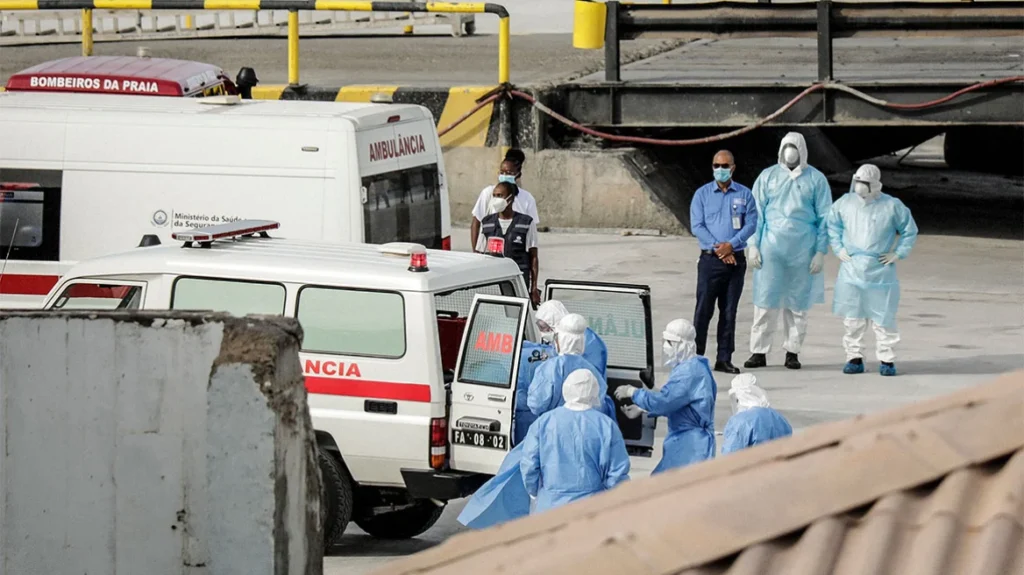
As the World Health Organization searches for the origin of the hantavirus mutation linked to contact between two passengers and a rodent during a birdwatching excursion in Argentina, life aboard the quarantined cruise ship MV Hondius is trying to continue as normally as possible.
“The journey you will remember for a lifetime,” the company had advertised the cruise to some of the most untouched landscapes on Earth. Passengers will indeed remember it for life, though for very different reasons: because they have become the protagonists of a public-health thriller being followed with bated breath around the world.
The 149 passengers from 23 countries — including Greece — aboard the ship are generally calm. Even as they watch specialists from the World Health Organization, dressed in full quarantine gear, disembark from the vessel after searching it for traces of rodents — believed to be the source of the “Andes” hantavirus mutation that can spread from person to person — they are easing their anxiety with good food, hot drinks, and relaxation in their cabins.
The usually lively luxury lounges of the ship — known for voyages to some of the world’s most remote places — are deserted. The crew has asked passengers to remain in their cabins as much as possible, wash their hands with sanitizer, wear masks, and keep their distance from others, just as people did during the coronavirus quarantines.
The calm atmosphere aboard the ship was disrupted by the publication of a video from American travel vlogger Jake Rosmarin. Speaking from his cabin on the Hondius, with tears in his eyes, Rosmarin said in the video posted on his social-media accounts:
“We are not just a story, we are not headlines in news media. We are people with families, with lives, with people waiting for us at home.”
Rosmarin’s expression of his desire to return home sparked an explosion of comments, with many users urging him to be patient for the good of the rest of humanity — if not for the sake of his own family — while others criticized his attitude.
The ship’s crew immediately stepped in to calm the emotional American influencer — as he himself admitted — by “serving good food,” resulting in further videos in which Rosmarin appeared noticeably calmer. Other passengers also sought to project this atmosphere of calm, including fellow travel influencer Kassem Hato, who said that “everything is under control and the passengers are calm.”
These comments arrived just in time, as rumors had begun spreading across social media claiming that the situation on the ship had spiraled out of control: that infections were multiplying, passengers were in a state of frantic panic, and crew members were forcibly confining them to their cabins. Even more extreme rumors claimed that no one was uploading videos from the Hondius because the ship itself did not… exist.
Meanwhile, footage taken by a passenger on April 12 also surfaced, showing the captain informing passengers that one of them had died the previous night “from natural causes,” while assuring everyone that “the ship is safe, as it is nothing contagious.”
And although things aboard the Dutch cruise ship appear calm, the situation outside it is not.
The vessel, carrying three confirmed and at least five suspected cases of hantavirus, received approval from Spain to dock at its islands, but officials in Cape Verde refused permission. The decision by the Spanish government was also rejected by the president of the Canary Islands, Fernando Clavijo, who prohibited the Hondius from docking.
The MV Hondius departed on April 1 from Ushuaia, Argentina — the southernmost city on the planet — traveling past a series of icy shores in Argentina and the British territory of South Georgia, famous for its colonies of millions of penguins, and Tristan da Cunha, the world’s most remote inhabited island.
The cruise took a nightmarish turn as the ship headed toward Saint Helena Island in the South Atlantic, where Napoleon was exiled.
On April 11, a Dutch passenger aboard the Hondius died from an undetermined cause, and his body was removed from the ship two weeks later, accompanied by his wife, who traveled to South Africa and was later hospitalized in Johannesburg. The WHO confirmed that the 69-year-old woman had hantavirus.
On April 27, another passenger who had fallen ill was transferred to a hospital in South Africa, where he remains in critical condition with hantavirus, while on May 2 a German passenger from the cruise ship died.
But how did the virus break out, and how was it transmitted among the ship’s passengers?
Given confirmation of the Andes mutation — which causes fatal pneumonia and can spread from person to person — authorities are almost certain that some passengers aboard the Hondius came into contact with specific rodents in a region of Argentina that experienced a deadly outbreak of the same mutation in 2018.
In Argentina, the virus is carried by long-tailed pygmy rice rats, common in rural areas and capable of living near homes. Humans are usually infected through contact with their urine, feces, or saliva. In some cases, rodents spread the disease through the air, spraying contaminated particles with their tails while grooming themselves.
In most cases, the infection is considered a “dead-end infection,” meaning that a person infected through contact with rodent waste cannot transmit it to others. However, this does not apply to the Andes mutation.
Although the World Health Organization estimates that the threat posed by the current outbreak aboard the Hondius is low, the WHO has classified hantaviruses as emerging priority pathogens with a high potential to cause international public-health emergencies due to the severity these infections can reach.
Hantavirus infection can prove fatal in up to 40% of cases.
Ask me anything
Explore related questions




