





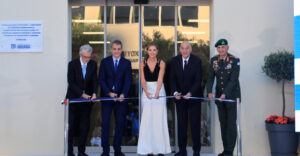
“The Hellenic National Defence General Staff’s Cyberspace Directorate is acquiring its own home here, on the grounds of the Ministry of National Defence,” Prime Minister Kyriakos Mitsotakis said at the opening ceremony. He described the new facility as one built to “the highest standards” and equipped for the critical work carried out by the Directorate.
The prime minister said modern conflict is no longer limited to the physical battlefield. “Wars today are no longer fought solely on the physical battlefield. They are fought mainly on the digital front, while threats increasingly have a hybrid character, with new technologies at the forefront,” he said.
Video from the inauguration ceremony of the Directorate of Information Technology and Cyberspace building was also released.
Risks in the digital realm
Mitsotakis said it was natural for any government whose priority is national protection to be active in this field. “All the more so when, in our time, threats extend beyond land, sea and air, into space, and above all into the digital realm,” he said.
He referred to the expanding range of hybrid threats, from cyberattacks on critical infrastructure, including energy networks, banks and hospitals, to disinformation campaigns intended to create confusion, amplify extremist voices and directly threaten democracy.
“These are undeclared wars, fought on invisible battlefields, which are nevertheless just as destructive and require constant vigilance,” the prime minister said.
He added that Greece is already implementing a broader plan to move national defence into a new era, describing this as one of the critical, and less visible, aspects of the government’s “Agenda 2030” defence reform programme.
Referring to the new building, which was donated by Athanasios Laskaridis, Mitsotakis said the full range of cybersecurity operations would now be housed in one fully organised structure. He said the facility includes a data centre, operations areas with real-time video walls and digital forensics laboratories, covering every aspect of operational readiness in the digital domain.
“In a world of rapid technological developments and constant geopolitical upheaval, our country is not standing still. It is evolving, innovating and fortifying itself against both old and new threats,” he said.
Shipping and society
Mitsotakis also thanked the Athanasios K. Laskaridis Charitable Foundation for what he described as a generous donation.
“I would like to take this opportunity to extend my special thanks to Mr and Mrs Laskaridis for yet another generous donation,” he said, responding to remarks made by the donor about social responsibility within the Greek shipping industry.
“You mentioned, Mr Laskaridis, a number of interesting economic figures, and I took note of them,” the prime minister said. “If the country’s top 50 shipping families have assets exceeding €1 billion each, and if the total value of these assets is around €50 billion, and if each person managing such wealth were to follow the example of Aristotle Onassis and Stavros Niarchos by leaving half of their fortune to a charitable foundation for the benefit of our homeland, then a sum of around €25 billion would be created.”
“With a very conservative return of 5%, that would mean the ability to support Greek society with more than €1 billion annually,” he added.
Mitsotakis said he hoped the example of the Laskaridis family would inspire others. “Our fellow citizens who have accumulated great wealth, to some extent with the support of the Greek state, which has always backed the Greek shipping industry, may reflect on this. I am certain that your example will inspire many others to follow,” he said.
Laskaridis: There is a great deal of idle wealth in shipping
Speaking earlier, Athanasios Laskaridis, a major benefactor of the Hellenic Armed Forces, said the project had begun 18 months ago and had created a facility built to high international standards.
He said a fully equipped data centre had been added to the original plan in order to provide Greece with a modern and durable tool. The project forms part of a broader donation programme he has undertaken for the Greek Armed Forces.
Laskaridis said several donations had been made in recent years, describing this development as positive but still insufficient. “There is a great deal of idle wealth in our country, particularly in the shipping sector,” he said.
He said that, as a percentage of GDP, this wealth amounts to 20% in the case of Greek families, compared with 10% in the United States. He also noted that many investments in Greece had been made possible through shipping capital, while warning that economic inequality and the concentration of wealth are problems that undermine the economy itself.
Laskaridis paid tribute to major Greek benefactors such as Aristotle Onassis and Stavros Niarchos, while stressing the power of example for the descendants of donors.
“Freedom is a secure achievement only for those who have the courage to defend it,” he said, thanking Prime Minister Kyriakos Mitsotakis for asking him to contribute to the completion of the building.
“I would especially like to thank Prime Minister Kyriakos Mitsotakis, whom I would call the Messi of modern politics,” Laskaridis said. “The criterion for success for anyone in power is simple: do they leave what they received in a better state?”
“Today, our country can finally defend itself with dignity,” he added.
Dendias: An operational core for cybersecurity
Greek Defence Minister Nikos Dendias, who hosted the ceremony, focused on the Armed Forces reform programme. He said “Agenda 2030” aims to transform Greece’s Armed Forces from a combat-ready force of personnel and systems into a system capable of receiving, transmitting, processing, prioritising and responding to information, meaning threats.
He recalled that the first law passed by his ministry, Law 5110/2024, established an Information Technology Corps within the Hellenic Armed Forces.
“This Corps serves the nation in cyberspace,” Dendias said. “It is a joint-service structure that brings together and unifies the critical functions of information technology, cybersecurity, software development, data analysis and the use of new technologies.”
He said the frontline unit of Greece’s “cyber warriors” is Unit 1864, which he described as the Armed Forces’ institutional operational response in cyberspace.
According to Dendias, Unit 1864 uses artificial intelligence to process and store vast amounts of data in minimal time, carry out automated risk assessment, detect and prioritise threats, support rapid decision-making and provide real-time situational awareness.
He said the unit also enables all types of cyber warfare operations to be carried out as part of the wider operational planning of the Armed Forces. The creation of this national capability, he added, is based on a new organisational structure, modern doctrines, advanced training, appropriate infrastructure and the continuous development of new operational capabilities.
A framework for hybrid threats
Dendias said that, within the Armed Forces’ strategic planning, Unit 1864 works alongside Electronic Intelligence Unit 1821, Space Applications Unit 1912 and Human Intelligence Collection Unit 1947. Together, he said, they form an integrated network for the collection, processing, protection and operational use of intelligence.
He described this as a key step in transforming the Armed Forces from a capable force of personnel and systems into an advanced mechanism for linking sensors, collecting and prioritising information and transmitting it to weapons systems that respond to matters of national interest.
“The facility we are inaugurating today houses a unified operational cybersecurity hub. Its aim is to protect the state, the Armed Forces and critical national infrastructure,” Dendias said.
Addressing Laskaridis, he added: “Mr Laskaridis, today’s donation reaffirms your steadfast support for the Armed Forces. It is in keeping with your tradition of philanthropy, and I must say that I listened with particular interest to your thoughts on the distribution of gross national product and the obligation of those who have wealth.”
The ceremony was attended by Citizen Protection Minister Michalis Chrysochoidis, Deputy Defence Minister Thanasis Davakis, Deputy Development Minister Zoi Rapti, Chief of the Hellenic National Defence General Staff General Dimitrios Houpis, Secretary General for National Security Thanos Dokos, Chief of the Hellenic Army General Staff Lieutenant General Georgios Kostidis, Chief of the Hellenic Navy General Staff Vice Admiral Dimitrios-Eleftherios Kataras and Chief of the Hellenic Air Force General Staff Air Vice Marshal Demosthenes Grigoriadis.
Also present were Athanasios Laskaridis, founder of the Athanasios K. Laskaridis Public Benefit Foundation; Evi Lazou-Laskaridis, president of the foundation; Vice Admiral ret. Panos Laskaridis, president of the Aikaterini Laskaridis Foundation; senior officers and other guests. The prime minister was accompanied by his wife, Mareva Grabowski-Mitsotakis.
The new Cyberspace Centre building
The cornerstone of the new building was laid on Wednesday, 18 December 2024. It was constructed through an exclusive donation by the Athanasios K. Laskaridis Charitable Foundation and represents a major investment in strengthening the capabilities of the Hellenic National Defence General Staff in information technology and cyberspace.
The state-of-the-art, three-storey building covers a total area of 2,500 square metres and houses the Directorate of Information Technology and Cyberspace, as well as Unit 1864 of the Hellenic National Defence General Staff.
The new facilities and equipment have been designed according to advanced international and allied cybersecurity standards and include infrastructure to support the Armed Forces in the digital domain.
Ask me anything
Explore related questions




