





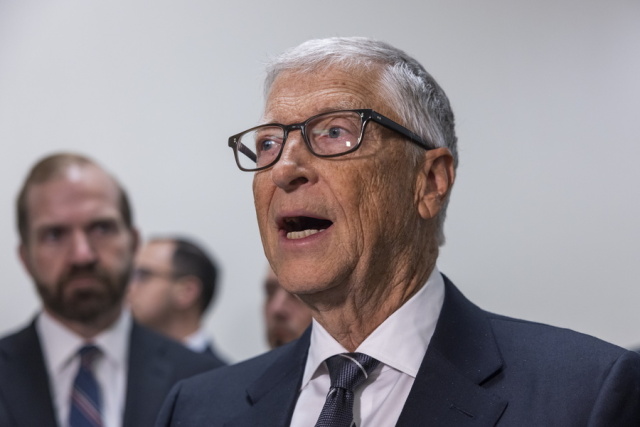
The Microsoft co-founder told the US House Oversight Committee that Jeffrey Epstein appeared to use information about his extramarital affairs as a form of pressure, according to a transcript released on Tuesday.
The transcript of Bill Gates’ closed-door testimony before the US House Oversight Committee on 10 June, concerning his relationship with Jeffrey Epstein, was released on Tuesday, 23 June.
According to the New York Post, the Microsoft co-founder named for the first time the two Russian women with whom he had extramarital affairs, and described how Epstein, the late convicted sex offender and disgraced financier, allegedly tried to use that information to blackmail him.
During his testimony, Gates said Epstein knew about two specific extramarital affairs, which he identified to the committee as involving Mila Antonova, a bridge player, and Karima Nigmatulina, a nuclear scientist. According to the testimony, Gates said Epstein appeared to use the information as a tool of influence.
Bill Gates with Mila Antonova:
At the centre of the case is a draft email dated 18 July 2013, which was made public in January by the US Department of Justice. The email is said to have been written by Epstein himself, most likely on behalf of Boris Nikolić, a close associate of Gates who was then preparing to step down from his role as scientific adviser.
The draft referred to internal departure procedures, as well as allegations linking Gates to illicit relationships, medication, and inappropriate behaviour.
“Although I was graciously offered a new position after six years of service, and although Bill, as he put it, would provide me with a generous severance package, I believe it would be dishonest to myself and my future to continue helping Bill obtain medication to deal with the consequences of his sexual encounters with Russian women, facilitate his illicit romantic encounters with married women, or be asked to provide Adderall for bridge tournaments,” the draft email stated, among other things.
Gates described the contents of the email as “an attempt at blackmail”, although he said it was unclear whether the message had ever been sent or had remained a draft. In his testimony, he said the email appeared to combine factual information with exaggerations, in what he believed was an attempt to strengthen the negotiating position of the departing executive.
Elsewhere in his testimony, Gates referred to Epstein’s later attempts to link financial demands to Antonova, saying he believed this was either an attempt to re-establish contact or a new form of pressure.
“He never blackmailed me, but looking at these emails, there’s a serious possibility that he had considered doing so,” Gates said, as he sought to clarify his view of Epstein’s actions.
Gates also stressed that he had not been aware of Epstein’s criminal activity, despite their acquaintance and discussions on philanthropic initiatives between 2011 and 2014. As he has previously said, their contact was mainly linked to efforts to support global philanthropy.
The released material also included separate testimony from Epstein’s former assistant, Lesley Groff, who described arranging massage appointments for Epstein almost daily, while insisting that she had no knowledge of illegal activity or the involvement of minors.
Groff described Epstein as “a man with a double life”, saying he projected an image of respectability while behaving in a manipulative and deceptive way.
“For 18 years, I worked for Dr Jekyll, without ever being allowed to see the real Mr Hyde,” she said.
Asked why she continued working with Epstein after his 2008 conviction, Groff said he had convinced her that he had been unfairly targeted and that the allegations against him were part of an extortion attempt.
In the same testimony, Groff said she had arranged occasional phone calls between Epstein and Donald Trump, roughly once every three months, although she said she did not know why the communications later stopped.
Ask me anything
Explore related questions




