





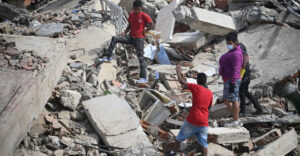
As the hours pass, hopes of finding survivors beneath the rubble in northern Venezuela are fading after two powerful earthquakes struck the country within just 39 seconds of each other, catching many residents at home during a national holiday.
By Friday morning, Venezuelan authorities had confirmed at least 235 deaths and around 4,300 injuries, while thousands of families continued to search for missing relatives. Local authorities have also set up a digital platform for missing-person reports, with large numbers of cases still unresolved.
The disaster was triggered by two earthquakes measuring 7.2 and 7.5 in magnitude, among the strongest to hit Venezuela in more than a century. The tremors caused widespread damage across the country’s northern coast, with La Guaira, near Caracas, among the worst-hit areas.
The rescue window is closing
Rescue teams are now working against time. More than 28 hours have passed since the earthquakes struck, and emergency crews are focusing on collapsed buildings where people may still be trapped.
The first 48 to 72 hours after a major earthquake are often described by rescuers as the most critical period for finding survivors alive. After that, the chances of survival fall sharply, particularly for those without access to water, medical help or breathable air.
Even so, rescue workers stress that survival can vary depending on the conditions beneath the rubble. People have occasionally been found alive days after major earthquakes, especially if they were trapped in spaces with air pockets or limited access to water.
Families search with their bare hands
In La Guaira, desperate families have joined rescue workers in searching through collapsed buildings. Some residents have been digging by hand, trying to reach relatives believed to be trapped beneath concrete and twisted metal.
One mother told AFP she was searching for her son in the ruins of a building, saying the debris was too heavy to move without help. Her 23-year-old grandson, Alessandro, put on a volunteer firefighter’s helmet and joined the search for his missing father.
“He’s in there,” he said, looking at the rubble.
La Guaira, once a seaside escape for residents of Caracas, has suffered extensive damage. High-rise buildings, beachfront homes and hotels have collapsed or sustained serious structural damage, while residents have been left standing amid dust, debris and destroyed streets.
Caracas airport closed after runway damage
The earthquakes have also caused major disruption to Venezuela’s transport network. Simón Bolívar International Airport in Maiquetía, the country’s main aviation hub serving Caracas, has suspended operations after serious damage was reported to its runways and terminal infrastructure.
Images from the airport show cracks and deformations in the asphalt, raising concerns over whether large aircraft can safely land or take off. Technical crews are assessing the extent of the damage, including possible subsidence in the coastal area.
Air traffic control services were also affected, prompting the issuance of a NOTAM, an international notice to aviation operators. Several major airlines connecting Venezuela with Latin America and Europe have suspended flights to Caracas while the airport remains closed.
Initial estimates suggest that repairs and safety certification could keep the airport out of operation until at least July 2, although authorities are still assessing the full scale of the damage.
Red Cross sends emergency aid
The International Federation of Red Cross and Red Crescent Societies has launched an emergency response operation, including an initial shipment of at least 40 metric tons of humanitarian aid to Venezuela.
The first technical mission includes 17 metric tons of essential supplies intended to support hundreds of families in the worst-affected areas. The shipment includes hygiene kits, kitchen items, blankets, sleeping supplies and other basic relief materials.
A second aircraft, described as a “solidarity plane”, is expected to carry a further 23 metric tons of humanitarian supplies.
El Salvador has also sent rescue workers, paramedics and emergency aid, as international assistance begins to arrive in the country.
U.S. eases sanctions for earthquake relief
The United States has temporarily eased part of its sanctions framework to allow earthquake relief transactions involving Venezuela.
The U.S. Treasury Department’s Office of Foreign Assets Control issued General License 60, authorising transactions related to post-earthquake relief efforts that would otherwise be prohibited under the Venezuela Sanctions Regulations.
The authorisation remains in effect until 12:01 a.m. Eastern Daylight Time on October 23, 2026, and includes certain fund transfers connected to permitted relief operations.
The measure is intended to allow humanitarian organisations, financial institutions and money transfer providers to support emergency response efforts without violating U.S. sanctions rules.
Ask me anything
Explore related questions




