






“Prepare for El Niño.”
That warning from the World Meteorological Organization (WMO) may sound surreal. As France, the United Kingdom, Germany, Belgium, Spain, northern Italy and several other European countries endure an unprecedented, historically severe and deadly heatwave, scientists are essentially saying that the worst of the heat is only just beginning.
This year’s phenomenon has been informally dubbed “Super El Niño”—a term not officially recognized by scientists but widely used to describe what could become, if not the strongest El Niño ever recorded, certainly the most powerful in the past 150 years. It is also expected to bring the hottest summer in recorded history for many countries.
While Europe mourns heat-related deaths as record-breaking temperatures engulf regions traditionally known for cooler climates beneath a so-called “heat dome,” researchers warn that the newly formed El Niño is likely to strengthen to historic levels, triggering extreme weather around the globe—from Europe’s scorching summer to hurricanes, floods and other severe weather events across the Americas and beyond.
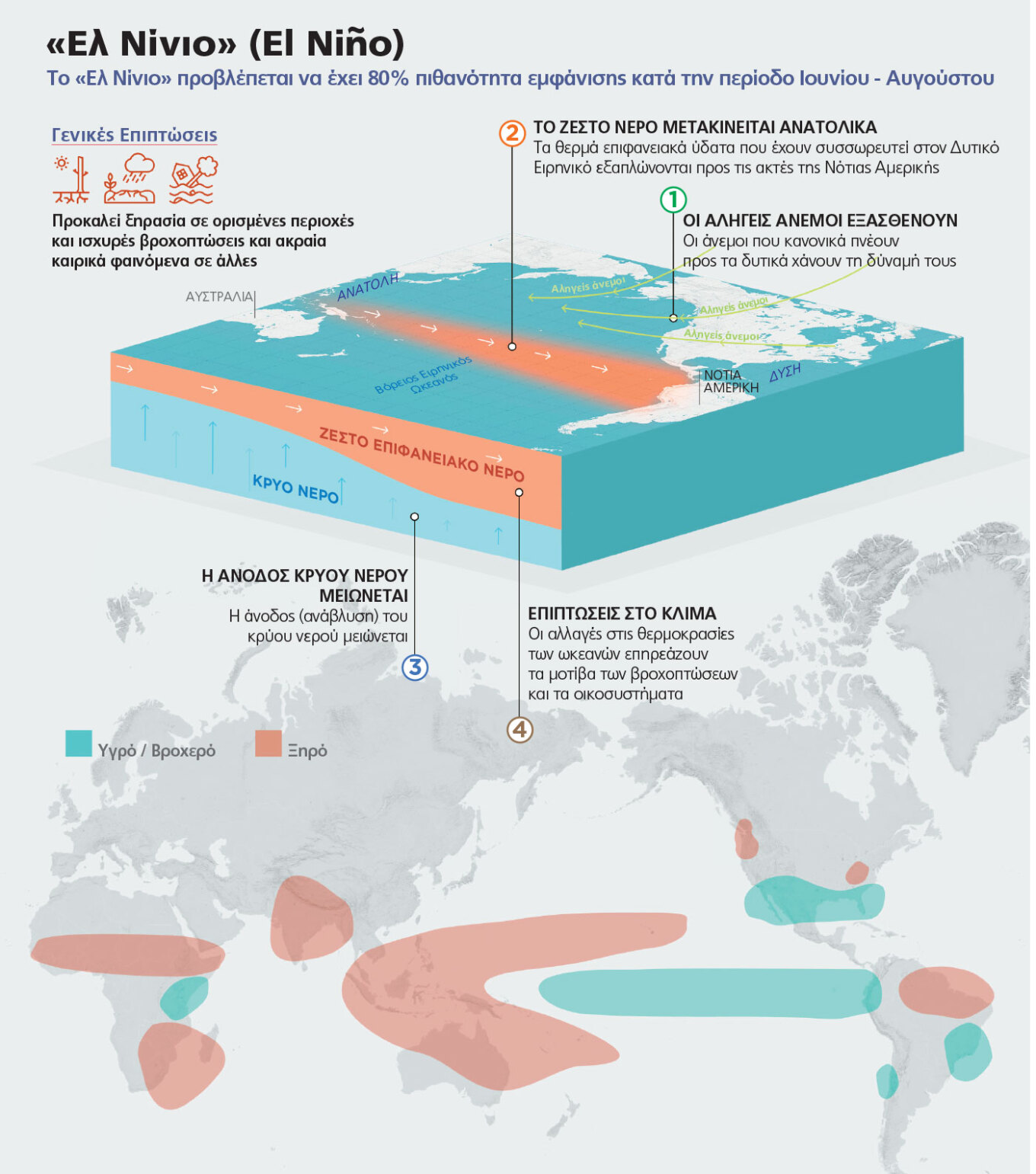
Source: NOAA, WMO / June 18, 2026
Red Alert
Last Tuesday was officially the hottest day ever recorded in France, surpassing the previous record set during the devastating August 2003 heatwave that claimed approximately 15,000 lives.
With the average temperature across 30 meteorological stations reaching 29.8°C, and highs climbing to 42°C in cities such as Paris, health authorities issued a red alert. French Health Minister Stéphanie Rist warned that the heatwave poses a threat to everyone, stressing that “even young people are suffering heart attacks.”
🥵 Europe is facing the most hellish heatwave ever recorded
— NEXTA (@nexta_tv) June 26, 2026
According to Reuters, citing scientists, the current heatwave is the most extreme in Europe’s recorded history.
EU countries have put health services on high alert. In France, at least 55 heat-related deaths have been… https://t.co/Y9eeCBLMxC pic.twitter.com/2N7dl1oAVw
Following the hottest daytime temperatures on record, Météo-France also recorded the country’s warmest night ever, with overnight temperatures averaging above 22°C nationwide and remaining at 27.2°C in Nantes.
Three nuclear power plants were shut down due to extreme heat, while teachers across France launched strikes, protesting what they described as “unacceptable working conditions.”
Yet France’s fatalities, widespread power outages and emergency warnings pale in comparison to what Germany is experiencing. Temperatures remaining above 40°C for prolonged periods have transformed the country into what many describe as a boiling cauldron.
Nights Without Relief
Imagine spending an entire night where temperatures never drop below 26.2°C.
That became reality in Baden-Württemberg on Wednesday, as Germany’s national weather service described the conditions as a “historic heatwave.”
Hamburg’s half marathon was canceled, while Germany’s rail operator offered free ticket cancellations for passengers concerned about traveling in the dangerous heat.
Luxembourg recorded 38.3°C last Wednesday—the country’s highest June temperature ever.
Italy, particularly its northern regions, continues to endure daytime temperatures above 40°C, followed by nights where the mercury barely dips below 29°C, sending residents and tourists alike searching for relief in air-conditioned buildings, beaches and public fountains.
Switzerland and the Czech Republic have also declared red heat alerts, while Vienna is forecast to reach or exceed 40°C over the weekend. Authorities have likewise issued warnings across 12 Dutch provinces, as well as London and northeastern England.
So why has Europe—particularly its northern regions—become the epicenter of this extraordinary heat?
France’s meteorological agency, Météo-France, attributes the extreme temperatures to a heat dome, while meteorologists at Severe Weather Europe agree that an “exceptionally anomalous and powerful heat dome” has settled over Western and Central Europe.
According to their analysis, temperatures are soaring 12°C to 16°C above long-term climate averages as greenhouse gas emissions continue to warm the planet.
Scientists explain that a heat dome forms when a strong high-pressure system develops high in the atmosphere, forcing air downward. As the air descends, it compresses and heats up, dramatically raising temperatures near the surface.
At the same time, the hot air expands, creating a dome-like structure that traps heat beneath it. Although winds typically move high-pressure systems along, the sheer size of this heat dome has made it nearly stationary.
The “Boy”
Many scientists also blame the current—and potentially even more intense upcoming—heatwave on an exceptionally strong El Niño.
The natural climate pattern, whose Spanish name means “the boy,” occurs when sea surface temperatures in the eastern Pacific Ocean become unusually warm.
That warming can raise global temperatures, increasing the likelihood of extreme weather. In this case, El Niño is also driving unusually warm ocean temperatures, with meteorologists warning that this year’s event could become the strongest in decades—a true “Super El Niño.”
Previous El Niño episodes, including the one lasting from May 2023 through March 2024, contributed to record-breaking global temperatures that fueled deadly heatwaves, wildfires and floods worldwide.
But why is Europe, especially Northern Europe, being hit so hard this time?
Scientists say the answer lies largely in climate change.
Europe is warming at twice the global average, with temperatures already approximately 2.5°C above pre-industrial levels.
That helps explain why El Niño’s effects appear stronger across Europe—but not why countries such as France, Britain, Germany and Switzerland, traditionally associated with cooler climates, are suffering the worst impacts.
The Arctic Connection
According to climate experts, the answer lies in geography.
These northern European regions are closest to the Arctic—the fastest-warming area on Earth, where temperatures are increasing up to four times faster than the global average.
This creates a dangerous feedback loop.
As Arctic sea ice melts, less sunlight is reflected back into space. Instead, darker ocean surfaces absorb more solar energy, accelerating warming and causing even more ice to melt.
Ironically, Europe also faces another climate paradox.
The European Union has successfully reduced air pollution through strict environmental regulations, greatly improving public health and air quality.
However, reducing pollution has also reduced the amount of atmospheric haze that previously reflected some incoming sunlight back into space. With fewer particles blocking solar radiation, more heat now reaches Earth’s surface, contributing further to warming.
Greece
Satellite imagery from Copernicus and weather agencies across Europe reveals something remarkable.
The heatwave appears to be “skirting” Greece, despite Athens being Europe’s second-hottest capital after Valletta, Malta.
Instead, the most intense heat has spread across much of the rest of the continent.
Meteorologists explain that Greece currently lies on the edge of the high-pressure system responsible for Europe’s heat dome, sparing the country from the most extreme temperatures—for now.
Other scientists argue that the unusual positioning of the heat dome is also linked to Arctic ice loss, which has shifted atmospheric circulation patterns further north.
But that does not mean Greece has escaped.
As a Mediterranean coastal nation, Greece remains highly vulnerable to the developing Super El Niño.
Warmer ocean currents are already heating the Mediterranean Sea, creating conditions favorable for prolonged heatwaves and other abnormal climate events.
This helps explain why Greece and Cyprus—followed by Romania, Bulgaria and Italy—have experienced some of Europe’s deadliest individual heatwaves in recent years.
During a single week last July (July 21–27), temperatures reached 6°C above seasonal averages, with approximately 950 heat-related deaths, equivalent to roughly 11 deaths per day per one million inhabitants.
According to the European Union’s Copernicus Climate Change Service (C3S), 2025 ranked as the third-hottest year ever recorded globally and across Europe.
The three hottest years on record worldwide are now 2024, 2023 and 2025, respectively.
Last year, temperatures exceeded 40°C in dozens of countries, triggering droughts, fueling devastating wildfires and contributing to thousands of deaths.
Researchers from Imperial College London and the London School of Hygiene & Tropical Medicine, who analyzed data from 854 European cities, concluded that climate change was responsible for 68% of the estimated 24,400 heat-related deaths last summer by increasing temperatures by as much as 3.6°C.
The Wildfire Nightmare
“Very difficult days lie ahead, with an extremely high wildfire risk.”
That was the warning issued recently by Greece’s Minister for Climate Crisis and Civil Protection, Evangelos Tournas, who stressed the need for constant vigilance.
Greece faces a dangerous combination of:
- Prolonged high temperatures
- Abundant vegetation following heavy winter rainfall
- Strong seasonal winds (meltemi)
Together, these conditions significantly increase the risk of catastrophic wildfires.
Across the Mediterranean—and increasingly around the world—authorities warn that climate change has ushered in a new era of megafires.
These massive wildfires spread with astonishing speed, consuming up to 25 acres (around 10 hectares) per minute, while generating their own weather systems that further fuel their growth.
As Colombian wildfire expert María Meza explains, fires now burn at higher temperatures and produce taller flames, making them far more difficult to extinguish—even from the air.
“The issue isn’t that we’re seeing more fires,” she says. “It’s that the fires we do see are becoming much more intense.”
That is why even the world’s best-equipped firefighting services—including Greece’s, with its extensive fleet of aircraft, drones, modern vehicles, thousands of firefighters and elite forest commandos—continue to face enormous challenges every summer.
Wildfires that local communities once managed with basic tools can now overwhelm fleets of firefighting aircraft dropping coordinated loads of water and fire retardant.
They are a defining feature of a warming world—and as Super El Niño makes conditions even hotter and drier, scientists warn that the greatest challenges may still lie ahead.
Trouble Beneath the Sea
Ironically, even the sea—the place where many people seek relief from the summer heat—may offer new dangers under Super El Niño.
The Mediterranean is one of the fastest-warming marine environments on Earth, heating approximately 20% faster than the global average.
Climate scientist Hatim Aznague summarizes the situation succinctly:
“The Mediterranean is showing us what a warmer world looks like.”
One of the most alarming emerging threats is Vibrio, a family of naturally occurring bacteria found in warm, brackish coastal waters.
Most Vibrio species are harmless.
However, Vibrio vulnificus, sometimes referred to as the “flesh-eating bacteria,” can cause severe—and in rare cases fatal—infections, particularly in people with open wounds or weakened immune systems.
And scientists warn that this may only be the beginning.
Ask me anything
Explore related questions




