





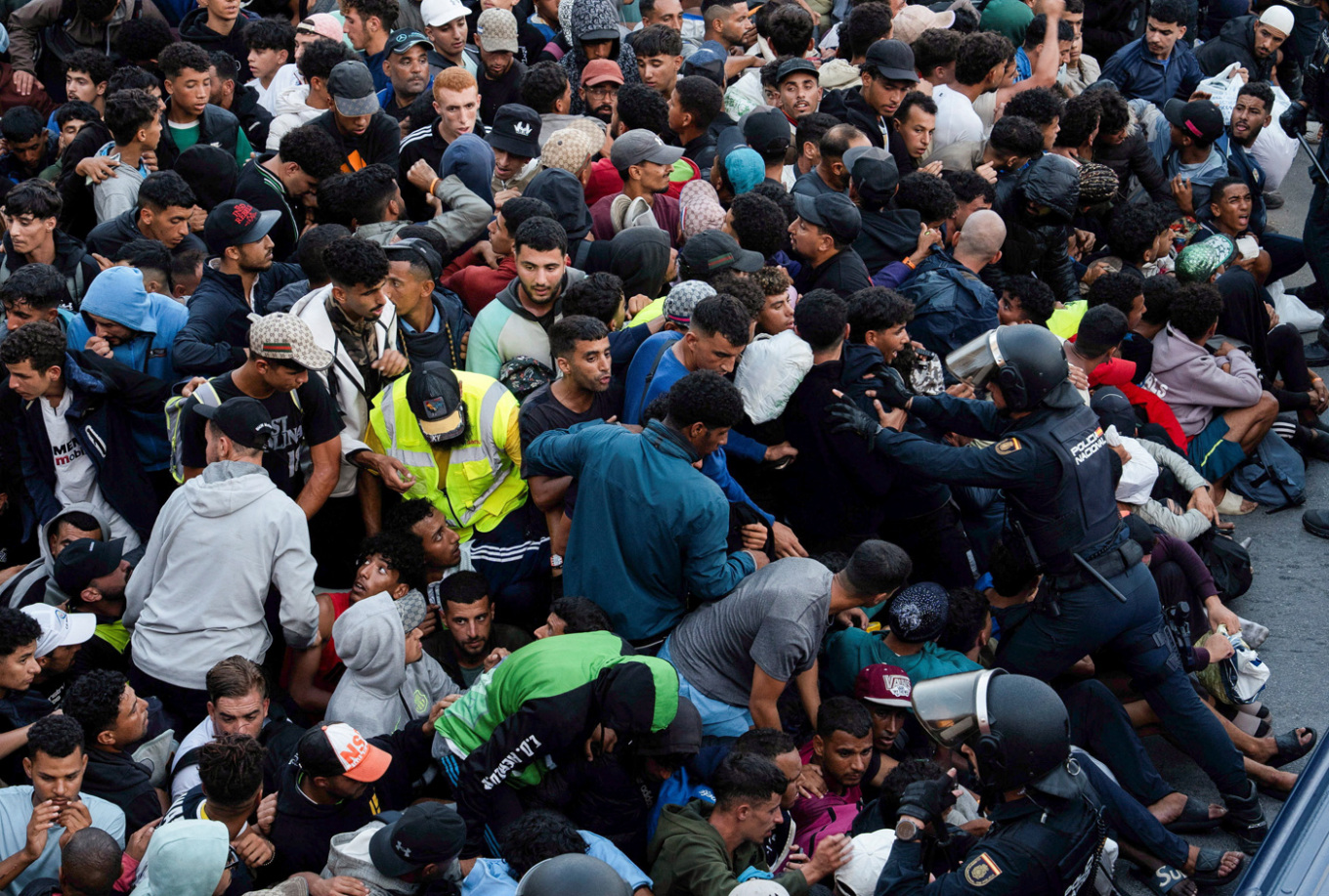
Spanish authorities began relocating people who had been living on the beaches for weeks. Around 13,000 migrants remain in the Spanish enclave.
Tense scenes played out on the streets of Ceuta on Friday as thousands of migrants began moving en masse towards the new accommodation site set up near the port. Spanish authorities had launched an operation to relocate those still living in makeshift conditions on the beaches, but a large number of people rushed towards the new camp in an attempt to secure a place.
The operation began at around 6.30am local time, with police rounding up the migrants, according to a Spanish government source in Ceuta.
During the process, however, crowding and chaos ensued, as many of those who had spent weeks on the beaches tried to reach the new site.
Spanish authorities say the camp has tents for around 1,700 people, with beds installed and shower facilities available.
Videos filmed during the operation show large crowds running through the streets, with many shouting and cheering as they head towards the accommodation site.
According to local media, the National Police and riot units had to step in to bring the situation under control, and there are also reports of tear gas being used.
The Spanish government decided to go ahead with the relocation despite objections from local authorities.
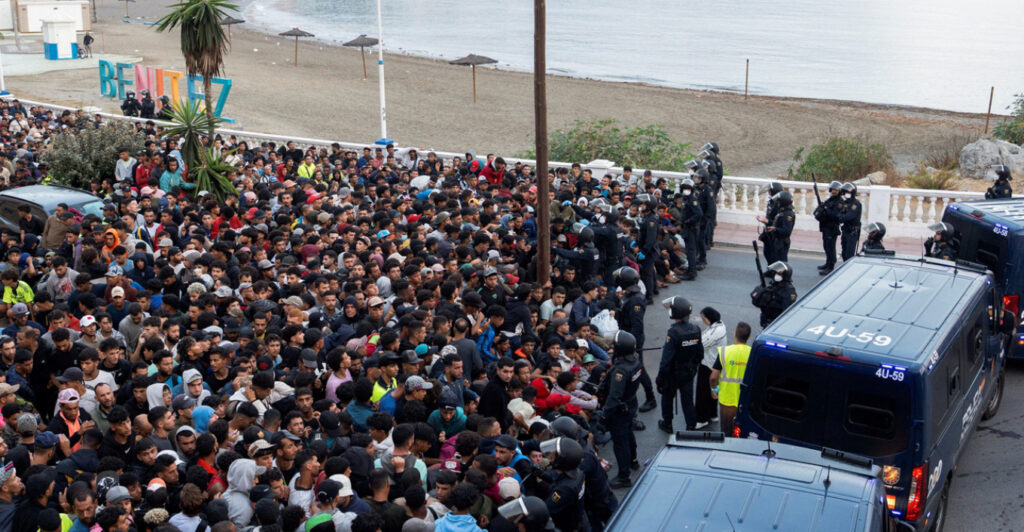
Around 13,000 people still in Ceuta
The situation in the Spanish enclave in North Africa began to deteriorate in late July, when tens of thousands of migrants crossed into Ceuta from Morocco.
Most went back, but according to local authorities around 13,000 people remained in the area. Many were forced to stay in improvised sites and on the beaches.
Spanish Prime Minister Pedro Sánchez has faced fierce criticism over his government’s handling of the crisis. He rejects the accusation that the situation was mishandled, arguing that the relevant services were faced with a number of arrivals they could not cope with.
In a television appearance on 14 September, Sánchez admitted that the authorities had been overwhelmed by the number of migrants arriving in Ceuta. He also said the government’s aim is to have the situation under control by the end of the year, and asked for patience from the city’s roughly 84,000 residents.
Questions have also arisen over whether, and to what extent, the Spanish government had been informed in advance of the mass arrivals.
🚩 Así ha sido la avalancha durante el traslado de miles de inmigrantes al nuevo asentamiento del puerto
— El Faro de Ceuta (@ElFarodeCeuta) September 18, 2026
📍 Tienes toda la información en El Faro de Ceuta a través de nuestro enlace en bio#Ceuta #Inmigracion #FronteraSur #Marruecos #Traslado #Asentamiento pic.twitter.com/PeynHBGeci
Initially, Spanish authorities said there had been no warning. On 25 August, the Government Delegation in Ceuta stated that it had no information about what was due to happen on 30 July.
Later, however, the government made public 40 communications that had until then been classified. These showed that Spain’s National Intelligence Centre (CNI) had warned on 29 July of organised attempts to enter Ceuta by both land and sea.
One of them referred to a call on social media for a mass attempt to cross the following night, while the CNI had also passed the information to Moroccan intelligence services, according to the Daily Mail.
Sánchez, however, rejected the interpretation that these messages amounted to an official warning about the scale of what followed.
“WhatsApp messages are not proof that there was a warning, quite the opposite,” he said.
La Policía Nacional intenta ordenar el traslado de los asentados en playa Benítez y alrededores al puerto ante el afán de los inmigrantes por estar entre los primeros que lograrán plaza pic.twitter.com/Nwn1z26OdR
— Radio Televisión Ceuta (@RTVCE) September 18, 2026
Concerns over safety and health conditions
Meanwhile, according to the British newspaper’s report, Ceuta residents are voicing concerns about safety, with reports of daily incidents of violence, attacks on soldiers and dozens of sexual assaults.
Ceuta’s public prosecutor, Silvia Rojas, has spoken of an “exponential increase” in crime, citing among other things sexual assaults, including cases involving underage victims.
Public safety experts who spoke to the Spanish newspaper El Mundo have also warned of the risk of further escalation.
Health conditions in the makeshift camps are also described as difficult. A Moroccan teenager tested positive for mpox this week and was placed in isolation, where he is receiving treatment. In addition, at least five cases of tuberculosis have been reported among the migrants.
18/09/2026.
— Muy.Mona/🇪🇸💚 (@Capitana_espana) September 18, 2026
Así amanece Ceuta. 📍 pic.twitter.com/2ulbIoeEMA
The President of Ceuta, Juan Jesús Vivas, has called for more support from the European Union, likening the situation in the area to a “pressure cooker” that could explode at any moment.
“The city is completely different from what it was before this event. The people of Ceuta have lost their joy and their way of life has been completely shaken,” he told MEPs.
Ask me anything
Explore related questions




