





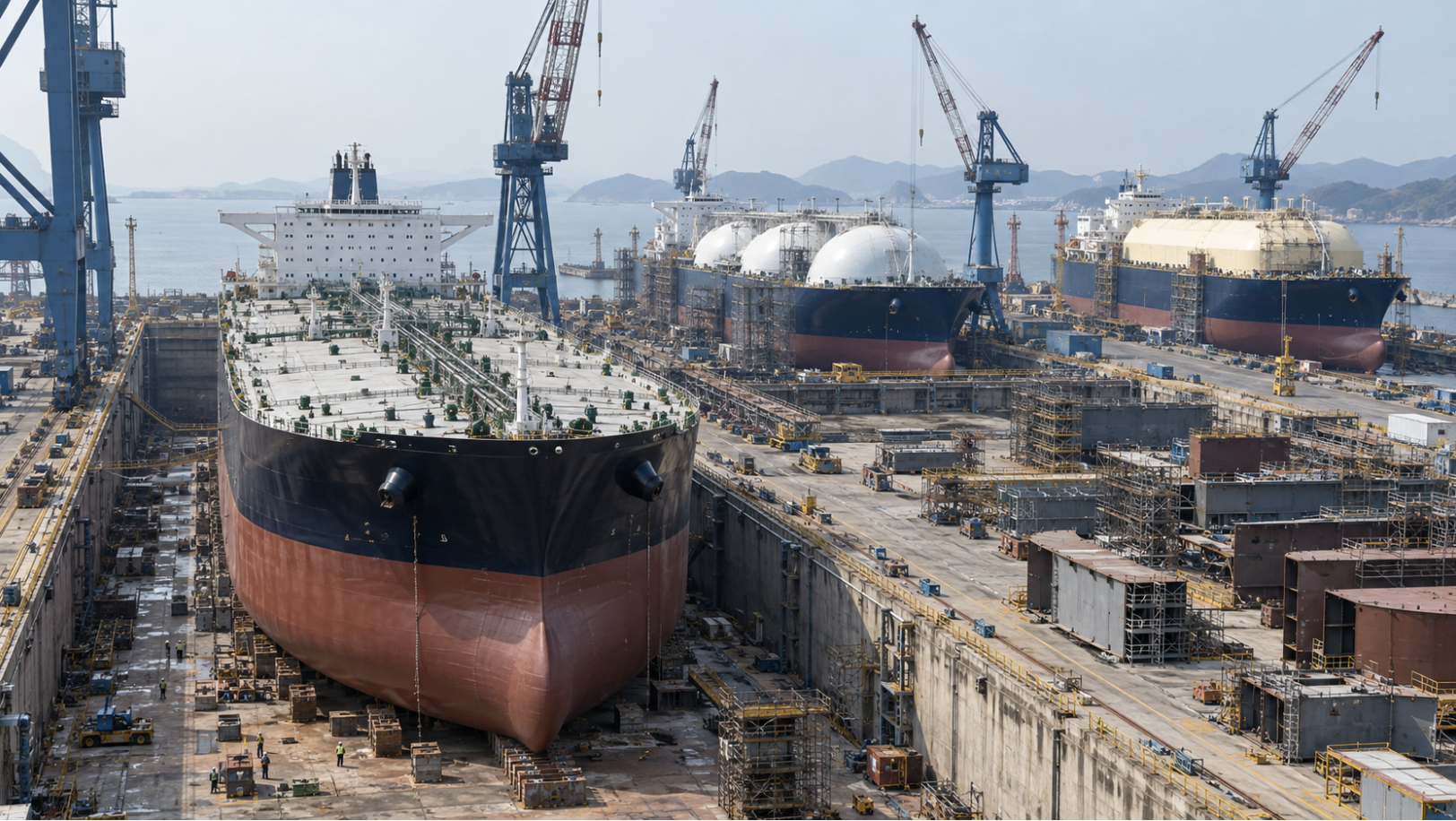
A strong Greek presence is being recorded in the international shipbuilding market, with Greek shipowners simultaneously placing orders for conventional tankers, LNG carriers and ammonia carriers.
According to the weekly Weekly Market Intelligence report by Weber Seas (Hellas), Greek interests are linked to new orders for a total of 14 vessels, scheduled for delivery in 2028 and 2029.
The package includes two 306,000-dwt VLCCs, one 157,000-dwt Suezmax and one 73,000-dwt LR1, as well as four large LNG carriers, each with a capacity of 200,000 cubic meters. The list also includes six VLAC ammonia carriers, each with a capacity of 93,000 cubic meters.
The two VLCCs and six VLACs have been ordered at China’s Hengli shipyard, while the Suezmax and LR1 will be built at New Times. The four LNG carriers were contracted at South Korea’s Samsung Heavy Industries, at a reported price of $263 million per vessel. This investment alone brings the total bill to more than $1.05 billion.
The new Greek investments come at a time when the large-tanker market has entered uncharted territory. Weber Seas notes that VLCC earnings in the spot market from the Arabian Gulf have surged, with rates on the Middle East–China route exceeding $1 million per day for the first time.
The extreme increase is attributed to severe disruptions around the Strait of Hormuz, which have reduced tanker availability, disrupted normal trade flows and increased delays and operational disruptions.
The exceptionally strong market is also reflected in time-charter rates. According to Weber Seas, a U.S.-listed company with a fleet consisting exclusively of VLCCs, fixed the 2016-built DHT Panther for three years at $100,000 per day. The charter is expected to begin in October 2026, with an international energy group as the counterparty.
Advertisement
Rally in Vessel Values
The surge in freight rates has also driven up second-hand tanker prices. A five-year-old VLCC is valued at an estimated $161 million, up 53.3% compared with the five-year average. A 10-year-old VLCC is valued at $136 million, 74.4% higher, while the price of a 15-year-old vessel has reached $107 million, almost double the five-year average.
Similarly, a five-year-old Suezmax is valued at $110 million, while a 10-year-old vessel is valued at $90 million. Weber Seas is recording particularly strong demand for VLCCs aged 15 years and older, with Middle Eastern buyers emerging as especially active.
Advertisement
The strength of the market was also reflected in the latest sales transactions. The 2003-built Xi Xiu, a 299,000-dwt VLCC, is reported to have been sold for $60 million to a buyer based in the United Arab Emirates. The 2000-built Dennie also changed hands for $40 million, with a buyer from the same region.
Orderbook Continues to Grow
Behind the optimism, however, a medium-term risk of additional supply is also emerging. The VLCC orderbook has reached 34.5% of the existing fleet in terms of capacity, while for Suezmaxes it stands at 30%. For Aframaxes, it remains significantly lower, at 10%.
A similar trend is being recorded in product tankers, where the LR2 orderbook corresponds to 35% of the fleet. For MRs, it stands at 18.9%, for LR1s at 16%, and for smaller Handy tankers at 5.1%.
The market is sending a dual message: geopolitical disruptions are generating historically high earnings today and boosting vessel values, while at the same time continued ordering is increasing future supply. Greek shipowners are seeking to capitalize on the current cycle, positioning themselves both in the traditional tanker market and in the emerging energy sectors of LNG and ammonia.
Ask me anything
Explore related questions




