





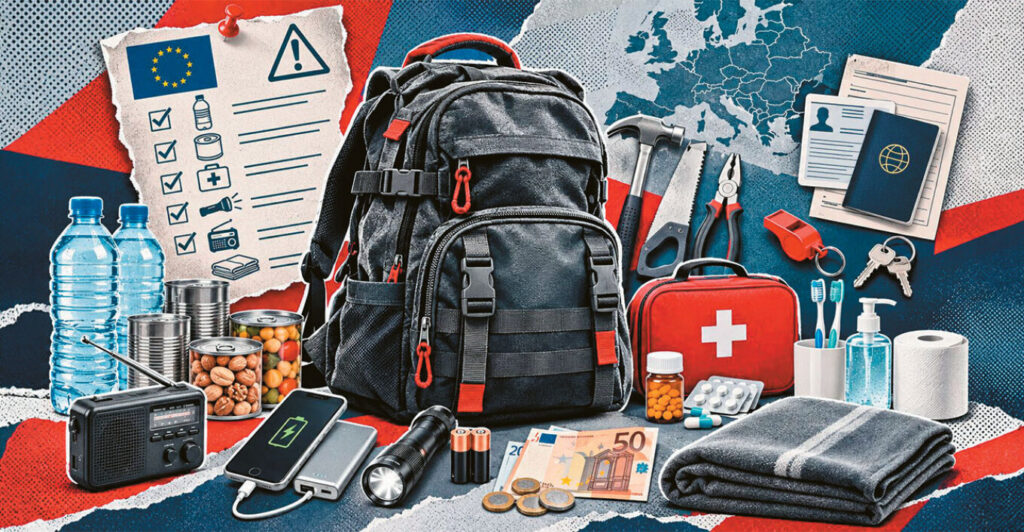
Europe has been gripped by debate over the 72-hour survival kit since last Tuesday. The European Commission is now formally encouraging citizens across the European Union to prepare for emergencies by storing essential supplies that would allow them to cope without immediate government assistance for at least three days.
The message, delivered in Brussels by Hadja Lahbib, the European Commissioner for Equality, Preparedness and Crisis Management, has generated widespread discussion and concern across European countries, including Greece.
Addressing the European Civil Protection Forum, attended by 1,900 participants from 80 countries, Lahbib emphasised the importance of individual preparedness.
“When disaster strikes, the first hours can make all the difference. Every European should know what to do, how to protect their family and how to help others. Preparedness starts in our homes, schools and communities. That is why we are giving people practical tools to prepare for crises,” she said.
The message was unmistakable: start preparing.
Despite the public reaction, there have been no significant official political responses. Governments have largely remained silent, although many are already following the approach advocated by Brussels.
Public anxiety, however, continues to grow, accompanied by a series of questions. What threats are serious enough to prompt the European Commission to encourage emergency preparations? What exactly are Europeans being asked to prepare for?
War, cyberattacks and disasters: What is Brussels anticipating?
According to Brussels, the potential emergencies include war, large-scale cyberattacks against essential infrastructure, another public health crisis comparable to COVID-19, major natural disasters and asymmetric hybrid threats.
But uncertainty remains over who might be responsible for such threats, why they could materialise and when.
An even more unsettling question has entered public debate: could European authorities possess information about an impending threat that has not been disclosed to the public?
These concerns have become topics of conversation in homes, workplaces and social gatherings. For many, the survival kit announcement has brought the prospect of a serious crisis into everyday life.
Some people are wondering whether they should immediately purchase emergency supplies, while others are considering stockpiling additional food and water. Many have already searched for detailed guidance on what a survival kit should contain.
Anxiety has also been heightened by references to preparations already under way in northern Europe.
During her presentation, Lahbib held up a 32-page Swedish government booklet entitled “In Case of Crisis or War”, a document that predates the latest European Commission initiative.
The commissioner also appeared in a light-hearted promotional video demonstrating the contents of an emergency bag, although the presentation prompted mixed reactions because of its informal tone.
Meanwhile, recent developments have intensified the wider atmosphere of uncertainty.
At around the time of Lahbib’s speech, hackers were reportedly expanding cyberattacks targeting commercial refrigeration systems across Europe, raising concerns about the security of food supply chains.
Further disruption followed on Thursday when bomb threats affected European flights. Although the threats ultimately proved false, they disrupted air transport and reportedly affected 27 flights. Russian extremists were also reported to have claimed responsibility.
These incidents have contributed to a broader question occupying European public debate: what might happen next?
🚨 BREAKING: 🇪🇺 The EU officially joins the 72-hour emergency preparedness push. Issuing new guidelines urging citizens to keep essential supplies ready for at least 3 days.👇 💧 Water 🥫 Non-perishable food 💊 Essential medicines 🔦 Flashlight + batteries 📻 Radio 💵 Cash 📄 Important documents 🎒 Emergency bag + family plan
— Bitinning (@bitinning) November 4, 2026
The origins of the EU’s preparedness strategy
This is not the first time the European Commission has urged citizens to prepare for major emergencies.
The original initiative was announced on 26 March 2025, when Brussels presented its EU Preparedness Union Strategy, following a report by former Finnish president Sauli Niinistö.
At that time, European households were officially encouraged to maintain sufficient supplies to remain self-sufficient for 72 hours in the event of a natural disaster, cyberattack or geopolitical emergency.
The announcement drew criticism from Hungary’s then prime minister, Viktor Orbán, who questioned what Brussels was planning and dismissed the proposal as ridiculous during an interview with Hungarian national radio.
The latest intervention, delivered last Tuesday, reiterated and expanded the Commission’s approach.
Lahbib outlined four priorities: ensuring that households can remain self-sufficient for 72 hours, incorporating preparedness education into schools, developing appropriate arrangements for people with disabilities and improving the exchange of reliable information between authorities and citizens.
The choice of 72 hours is not arbitrary. According to emergency management specialists, three days is generally considered a crucial period during which civil protection authorities may need to restore communications, reach affected households and organise comprehensive assistance following a major disaster.
🇪🇺 European Union urges all citizens to prepare emergency survival kits with enough supplies to last 72 hours. https://t.co/D4lwvOdzSK
— The Market Journal (@MarketJournalX) November 4, 2026
What threats is the European Union preparing for?
The European Commission identifies a broad spectrum of potential dangers.
These include natural disasters such as floods, wildfires, earthquakes and extreme weather events intensified by climate change.
They also encompass human-caused emergencies, including industrial accidents, technological failures and pandemics.
Another major category concerns hybrid threats, including cyberattacks, disinformation campaigns, foreign information manipulation and interference, and sabotage targeting critical infrastructure.
Geopolitical crises are also explicitly included, with the possibility of armed conflict or even an attack against an EU member state forming part of the preparedness framework.
🚨 BREAKING ALERT: EUROPE JUST MADE IT OFFICIAL. The European Commission just published new guidelines. They call on people to keep supplies to last at least 72 HOURS on their own, and to pack an emergency bag. 23 European countries ALREADY told their people to stock up: 🇦🇹 AUSTRIA: 14 DAYS 🇩🇪 GERMANY: 10 DAYS 🇸🇪 SWEDEN: 1 WEEK 🇳🇴 NORWAY: 1 WEEK 🇨🇭 SWITZERLAND: 1 WEEK 🇪🇪 ESTONIA: 1 WEEK 🇬🇧 UK: 3 DAYS 🇩🇰 DENMARK: 3 DAYS 🇵🇱 POLAND: 3 DAYS 🇬🇷 GREECE: 3 DAYS 🇨🇾 CYPRUS: 3 DAYS 🇮🇸 ICELAND: 3 DAYS 🇫🇷 FRANCE: 72 HOURS 🇳🇱 NETHERLANDS: 72 HOURS 🇧🇪 BELGIUM: 72 HOURS 🇱🇺 LUXEMBOURG: 72 HOURS 🇫🇮 FINLAND: 72 HOURS 🇨🇿 CZECHIA: 72 HOURS 🇱🇻 LATVIA: 72 HOURS 🇱🇹 LITHUANIA: 72 HOURS 🇧🇬 BULGARIA: 72 HOURS 🇭🇷 CROATIA: 2 DAYS 🇮🇪 IRELAND: EMERGENCY KIT Now the EU says it too, in OFFICIAL guidelines. The reasons these countries give: WAR. CYBERATTACKS. Extreme weather. Covid came with NO warning. This time the warning comes FIRST. 72 hours is only the MINIMUM. Germany says 10 days. Austria says 14. Don’t stop at 3 days. PREPARE for at least 10. WHAT TO STOCK: 💧 Water 🥫 Food that won’t spoil 💊 Medicines 🔦 Flashlight + batteries 📻 Radio 💵 Cash 📄 Important documents 📋 A family emergency plan Emergency numbers: 112 (EU) / 999 (UK) / 911 (US) Go out NOW and do it. Most outlets will run this once and move on. I’ll post every new country that adds a warning, so follow me.
— Taegun Lee (@TGLetter) November 3, 2026
The central principle of the European strategy is that modern crises are interconnected.
A serious disruption to the energy sector, for example, could trigger cascading consequences for healthcare, transport, telecommunications and the wider economy.
Consequently, the Commission aims to strengthen strategic reserves of essential goods and medical equipment while improving coordination between member states.
The wider objective is to ensure that critical services, including electricity, water supplies, transport networks and internet connectivity, can continue operating during emergencies.
The European Union is urging citizens to prepare emergency survival kits with enough supplies to last at least 72 hours. The guidance recommends keeping essentials like food, water, medication, batteries and other necessities ready in case of a major crisis or disruption. https://t.co/eFSq1ANicu
— Resist the Mainstream (@ResisttheMS) November 3, 2026
Five scenarios causing concern
Although the Commission’s announcements and preparedness strategy identify broad categories of risk, they offer limited detail about specific threats.
This lack of precision has created fertile ground for speculation.
When authorities do not identify exactly where a danger might emerge, when it could materialise or who might be responsible, uncertainty can generate competing interpretations and possible scenarios.
1. Russia and the possibility of military escalation
The first scenario concerns Russia, which is widely regarded as the principal conventional military threat to European security.
Moscow’s increasingly confrontational rhetoric and unconventional activities, including drone incursions into European airspace, have intensified concerns.
The central question is whether European governments possess additional intelligence suggesting that Russia may be preparing a more serious escalation.
Speculation also extends to the possibility of a nuclear strike in Ukraine, although the existence of any specific plans or intelligence supporting such a scenario has not been established.
2. A large-scale cyberattack
The second scenario involves increasingly sophisticated cyberattacks against national and cross-border infrastructure.
These could target individual countries or multiple EU member states simultaneously, potentially affecting electricity grids, fuel supplies, water distribution, telecommunications, banks, transport networks and supply chains.
Although previous cyber incidents have caused serious disruption, the consequences have generally been contained.
However, the growing frequency and scope of attacks, combined with the increasing use of artificial intelligence, are changing the cybersecurity landscape.
A simultaneous failure of multiple essential systems across European countries could produce unpredictable consequences.
The European Union Agency for Cybersecurity, ENISA, has warned in its annual reporting that growing digital dependencies have significantly expanded the potential attack surface.
Public administration, accounting for 32% in the figures cited, is among the principal targets, alongside transport, energy and supply chain infrastructure.
Cybersecurity company Integrity360 has also highlighted the growing sophistication of software supply chain attacks, particularly those associated with geopolitical tensions and state-backed hacking groups.
Rafe Pilling, an analyst at Sophos, told The Guardian that recent attacks involving refrigeration infrastructure could represent a demonstration of the capabilities of a state-linked actor.
The UK’s National Cyber Security Centre has also warned that, by 2028, China, Russia and other countries are likely to be routinely using artificial intelligence in cyberspace to advance geopolitical objectives.
3. Sabotage, hybrid threats and terrorism
A third scenario concerns hybrid operations, particularly sabotage involving energy installations, transport infrastructure and other critical facilities.
Terrorist attacks are another potential concern.
Security agencies across Europe remain alert to such threats, although the precise intelligence available to national authorities is not publicly known.
The combination of geopolitical tensions, emerging technologies and vulnerabilities within essential infrastructure has created a complex security environment.
4. Major natural disasters
The fourth scenario concerns severe natural disasters.
As Europe experiences the consequences of climate change, governments are increasingly focused on prevention, resilience and emergency preparedness.
Earthquakes, catastrophic flooding and large wildfires can have devastating consequences, even though the timing and scale of individual events cannot be reliably predicted far in advance.
Ensuring that citizens can meet their basic needs during the initial stages of such disasters is therefore a central component of emergency planning.
5. A new public health emergency
The fifth scenario involves a possible future pandemic or major public health crisis.
The experience of COVID-19 exposed weaknesses in health systems, supply chains and emergency coordination.
Developments in artificial intelligence-assisted biological research have also attracted attention, including announcements by start-ups concerning the laboratory development of bacteriophages, viruses that infect bacteria.
However, these developments do not in themselves establish the existence of an impending pandemic threat.
Uncertainty surrounding research programmes in countries such as China has nevertheless contributed to wider public concerns about biological risks.
Guidelines rather than legally binding obligations
An important distinction has been overlooked in some reporting on the Commission’s initiative.
Although the preparedness framework has frequently been described as an official recommendation or directive, its legal status is different.
The European Commission has issued a communication entitled “Guidelines on Population Preparedness in the Context of the EU Preparedness Union Strategy”, accompanied by five working documents.
A Commission communication establishes policy direction but does not create the same legal obligations as an EU regulation.
A formal recommendation carries greater institutional weight in discussions with national governments, while a regulation can impose binding requirements.
The preparedness initiative remains within the first category.
Its purpose is to encourage EU member states and countries participating in the relevant European mechanisms to develop measures suited to their national circumstances.
The guidelines are therefore not legally binding.
Instead, they seek to establish a culture of preparedness throughout Europe, helping citizens and communities become better informed, equipped and capable of responding to emergencies.
On a map, the word “frontier” is just a line. For explorers, it’s where new possibilities begin. Today in Brussels, with @wef’s Sheba Crocker, we are launching #InvestFrontier: humanitarians, businesses, investors & philanthropies at one table. https://t.co/8ypbYUOBlq
— Hadja Lahbib (@hadjalahbib) November 6, 2026
Northern European countries are already ahead
Public preparedness is considerably more established in northern and eastern Europe, where the perceived threat from Russia has long shaped national security planning.
Sweden has distributed a comprehensive emergency preparedness booklet advising households to maintain supplies of drinking water, energy-rich food, blankets, alternative heating arrangements and battery-operated radios.
In Norway, citizens have been encouraged to keep enough provisions for one week.
Guidance also addresses medicines and iodine tablets for use in specific nuclear emergency circumstances.
Germany recommends maintaining food and essential supplies for ten days, while also considering how basements, garages and storage spaces could be adapted for use as emergency shelters.
According to the figures cited in the preparedness discussion, 17 European countries have issued comparable guidance.
In Britain, a three-year “Be Ready” public information campaign is intended to improve citizens’ ability to respond to serious incidents, including extreme weather, prolonged power cuts, cyberattacks and hostile state activity.
Similar preparedness recommendations have reportedly been introduced in 33 countries worldwide.
Beyond Europe, these include Israel, Japan, India, Taiwan, the Philippines, Singapore, Brazil, Argentina, Chile, Colombia, Mexico, Canada, South Africa, Australia and New Zealand.
The United States also maintains extensive public preparedness guidance through Ready.gov, a website associated with the Department of Homeland Security.
It encourages Americans to maintain essential supplies sufficient for at least three days.
Helsinki’s underground city: A Cold War legacy
One of the most extensive examples of national emergency preparedness can be found in Finland.
Helsinki’s underground infrastructure is frequently regarded as a model of European civil protection planning.
The network is described as extending across approximately 447 kilometres of tunnels, underground spaces and shelters, reaching depths of up to 90 metres.
More than 500 facilities are designed to accommodate as many as 900,000 people during emergencies.
However, the system is not a recent response to the current geopolitical environment.
Its origins date back to the Cold War, when Finland developed extensive civil defence preparations.
The country maintains underground shelters intended to protect civilians during bombardments and potentially nuclear emergencies.
It also operates a national emergency supply system designed to ensure continued access to critical goods during a crisis.
Many of Helsinki’s underground facilities serve ordinary purposes during peacetime.
They include the Amos Rex underground art museum, a church, shopping centres, department stores and a swimming pool capable of being converted into a nuclear shelter.
How uncertainty fuels conspiracy theories
A lack of clarity about the nature, scale and immediacy of potential threats can quickly turn understandable concern into widespread insecurity.
This is particularly problematic when genuine security risks become intertwined with unsubstantiated claims and conspiracy theories.
The 72-hour survival kit initiative has already become part of several competing narratives circulating online.
Among the most prominent is the so-called Great Reset theory, which claims that governments and powerful economic interests are preparing a deliberately engineered collapse of essential infrastructure.
According to this unsupported narrative, coordinated cyberattacks would cause widespread blackouts affecting electricity, the internet, fuel distribution, food supplies and banking systems.
The resulting disruption would supposedly provide the justification for a planned restructuring of the global economy.
Claims associated with the theory include the cancellation of national debts, the abolition of cash, the compulsory introduction of digital currencies and the destruction or redistribution of private and public wealth.
The enormous size of US national debt, cited in the source material at approximately $43 trillion, has also been incorporated into these claims.
There is no substantiated evidence that the European Commission’s preparedness initiative forms part of such a plan.
One of the figures promoting similar narratives is Mike Adams, the 59-year-old operator of Natural News, based in Austin, Texas.
Adams has a history of promoting conspiracy theories and has also endorsed the European preparedness initiative.
At the same time, his online business, Health Ranger, sells products associated with emergency preparedness, including survival supplies.
Are businesses benefiting from public anxiety?
Another theory suggests that the emergency preparedness campaign is being promoted to increase sales for manufacturers and retailers of long-life food, camping equipment, generators, power banks and other survival products.
According to this narrative, heightened public anxiety would translate into substantial commercial gains.
Although claims of a coordinated commercial strategy remain unsubstantiated, reports indicate that emergency preparedness campaigns can generate measurable increases in demand.
Following the launch of the British “Be Ready” initiative, businesses cited by BBC Newsnight and the Evening Standard reportedly recorded significant rises in sales.
Radio sales increased by 160%, torch sales by 284% and power bank purchases by 106%, according to the figures presented.
The businesses attributed these increases to public responses to the government preparedness campaign.
A third conspiracy narrative alleges that European governments are deliberately maintaining a permanent atmosphere of danger, following the experience of the pandemic and energy crisis.
Its proponents claim that the objective is to make citizens increasingly dependent on official instructions and more willing to accept restrictions on their freedoms.
Again, such allegations are not supported by evidence demonstrating that the EU’s preparedness guidance serves this purpose.
Hadja Lahbib and the “What’s in my bag?” survival video
The European Commissioner responsible for crisis management has also attempted to communicate the preparedness message through social media.
In an earlier video, Hadja Lahbib demonstrated the contents of her personal survival bag, adopting a format reminiscent of Vogue magazine’s popular “What’s in my bag?” series.
The 56-year-old commissioner appeared comfortable in front of the camera, reflecting her previous career as a journalist and television news presenter in Belgium before entering politics and eventually becoming the country’s foreign minister.
With a relaxed manner and occasional humour, she introduced the basic items citizens might need during the first 72 hours of an emergency.
Opening her bag, she described it as a “survival edition”.
She began by displaying her glasses and personal documents, which she recommended keeping in a waterproof pouch.
Next came a torch, which she switched on, followed by a large box of matches and a lighter.
She then produced a bottle of drinking water and a Swiss Army knife, which she described as an important companion.
Food supplies followed, including rice cakes and tinned products.
The commissioner then turned to the importance of keeping cash readily available.
“And of course, some cash. In the middle of a crisis, cash is king. And your credit card might just be a piece of plastic,” she said.
Her remarks highlighted the possibility that electronic payment systems could become unavailable during a major disruption.
She finished by presenting a mobile phone charger, a power bank and a pack of playing cards for entertainment.
“These are the things every citizen needs to survive the first 72 hours of a crisis. Be prepared, stay safe,” she concluded.
The approximately 90-second video has been reproduced by numerous websites and social media accounts across the EU’s 27 member states, bringing the preparedness message to a broad audience.
What should a 72-hour emergency kit contain?
The precise contents of an emergency survival kit are determined by individual countries.
The basic principle is that households should possess enough essential supplies to remain self-sufficient for at least 72 hours if access to everyday services and provisions is interrupted.
On 12 October, the European Commission’s civil protection service published an example based on the emergency kit recommended in the Netherlands.
The suggested contents include:
- Drinking water: Three litres per person per day.
- Non-perishable food: Nuts, dried or prepared fruit and tinned vegetables.
- Battery-powered radio: To receive important information if electricity or internet access is disrupted.
- Mobile phone and charged power bank: To maintain communications wherever networks remain operational.
- Torches and spare batteries: Along with candles and matches.
- First-aid kit: Including instructions for its use.
- Blankets: To maintain warmth if heating systems are unavailable.
- Whistle: To attract the attention of rescuers.
- Cash: The Dutch example recommends €70 per adult and €30 per child, in banknotes and coins.
- Basic tools: Such as a hammer, saw and pliers.
- Personal hygiene products: Disinfectant, toilet paper, wet wipes, sanitary products, toothpaste and toothbrushes.
- Important documents: Copies of identity cards, driving licences and passports, together with a list of essential telephone numbers.
- Spare keys: For the home and car.
- Personal necessities: Prescription medication, spare prescription glasses, baby food and food and water for pets.
The emergency kit should be stored somewhere easily accessible.
A durable bag or rucksack should also be kept nearby so that essential supplies can be taken quickly if an immediate evacuation becomes necessary.
The underlying message from Brussels is that preparedness should become part of everyday life rather than something considered only after disaster strikes.
Whether the initiative succeeds in building public resilience or continues to fuel anxiety will depend partly on how clearly European institutions and national governments explain the threats they are preparing citizens to face.
Ask me anything
Explore related questions




