

×
GreekEnglish

×
  • Politics
  • Diaspora
  • World
  • Lifestyle
  • Travel
  • Culture
  • Sports
  • Cooking
Sunday
14
Dec 2025
weather symbol
Athens 11°C
  • Home
  • Politics
  • Economy
  • World
  • Diaspora
  • Lifestyle
  • Travel
  • Culture
  • Sports
  • Mediterranean Cooking
  • Weather
Contact follow Protothema:
Powered by Cloudevo
> Culture

Final resting place of up to 65 British kings revealed as discovery sheds light on King Arthur era

Most of the tombs appear to date from the fifth and sixth centuries, a time when Britain was a patchwork quilt of dozens of small kingdoms

Newsroom March 16 10:00

Archaeologists have discovered what are likely to be the long-lost tombs of up to 65 British Kings and other senior royals from the era associated with the legend of King Arthur.

The discovery is a major breakthrough in archaeologists’ and historians’ understanding of the nature of Dark Age society. As investigations continue, it may also shed crucial new light on the currently often poorly understood political geography of post-Roman Britain.

Prior to the new research, only one final resting place of an indigenous British monarch from that time was known, along with half a dozen other potentially royal graves.

But now, at least 20 probable royal burial complexes (each containing up to five graves) have been tentatively identified – with a further 11 potentially royal burial complexes under consideration.
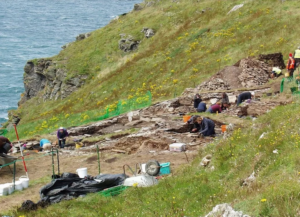
Most of them appear to date from the fifth and sixth centuries – a time when Britain was a patchwork quilt of dozens of small kingdoms.

In what is now the east and south of England, a whole series of these tiny states were ruled by Anglo-Saxon kings of fully or partially Germanic origin.

These mainly or partly continental-originating dynasties had acquired their lands and positions through conquest, marriage or alliances in the decades following the collapse of Roman rule in Britain in around 410 AD.

See Also:

140-year-old rusty batteries offer huge breakthrough for energy storage

But in the west and the north, where initially there was virtually no Anglo-Saxon penetration, the post-Roman royal dynasties that emerged were mainly Celtic ones (i.e., of indigenous British or Irish-originating dynastic origin).

But, until now, virtually nothing was known about where those Dark Age British Celtic monarchs were buried. Although archaeologists had found nine Anglo-Saxon royal graves, only one definite indigenous British royal burial site had ever been identified.

>Related articles

How “Albanian” was Georgios Kastriotis or Skanderbeg, what does the domed tomb at the Hilandar Monastery on Mount Athos hide?

Shooting in Sydney: Gunfire by two unknown individuals at a Jewish celebration on a beach, reports of casualties (videos)

Shooting at Brown University: Ongoing incident, suspect sought

But now new research, by a leading expert on that period, Professor Ken Dark of the University of Reading and Spain’s University of Navarra, has succeeded in tentatively pushing that Dark Age Celtic British royal graves tally dramatically up – to between 55 and 65.

The new discoveries are in Wales, Cornwall, Devon and Somerset. The newly published research suggests that they are royal final resting places because they have very unusual designs that are quite different and clearly much more high status than the thousands of other Dark Age British graves. Indeed some key examples are associated with high status probably royal Celtic locations – and have similarities with Irish royal tombs.

Read more: Independent

Ask me anything

Explore related questions

#archaeology#culture#discovery#England#history#King Arthur#king's#UK#world
> More Culture

Follow en.protothema.gr on Google News and be the first to know all the news

See all the latest News from Greece and the World, the moment they happen, at en.protothema.gr

> Latest Stories

How “Albanian” was Georgios Kastriotis or Skanderbeg, what does the domed tomb at the Hilandar Monastery on Mount Athos hide?

December 14, 2025

See all the farmers’ demands to the government: They do not want OPEKEPE’s control to be transferred to AADE

December 14, 2025

Mitsotakis to farmers: Dialogue cannot take place with ultimatums – Roadblocks undermine your struggle – We are examining a new support package

December 14, 2025

Shooting in Sydney: Gunfire by two unknown individuals at a Jewish celebration on a beach, reports of casualties (videos)

December 14, 2025

Shops are open today, the market is open during festive hours

December 14, 2025

Sunday Sports Broadcasts: Where to watch the tests of the Super League’s Big Four

December 14, 2025

Moments of terror at Brown University after the shootings: Police evacuated students who had hidden

December 14, 2025

The redevelopment of Ellinikon prioritizes the extension of the Metro toward Glyfada – New extensions to follow

December 14, 2025
All News

> Culture

How “Albanian” was Georgios Kastriotis or Skanderbeg, what does the domed tomb at the Hilandar Monastery on Mount Athos hide?

Questions about Georgios Kastriotis: The “Tower of the Albanian” on Mount Athos, the relations of Ioannis Kastriotis, Georgios’s father, with Mount Athos – The arcosolium (domed tomb) at the Hilandar Monastery and who has been buried there

December 14, 2025

9th Ministerial Meeting of the forum of Ancient Civilizations: Athens as the meeting point for Culture Ministers from around the world

December 12, 2025

Emma Stone for Gala magazine: “Life has a sense of humor, even in its darkest moments”

December 12, 2025

Marianna Latsis visits the Apostolic Diakonia of the Church of Greece – Welcomed by Metropolitan Agathangelos of Phanar

December 11, 2025

Italy: The non-profit organisation managing Florence Cathedral is the victim of a €30 million fraud

December 11, 2025
Homepage
PERSONAL DATA PROTECTION POLICY COOKIES POLICY TERM OF USE
Powered by Cloudevo
Copyright © 2025 Πρώτο Θέμα



