





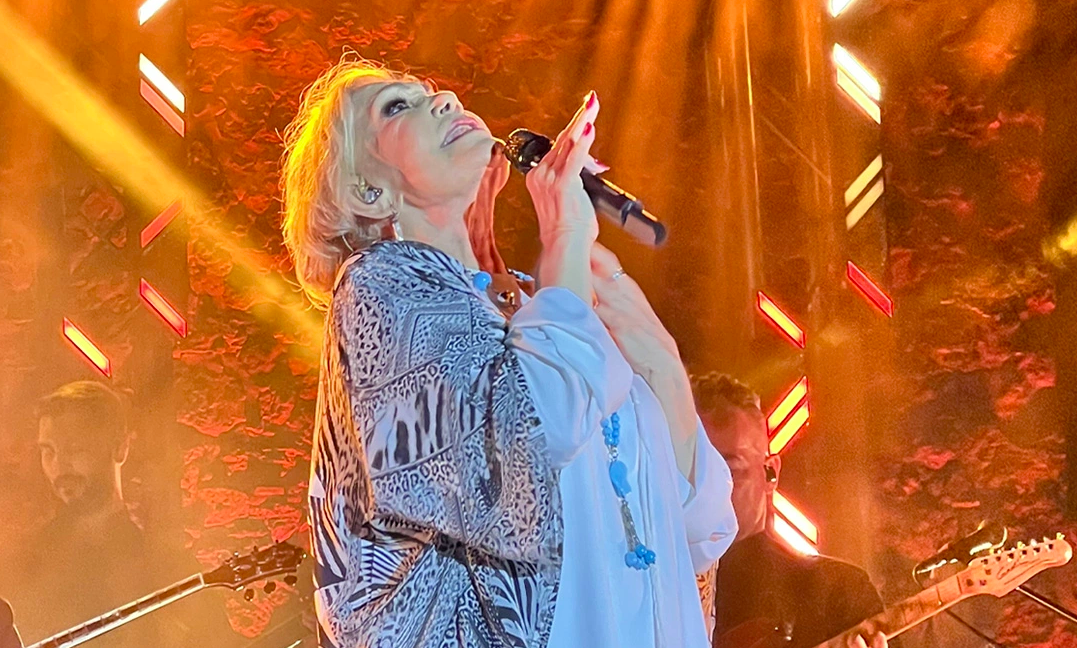
A star is born, not made, and has no age. This realization prevailed in the minds of all of us fortunate enough to attend Marinella’s concert last Saturday evening, in the beautiful courtyard of the Moni Toplou. There, a few kilometers outside Sitia, in a mountainous area, the great lady of Greek song broke the silence and flooded the sacred and historic space with her voice, songs, emotions, and artistic presence, as well as the hearts of her audience who came en masse to enjoy her. For those who had never seen her live, it was a revelation, and for those who had seen her before, it was a huge surprise.
How can one not be amazed when seeing, up close, such a phenomenon, a woman in her ninth decade of life, a great artist with a career of over 65 years, dominating the stage for more than an hour and a half with incredible energy and enthusiasm, performing with a voice almost untouched by time, constantly interacting with her excellent musicians and the audience, stirring and moving them with equal ease.
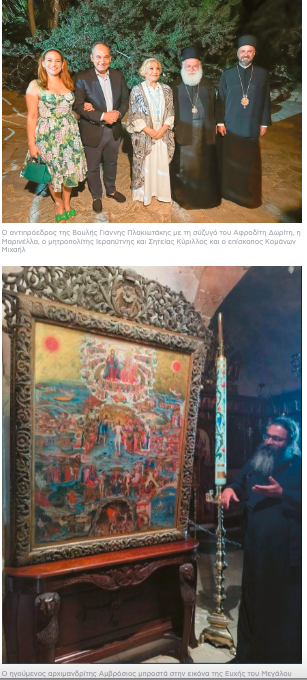
The Vice President of Parliament Yiannis Plakiotakis, along with his wife Aphrodite Doriti, Marinella, the Metropolitan of Ierapytni and Sitia Kyrillos, and the Bishop of Komana Michael.
The abbot Archimandrite Ambrosios is in front of the icon of the Prayer of the Great Blessing, painted in 1770 by Ioannis Kornaros.
Transformation on Stage
It was the same woman who, a little earlier, arrived dizzy from the many turns of the road to Moni Toplou, showing obvious signs of fatigue: “Are the turns over?” I asked. “No,” they told me, “there are a few more.” I said, “Guys, my stomach is turning. By the time we get there, by the time we do a little rehearsal, by the time I sing, I don’t see myself well,” she confessed very descriptively and with a lot of humor to the audience. Yet, metaphysically, the moment she stepped on stage, she transformed at once. Her figure, bright, moved to her position with steady and sure steps, her eyes shone, and the first word came out of her mouth, indicative of her character: “I dare!”
This has been Marinella over time. A gifted artist with a huge voice and an unparalleled stage presence, established as one of the greatest, if not the greatest, stars of Greek song.
It is no coincidence that the most important composers entrusted her with their songs, from Vassilis Tsitsanis, Apostolos Kaldaras, Giorgos Zampetas, Manolis Hiotis, and Akis Panou to Manos Hadjidakis, Mimis Plessas, Giorgos Hatzinasios, Yiannis Spanos, Kostas Hatzis, and Christos Leontis, nor the fact that she collaborated with the greatest voices this land has produced, from Stelios Kazantzidis, Grigoris Bithikotsis, Manolis Aggelopoulos, and Vicky Moscholiou to Stratos Dionysiou, Tolis Voskopoulos, Yiannis Parios, Giorgos Dalaras, and so many others.
Marinella has a unique way of captivating those around her, especially when she is on stage. And this is a unique gift that even the relentless passage of time cannot take away from her, as is evident. Because everything remains intact: the intensity and depth of her voice, her excellent articulation, her unique brio, the magical movements of her hands that when she opens them wide, she seems enormous, almost untouchable. But at the same time, communicative, simple, and approachable… And for this, she feels happy and blessed.
Classics and Jazz
Her joy was even greater as, as she confessed to us, she came to sing in this monastery with its great history, which in recent years has hosted great Greek and foreign artists. Just before starting, she promised the crowd, who had come from all over Crete, a very beautiful evening. She kept her promise and more. She stirred us up with her great dance hits like “And Better”, “Too Bad for Your Height”, “Who is That Tall Guy?”, “Let the Transistor Play”, as well as with her interpretative approaches to old pieces not included in her discography, such as “You Are the Reason I Suffer”, “Laos and Kolonaki”, “Raise the Anchors”, and “Take the Girl”, which she presented in contemporary jazz-swing versions with the help of her very good musicians.
She moved us with her passionate performances of her love songs that made history, like “This Silence Drowns Me”, “Give Me the Immortal Water”, “Love Endures All”, “You and Me”, “I Will Cry Again”, “Open Stone”…
She enchanted us with her performance of Panagiotis Toundas’ song “Lili the Naughty”, which her parents sang to her when she was little, as she revealed, making wonderful vocal turns and performing an impressive karsilamas, while her musician played a solo tambourine. She made us laugh with the teasing of her orchestra’s musicians, “my children” as she calls them, and when she made a humorous reference to her two marriages with Stelios Kazantzidis and Tolis Voskopoulos: “I married two men. I sent them both away. May they be well wherever they are,” she said, laughing slyly and looking towards the sky. “Sometimes I say I should change the sky but there are no roads,” she sang as the lights dimmed, heralding the end of this unique evening. Everyone applauds her standing and shouts “bravo.” And she seems to enjoy it and be moved. Because she confirmed once again that her path will be unique until the end: the one that leads to the stage!
marinella_in__3_
The abbot Archimandrite Ambrosios in front of the icon of the Prayer of the Great Blessing, painted in 1770 by Ioannis Kornaros.
Seven Centuries
Marinella’s concert at Moni Toplou was organized by the Region of Crete with the contribution of Lasithi MP and Vice President of Parliament Yiannis Plakiotakis, who attended. This was the third consecutive musical event hosted in this space after concerts by Placido Domingo and Stavros Xarchakos last year and the year before, all with free admission.
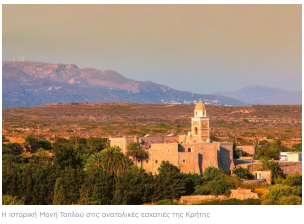
Moni Toplou has stood proudly since the 14th century at the easternmost end of Crete and is one of the island’s most important monasteries, with intense revolutionary and resistance activity, evidenced by its fortified construction. It has faced fierce attacks from aspiring conquerors and was looted, such as in 1821 when the Turks massacred its monks and destroyed many relics.
Its imposing bell tower is 33 meters high, and in its katholikon, there are valuable ecclesiastical and historical relics, rare icons dating from the 15th century onwards, and intricate frescoes. One of the most impressive icons is that of the Prayer of the Great Blessing (Mighty is the Lord), painted in 1770 by the significant painter Ioannis Kornaros.
The soul of Moni Toplou in recent years is the abbot Archimandrite Ambrosios Skarvelis, an extremely intelligent, creative, and hospitable clergyman who immediately wins over visitors and leads its activities, including the production of excellent wines and other products.
Ask me anything
Explore related questions




