





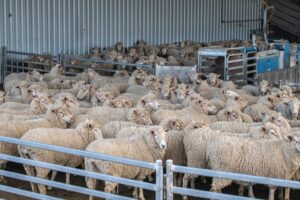
“Sheep and goat pox does not pose a threat to humans,” says Spyros Kritas, Professor of Microbiology and Infectious Diseases at the School of Veterinary Medicine, Aristotle University of Thessaloniki (AUTH), clarifying that humans are not affected by this disease, nor does the virus remain in the dairy products or meat of “infected” animals. “There is no danger to public health,” Mr. Kritas emphasizes, explaining that the receptors (“locks”) present in human cells do not fit the virus’s “keys,” preventing it from infecting people.
Sheep and goat pox is a generalized viral disease characterized by fever, the appearance of papules and vesicles on the skin, and respiratory involvement, often resulting in death either directly or due to bacterial complications. Mr. Kritas notes that the disease is highly contagious, with high morbidity and mortality rates (50-100%). Recovery takes 20-30 days and “leaves strong immunity,” he explains, adding that the virus is endemic in North Africa, the Middle East, Turkey, Central Asia, and parts of China, with “outbreaks” reported in Southern Europe in recent years. In countries where the disease is endemic, vaccinations are administered; however, their use is not permitted in the EU.
As Mr. Kritas points out, implementing vaccinations would result in the immediate official designation of a country as “infected,” leading to the long-term removal of significant PDO agricultural products (e.g., feta cheese) from international markets, which would be replaced by similar competing products from other countries (e.g., cheeses from Canada). “Can you imagine the economic damage?” he asks pointedly, noting that “veterinary authorities are cautious, always considering the cost-benefit ratio for the national economy.”
How is it transmitted, and is there a treatment?
The resilient pox virus is mainly transmitted through direct contact, aerosols containing the virus, or dust from dried scabs and other infected tissues or secretions. It can also spread indirectly via contaminated tools, vehicles, products (waste, animal feed, etc.), or insects (mechanical carriers). It is a notifiable disease due to its high transmissibility and the severe economic losses it causes in livestock.
There is no specific antiviral treatment, and as the professor says, “Handling the disease is very challenging, relying on prevention and mainly proper biosecurity measures in herds to curb the virus’s rapid multiplication and prevent its escape from the initial outbreak.”
Strict measures are a step in the right direction
Regarding the strict measures implemented to halt the spread of sheep pox, which emerged in August in Evros and spread to Serres, Drama, Xanthi, Magnesia, Corinth, Messinia, Phocis, and Lesvos, the AUTH professor notes that authorities “are moving in the right direction because, given its high transmissibility, the pox virus can easily be spread through human movement.”
According to him, detecting a positive case rightly means the immediate culling of the herd. “Allowing a single infected animal, which can produce 10 million viruses, to spread among 500 others in the herd would significantly worsen the situation. We don’t want to increase the viral load, as it raises the chances of transmission and the consequent destruction of farmers,” he says. “You extinguish a spark at its source; otherwise, it will grow into an uncontrollable wildfire,” he emphasizes.
In this context, Mr. Kritas argues that “the state is taking the appropriate measures to combat the pox, but it also depends on the farmers, who must comply with biosecurity measures; otherwise, nothing will be achieved.”
He acknowledges that it is “harsh” for a farmer to lose an entire herd due to a single positive case of pox. However, the professor from AUTH explains that “the reason behind the culling and sanitary burial of animals from positive farms, as well as close monitoring within a three-kilometer protection zone and a ten-kilometer surveillance zone surrounding an outbreak, is to halt the virus’s rapid spread and prevent it from escaping the initial source to other sheep and goats.” This is also why bringing animals to slaughterhouses is prohibited, as the virus could be transmitted through vehicles, shoes, or other means, potentially spreading to other herds.
Managing infectious diseases is difficult – Measures are in the right direction
“Despite the easy words from so-called ‘experts,’ infectious diseases are hard to manage and can quickly spiral out of control and spread among populations if strict guidelines are not followed, and improvisations are made,” Mr. Kritas emphasizes.
He points out that most diseases observed in recent years are strictly zoonotic, meaning they only affect animals without posing a threat to humans. Sheep and goat pox, African swine fever, small ruminant plague, bovine lumpy skin disease, and bluetongue “concern only animals,” he underlines, explaining that all the mentioned diseases are categorized as notifiable by the Ministry of Rural Development and Food.
The role of climate change in the increasing incidence of diseases in animals and humans
Certain infectious diseases, such as bluetongue (or Bluetongue disease), are transmitted by specific insects like midges and some mosquito species. Mr. Kritas explains, “These were diseases of sub-Saharan Africa, and now, with global warming, these insects have begun migrating north, bringing these viruses with them. As a result, they appear in Greece and even further north in Germany and France.” He notes that most microbes thrive in temperatures of 37°C with high humidity, “so global warming helps them, while animals suffer in these conditions.”
On the other hand, Mr. Kritas points out that microbes are long-term preserved in extremely cold environments, which is why they are stored in ultralow freezers at temperatures of -80°C for many years.
He asks us to consider what he tells his students, “which is no longer science fiction but reality: as glaciers melt due to global warming, some frozen mammoths or smaller animals are coming to the surface with unknown microorganisms they carried back then.” Such cases have been recorded in Siberia or the Himalayas, according to related publications. It becomes clear that “forgotten viruses that had vanished for centuries are beginning to re-emerge, and there is no immunity against them.”
Moreover, according to him, it would be an exaggeration to claim that humans are solely responsible for all these. “This is because humans deforest the Amazon to plant sugarcane, essentially displacing hundreds of thousands of animal species that carry unknown bacteria and viruses. Humans are destroying their habitat, forcing these animals to move closer to urban areas, not by choice, but to find food,” he explains.
He adds, “When humans choose to eat exotic animals like pangolins or bats as delicacies, it’s inevitable that the microbes carried by these animals will eventually infect them. If we also consider the rapid air travel of modern times, it is not hard to imagine that we should expect more frequent disease outbreaks, animal variations, and potentially dangerous zoonoses that could be quickly transmitted across the globe.”
Still, he is quick to note, “In most cases, they can be managed through simple daily measures and basic biosecurity practices, such as proper washing with soap, disinfecting, and avoiding crowding.”
Farmers are worried – “What about bluetongue?” they ask.
Expressing concern that sheep and goat pox seems to be taking on pandemic proportions, the vice president of the Hellenic Livestock Association (SEK), Dimitris Moschos, head of the Kastoria Livestock Cooperative for Cereals and Livestock Products, points out that in combination with bluetongue, “which no one talks about,” as he says, and the “lack of substantial measures by the state,” flocks are being wiped out, a large number of animals are being culled, and property is lost.
Criticizing the inadequacy of current measures, he notes that their ineffectiveness is largely due to the understaffing of veterinary services and the slow implementation of related laboratory tests. “Forty-five percent of veterinary service positions are vacant,” he says pointedly.
He notes that outbreaks of positive pox cases currently exceed 20,000 and suggests, “It’s time to start the discussion in the EU and open the vaccination policy.”
Regarding bluetongue in ruminants, which appeared two and a half months ago in Igoumenitsa, the Ionian Islands, Edessa, and Veria, he questions why no one speaks about it and calls for animal vaccinations to be allowed, as has been done in Italy since 2019.
Bluetongue is an infectious disease in ruminants caused by an Orbivirus (family Reoviridae) and is transmitted by insects of the Culicoides genus, although it does not affect humans.
Ask me anything
Explore related questions




