





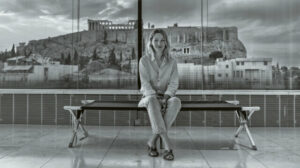
She is the Italian woman who took it upon herself to defend the rights of our country by writing and publishing books about Greece, who raised the flag high on the issue of the Sculptures, mobilizing French and Italians in the struggle for their return. In fact, in order to make the Greek spirit even better known as a deep connoisseur of myths and as a communications consultant to politicians and big corporations, she published the book “The wonderful language – 9 reasons to love ancient Greek” (Pataki Publications) which sold over 100,000 copies in her native Italy and was translated into many languages.
100,000 copies of the Greek language in over 100,000 languages and has been translated into many languages.
This was followed by “The measure of heroism – The myth of the Argonauts and the courage that motivates people to love”, and “The art of running: From Marathon to Athens with wings on her feet”, all in the context of promoting Greek culture, of which she was the most ardent supporter. Her latest venture is her fight for the return of the Sculptures, for which she decided to spend an evening alone inside the Acropolis Museum and then publish the book “A Night at Acropolis Museum“, which is published in Greek by Pataki Publications (ed. Stavros Papastavrou) with a beautiful photograph by her good friend Nikos Aliyaga on the cover.
It is no accident that in France she became known as the heroine from Greece (“héroïne grecque”), as was the characteristic title of the Monde when her first book, devoted to ancient Greek, was published. We were lucky enough to meet and talk to Andrea Marcolongo in Thessaloniki, at the stand of Pataki Publications, in the context of the 21st International Book Fair. “The truth is that I owe it to the school that taught me about your country, its myths and history. I come from a poor family, without the necessary educational tools to help me get in touch with these stories, but with a love of knowledge. It all started in my teens, as I learned about all the mythical and magical things that changed my life: ancient myths and Greek history. It’s exactly what shaped me as a person.” However, the good thing is that in her book, where she talks at length about the ancient myths, she makes them seem as if they are relevant today, as if all these deities are still protecting the rights of the Greeks. “I am convinced that Ancient Greece is still alive and modern, it is the same country not only because of the Parthenon and the archaeological sites, but because it is the oxygen we all breathe. This culture permeates everything. You are constantly in contact with it, as long as you keep your eyes open and look around when you visit the country, because what you have read in books is not enough.”
That’s why in her latest book, A Night at the Acropolis Museum, she not only talks about the Parthenon Sculptures and their history, but explains in detail how ancient Greek thought and culture essentially shaped her identity. “My goal was to write the history of the sculptures about modern Greece, but at the same time, I wanted to tell my own little story. As Greece is still searching for its identity, at the same time, I feel that I have taken on a similar mission: I know where I come from, I have an understanding of my Italian origins and of the different influences, such as being a different person today.” As he writes in the book, connecting Greece’s past with its present, discovering the Ancient Greeks and Seferis, it is Greece’s destiny to pay a high price for its origins and history. Referring to Seferis’s line “In yet another ‘attack of fate with tear gas'”, he identifies the issue of the loss of the Sculptures with Greek trauma. “With time and faith, the void of the soul can be filled, or so they say. But how does the emptiness of a museum get fixed? Is it a simple procedural matter of restoration, the one that Greeks have been patiently waiting for for almost two centuries and for whose sake they built this modern museum where I am tonight, or is it that, after the results of the excavation, the absence can no longer be made up for?”
“We all steal from Greece.”
I can’t help but ask her if the experience was worth it and how difficult it was – something she points out in the book – to convince the Acropolis Museum’s administrators and its current director, Nikolaos Stambolidis, to grant her permission to spend, for the first time in history, a whole evening, alone, on the museum grounds. “It was the most overwhelming experience I have ever had in my life, and I still can’t believe I lived it. The truth is that I had to wait a long time, about a year, for an answer, so I had the opportunity to dig deep into the history of the sculptures, find out all the background, find the relevant documents and read the whole chronicle of the theft and Elgin’s biography that I mention in the book. After all that, I finally realized that we all steal from Greece, everything.”
But to what extent did she change her mind when she visited the museum, or more accurately, how much did she feel shifted by this experience under the Sacred Rock, in the heart of the Acropolis Museum? “Unfortunately, I’m not Greek and I tend to see Greece from the outside, from the perspective of Italy or France. But when I visited the Acropolis Museum, my perception of the country changed radically. I had the feeling that we Italians, the French, want to modernize Greece or change its image, so I needed to try to understand what has happened concerning the sculptures today by being there. Then I understood that this was a case of not only blatant theft, but also of savage violence: the way Elgin ripped the sculptures up, ripped them apart, all the unspeakable violence he did to them. It’s very hard to imagine all that, unless you actually go through Acropolis, you don’t find yourself in those places.” He has a very graphic image in the book, as he literally likens Elgin to a butcher who cut off the members of the Marbles. “We can easily imagine someone stealing paintings and hiding them, it doesn’t cause us the revulsion that comes from this unthinkable shredding of the Sculptures. But this is truly horrific. Moreover, it was an even more difficult task, and one can imagine the fury with which Elgin indulged in this heinous act. It is truly a crime.”
“There was no firman.”
The book describes the whole chronicle of the disaster as a thriller that begins with Elgin’s journey from Constantinople, where he had spent some time as a diplomat, a position he took advantage of to enable him to manufacture what appears to be a fake firman. As she points out in her book, no original version has ever been found, only a translation of the supposed original order into Italian, something Marcolongo found during her research.
Significantly, in her book the author reveals to us not only Lord Elgin’s deception, but also all the secondary persons who played a part in the theft, such as the Reverend Philip Hunt, Elgin’s vicar, “who probably drafted the draft of the supposed firman, the notes at the beginning of the official document in Italian, and it is just as likely that this chaplain was responsible for the addition of the controversial final note”, as he points out, adding that “it was again Hunt to whom Elgin entrusted the task of taking the firmani to Athens and having it ratified by the Greek authorities, a task which the Reverend carried out with great zeal and ambition”.
She, however, believes that the lord acted in this way because he took advantage of the colonial climate of the time, which allowed such depredations. Marcolongo argues that his ambassador Augustus Suazel-Gouphier, along with his artist Fovell, had tried repeatedly to send to Paris the ancient Greek artifacts they had found in Athens, but had failed. And, if they could, they would have done the same with the Parthenon, but they didn’t dare. “That’s why I think all of Europe is accountable for what happened, is complicit, because everybody took advantage of the situation in the worst way. It is a matter of pure colonialist vision and conscience. They saw Greece in much the same way as they saw the countries of Africa, that it was a distant state, under Ottoman rule, so they felt they had the right to grab whatever they could in the colonial spirit of the time. Just as they also mistakenly believed that the Greeks were not strong enough to rebel.”
The nemesis
We are talking about a series of seemingly fateful events, as she sees it, which showed in practice that after hubris comes nemesis. It is no coincidence that a series of misfortunes befell Lord Elgin, as punishment for the crime by the ancient gods: he lost his property, experienced deaths, suffered deformity, details of which Marcolongo informs us in detail in the book. As for the book, he tells us in closing: “It was my minimal contribution to Greece, because we think we know the history of the sculptures, but we ignore the details and don’t understand the magnitude of the crime[…] We all say our roots are in Greece, but how can we say that when the Parthenon’s parts were torn to pieces?”
Of course, she says she is proud as an Italian that her country played a very important role in returning the Feagan piece and agrees that this diplomatic move, which started in her part of Sicily, paved the way for the return of the sculptures.
Ask me anything
Explore related questions




