





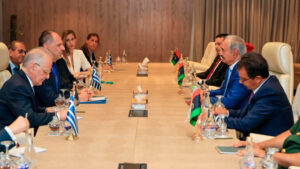
Good news, but requiring daily confirmation, were received by Foreign Minister Giorgos Gerapetritis during his short visit to Benghazi, where he met with the strongman of eastern Libya, Khalifa Haftar, and his three sons, who are in charge of the military, economy, reconstruction and political contacts.
Athens believes that a good first step has been taken to reconnect the two sides, to highlight the opportunities in the relationship and the importance for Libya, and especially for the Eastern side, of continuing good relations with Greece. And the Haftar side seemed to recognize that Greece’s initiatives and moves, both autonomously and within the UN Security Council and the EU, can help and benefit Libya, and at the same time understand what negative relations with our country would mean.
On the migration issue discussed in the meeting with General Haftar, there was a willingness to cooperate. However, serious obstacles remain, such as the lack of means and infrastructure, as well as difficulties in dealing with smuggling rings and guarding the border with Egypt. In this context, Greece offered to provide information from its surveillance of the maritime areas outside Libya’s territorial waters.
At the same time, in the visit to Tripoli and Benghazi on Wednesday, the EU Migration Commissioner, together with the Migration Ministers of Greece, Italy and Malta, will present a concrete framework for providing expertise and infrastructure to tackle the problem, which is tending to take on major dimensions.
Much of the talks covered the issue of sea zones. The axes on which the Greek side moved were both the prevention of moves such as the possible ratification of the Turkish-Libya Memorandum, and the start of discussions on the delimitation of maritime zones.
According to reports, the Libyan side, in response to the Greek intervention, indicated that it would not want Eastern Libya to change its stance on the Turkish-Libya Memorandum. There was a positive reaction, and according to the same reports, Benghazi claims that a committee has been set up in parliament to review all Libya’s maritime zones in the context of seeking ways to exploit the country’s natural resources. In this context, there appeared to be a positive response in principle to the opening of talks.
On the Greek side, however, cautious optimism was expressed that there would be no unpleasant surprises in the near future. The Greek position was clear: Athens will not accept new fait accompli and a possible ratification of the Turkish-Libya Memorandum would create new, serious problems.
It is indicative, however, of the importance Benghazi attaches to relations with Greece that General Haftar himself, while receiving the Greek Foreign Minister, expressed his desire to visit Athens. Present at the first meeting were his two sons, Saddam, who is now the unofficial commander of the Libyan National Army, and Al Sadiq, who is a political adviser to his father.
George Gerapetritis, shortly afterwards, met with Belgashim Haftar, the other son of the General, who effectively controls the economy of eastern Libya as head of the Reconstruction and Reconstruction Organization. Belgashim Haftar has issued a call for Greek businesses to join the projects planned to start in his country.
Economic and trade relations were also discussed at the meeting, with the Greek minister announcing that there will soon be a Greek business mission to Benghazi. At the same time, other areas of cooperation and exchanges were also discussed, as well as the reconnection of Greece and Benghazi through direct air and sea links.
The focus now turns to Venghazi‘s moves in the coming period to consolidate the positive climate that emerged from the talks. At the same time, the visit of C. Gerapetritis’ visit to Tripoli on 15 July, where there is now a serious political problem. The Dbeiba government is faltering and is in the crosshairs even of its former supporters.
This situation has also caused concern in Ankara, which – despite the restoration of relations with Eastern Libya – is maintaining its political and military influence in Libya through the Dbeiba government.
Ask me anything
Explore related questions




