





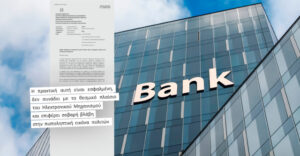
Banks have reportedly created illegal monitoring systems, rejecting loans and credit cards even for citizens who simply visited the out-of-court debt settlement platform without submitting any application. The Ministry of National Economy has sent a formal letter to the Hellenic Bank Association demanding an immediate halt to this practice and the removal of affected tax identification numbers (AFMs) from any internal markings.
This practice effectively turned the out-of-court mechanism into an informal “Tiresias,” negatively impacting healthy businesses and individuals, even those without bank debts. The Ministry has also set up a dedicated oversight team to monitor and investigate complaints against credit managers. Noncompliance will trigger supervision by the Bank of Greece, which can impose corrective measures or sanctions.

Illegal Preemptive Surveillance
Banks reportedly implemented a makeshift, illegal preemptive monitoring system, cutting off credit even for borrowers with no outstanding debts. Citizens who logged into the platform using their TAXISnet credentials, even just to explore the process, were automatically labeled as seeking refuge to avoid repaying debts.
As a result, they were placed on a “blacklist,” and some saw their loan or credit applications rejected as if they had a negative record in the official credit registry.
A letter sent last Wednesday by the Ministry of National Economy and Finance to the Hellenic Bank Association, revealed by Protothema, shows that banks used the debt settlement platform as an opportunity to create an informal, unauthorized profiling system, applying financial pressure on responsible borrowers and businesses in violation of Law 5072/2023 and professional ethics.
Pierakakis’ Intervention
The Ministry’s intervention signals the end of tolerance for practices that undermine healthy borrowers and businesses. It extends across multiple areas: excessive fees, unfair practices by “red loan” managers, and other abuses that should have been reviewed by servicers under Article 13 of Law 5072/2023.
The Ministry’s message is clear: compliance with law, ethics, and social justice is mandatory.
How the Blacklisting Worked
The system flagged citizens simply for logging in to the platform, even without submitting an application. The intention to explore debt settlement was enough to classify borrowers as “suspect,” automatically cutting off their credit. This represents the peak of arbitrary practices identified by the Ministry.
The General Secretariat of the Financial Sector and Private Debt Management (GSFSPDM) sent a letter stating:
“Some financial institutions continue to mark applicants as ‘active in the Out-of-Court Debt Settlement Mechanism’ solely because they accessed the electronic platform, even when no application was submitted or the application was canceled before final submission. This is incorrect, violates the legal framework, and severely harms citizens’ credit records, causing unjustified rejections of financial product applications (e.g., loans, credit cards).”
The letter includes a clear order:
“All AFMs included in the file sent by the GSFSPDM must be immediately cleared of any internal markings. Financial institutions must delete any such marks within 15 working days of receiving the file.”
Impact on Healthy Businesses
The scandal affected not only “red” borrowers seeking debt settlement but also:
- Entrepreneurs using the platform for tax or social security obligations with no bank loans.
- Citizens exploring the platform without submitting a completed application.
- Responsible borrowers who had debts to the state or social security, not banks.
- Even government employees accessing the platform to assist citizens or businesses.
Three-Pronged Ministry Response
- Ultimatum on Blacklists – Immediate halt to credit exclusion and removal of affected AFMs within 15 working days. Any unjustified rejections must be treated as null.
- Stop Arbitrary Charges – A separate letter orders banks to comply strictly with ATM fee regulations under Law 5167/2024, preventing overcharging.
- Complaint Oversight Committee – A new specialized team monitors and evaluates servicers’ behavior, maintaining a digital record of violations and enabling sanctions.
This creates a formal system of accountability, tracking complaints and ensuring compliance with Law 5072/2023, protecting borrowers and promoting fair banking practices.
Role of the Bank of Greece
Noncompliance triggers immediate supervisory action by the Bank of Greece. Existing laws already empower the central bank to impose corrective measures, fines, or even revoke a bank’s license.
For citizens and businesses affected by these blacklisting practices, the Ministry’s measures send a strong message: there is now an official avenue to report abuses, a permanent record of complaints, and a regulatory body that enforces accountability.
Ask me anything
Explore related questions




