





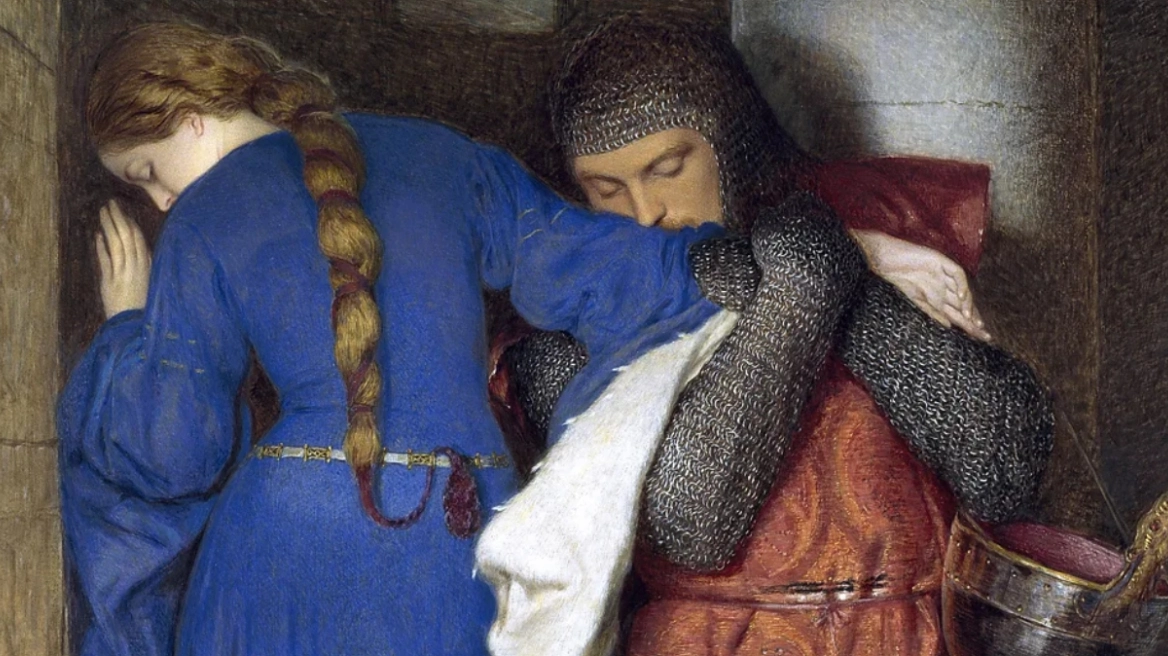
A 19th-century painting capturing a dramatic moment of love before an inevitable death continues to move audiences and is gaining renewed popularity on social media. The work is “The Meeting on the Turret Stairs” by the Irish painter Frederic William Burton, created in 1864, and considered one of the most iconic examples of romantic painting.
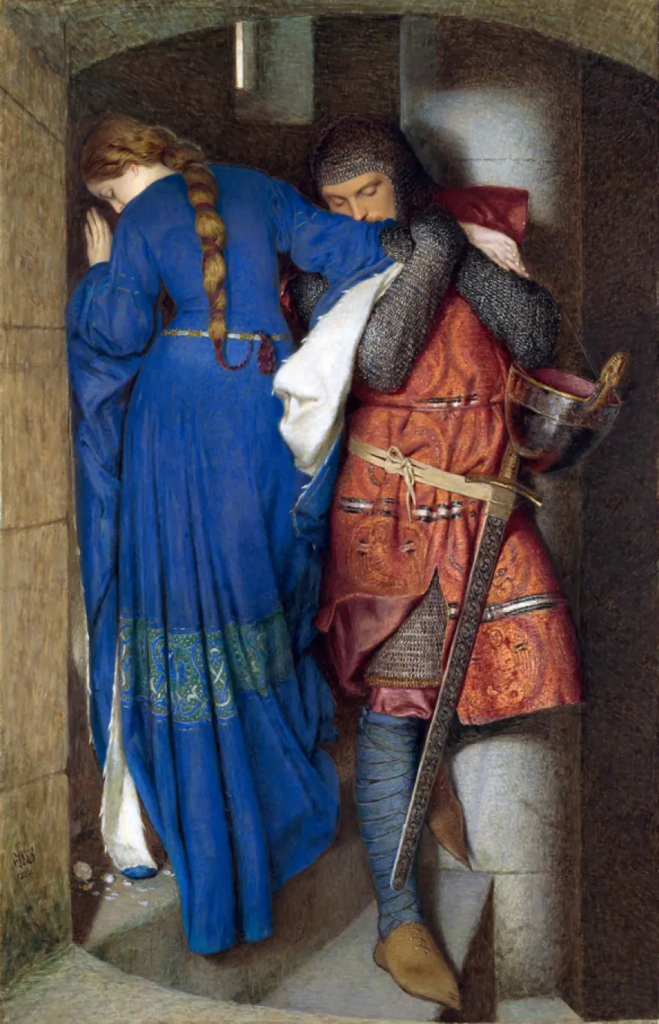
The painting depicts the last meeting of two lovers, Hellelil and Hildebrand, shortly before the tragic conclusion of their story. In the scene, Prince Hildebrand meets his beloved on a turret staircase for a final embrace before his death, which has been orchestrated by her strict father, according to the BBC.
The story behind the painting is based on a medieval Danish ballad, translated in 1855 by Burton’s friend Whitley Stokes. In the tale, a bodyguard falls in love with the princess he is tasked with protecting. Their relationship, however, angers her family and sets off a chain of violent events.
In the ballad, Hellelil’s father orders his seven sons to kill Hildebrand. The prince manages to kill her father and six of her brothers but is ultimately mortally wounded when Hellelil, trying to protect her last brother, inadvertently distracts him. Hildebrand dies from his injuries, and shortly afterward, Hellelil also dies, bringing the story to a tragic close.
Burton chose not to depict the story’s violence, but the moment before the destruction. In the painting, the two lovers share a silent, emotionally charged farewell. Hildebrand bends to kiss his beloved’s hand, while she turns away, seemingly unable to bear the weight of the moment.
Frederic William Burton (1816–1900) was born in Ireland and began his artistic career painting miniature portraits and ancient monuments. He later moved to London, working as a watercolorist and eventually becoming director of the National Gallery. His work was heavily influenced by the Pre-Raphaelite movement.
From its first exhibition, the painting deeply moved audiences. Writer George Eliot, a friend of Burton, commented that “it could have become the most vulgar thing in the world, but the artist elevated it to the highest level of refined emotion.”
Today, the painting is housed in the National Gallery of Ireland in Dublin and continues to attract many visitors. In 2012, it was voted the favorite painting of the Irish people.
However, there is an important peculiarity: the public can view it only two hours a week. This is because Burton used gouache, a type of water-soluble paint that is highly sensitive to light and can fade when exposed to strong illumination.
To protect the work, gallery curators enforce strict measures. Lighting remains very low, and after the brief viewing period, the painting is returned to a specially designed protective cabinet.
Despite the sensitivity of the materials, the painting’s colors remain strikingly vibrant even after more than 160 years. Burton used strong shades of red and blue, while small details – such as the white flower petals near Hellelil’s feet – symbolize purity and fidelity.
Caroline Campbell, director of the National Gallery of Ireland, has said she was particularly impressed by the intensity of the scene when she first saw the work. She notes that Hellelil’s vivid blue dress and the drama of the moment create an image that remains powerful even today.
Despite the story’s tragic ending, many in Ireland regard the painting as a symbol of romantic love. According to Campbell, several couples have become engaged in front of it, and a reproduction appears in the city’s registry, linking it in collective memory with love and marriage.
Thanks to its spread on social media, Burton’s work is now being discovered by a new generation of viewers. Many describe it as one of the most striking visual depictions of love, a moment frozen in time just before an unavoidable tragedy.
Ask me anything
Explore related questions




