





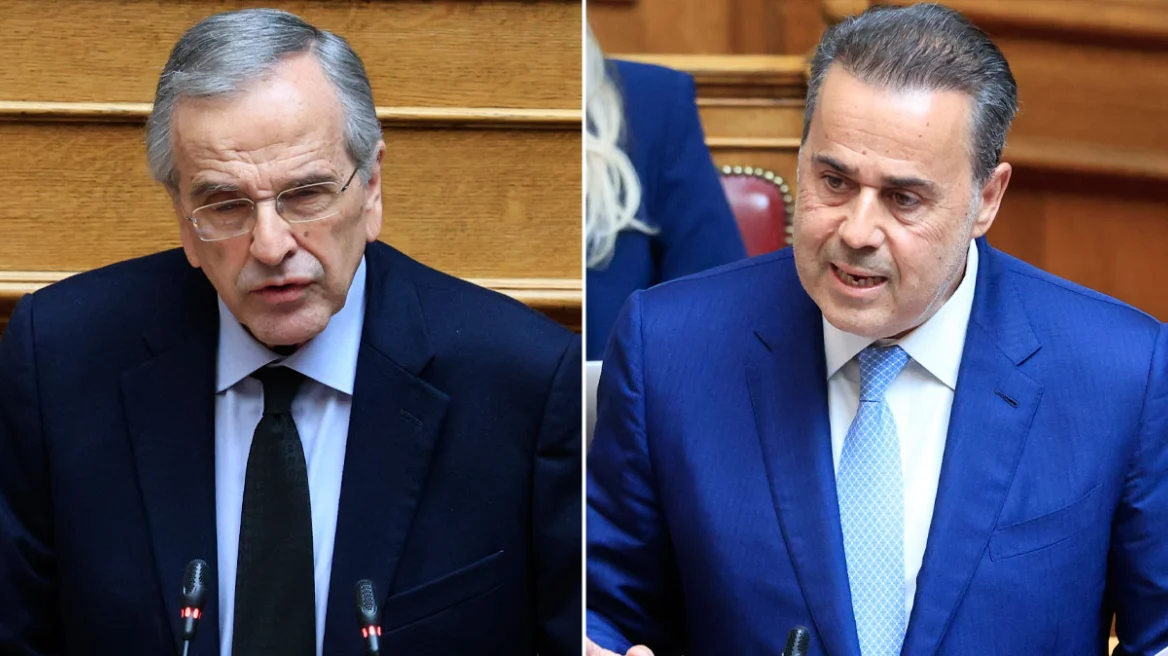
A confrontation using political, historical, and diplomatic arguments over hydrocarbon exploration and exploitation contracts, as well as the country’s broader foreign policy, took place in the plenary session of the Hellenic Parliament between former prime minister Antonis Samaras and Stavros Papastavrou.
The Minister of Environment and Energy, responding to the sharp criticism earlier voiced by the former prime minister regarding what he described as an “appeasing” foreign policy and a “potential concession of national sovereignty” through the Greece–Chevron agreement south of Crete, made a historical reference to their close cooperation before adding that Mr. Samaras “has been misinformed.”
Papastavrou said:
“Mr. President, in August 2012 you asked me to undertake one of the most critical negotiations for the country, and in November 2012 we achieved the disbursement of €44 billion to stabilize Greece in the eurozone. At critical moments for our country we fought together and achieved the impossible. Unfortunately in this case (hydrocarbon contracts) you do not have the correct information. Do not do yourself an injustice. Sovereign rights are not ceded in this way. You have worked on such contracts. These are contracts with private companies and cannot transfer sovereign rights, which under international law cannot be ceded through such agreements. However, they are important for our country.”
Insisting that the agreements strengthen Greece’s position, he added:
“Even though maritime boundaries have not been defined, even though the illegal Turkey–Libya maritime memorandum exists and there has been a verbal note to the United Nations, the company still comes and signs an agreement with us. In international law this is taken into account. It strengthens the Greek position and weakens opposing arguments. There is a tri-national point involving Libya and Egypt that has not been delimited. Article 30 is a legal safeguard for the contracting parties and protects the public interest. The final decision belongs to our country, which has full discretion on the matter.”
Responding to Samaras’ criticism of foreign policy, he added:
“We cannot talk about appeasement when we have HS Kimon (FDI frigate), HS Psara (MEKO 200 frigate), and F‑16 Fighting Falcon in Cyprus. They did not go there just to spend one night; they remain there. That is not appeasement. The agreements double the areas for exploration and exploitation for our country and multiply the chances of commercially viable resources.”
Samaras’ response to the “professional worriers” comment
From his side, Samaras began his speech by sharply responding to remarks from the Prime Minister’s office about “professional worriers.”
“Today I do not intend to express my concerns:
- about high prices and profiteering,
- about corruption, now confirmed even by the European Union,
- about wiretapping, which also concerned me personally,
- about paid trolls that poison our democracy,
- about the housing and rent crisis,
- about the farmers’ problem and EU–Mercosur trade agreement,
- about the demographic issue and the weakening of the Greek regions,
- about illegal migration and the new flows the war will bring,
- about the constant decline of small and medium-sized businesses,
- and about a tired society where people lose purchasing power every day.”
“So I will not express these concerns today… so that the Prime Minister will not again speak about ‘professional worriers’ and ‘armchair patriots’.”
He continued:
“When the Prime Minister speaks of ‘professional worriers’, what does he mean? That some people worry for financial gain? Government-friendly media point to me and Kostas Karamanlis. I would not want to believe that Kyriakos Mitsotakis accuses two former prime ministers and leaders of the party of making national concerns our ‘profession’. If the parrots are right, then the situation changes. Because then the Prime Minister himself should be worried.”
Criticism of foreign policy
Samaras argued that Greece’s foreign policy is now conducted “without foresight.”
“International developments highlight the importance of geopolitics and foresight. Unfortunately the Prime Minister and the country’s foreign policy are characterized not by foresight but by communication show-offs. It is the doctrine of ‘wherever the wind blows’ — the doctrine of the shallow and the short-term.”
He then analyzed global geopolitical developments and the uncertainty among political leaderships within the European Union.
On Cyprus and defense measures
Nevertheless, Samaras acknowledged certain government actions regarding Cyprus:
“The geopolitical situation is an ideal opportunity that must not be wasted. Cyprus is European territory, the border of Europe. The permanent stationing of Greek and European forces on the island is therefore necessary. Everyone realizes that the old defense architecture in our region no longer works.”
He described several moves as positive and self-evident, including:
- the deployment of frigates and aircraft to Cyprus,
- Patriot missile system units on Karpathos,
- and the defense agreement with Bulgaria.
However, he warned that these moves must not become mere gestures for impression, adding that Greece must maintain a clear policy toward Turkey even after the current regional crisis subsides.
“I have spoken for years about the doctrine of deterrence. We need deterrence against Turkey, which constantly threatens us — not against distant Iran, which threatened us for only fifteen days.”
He also criticized the “grey-zoning of the Aegean” and what he called the international rehabilitation of Turkey through a friendship agreement.
Reference to the Annan Plan and regional alliances
Samaras recalled that in 2004 he opposed the Annan Plan for Cyprus, alongside then prime minister Kostas Karamanlis, despite criticism from those he called “so-called realists.”
“Imagine if the Annan Plan had been implemented today, with a rotating presidency including a Turkish Cypriot president. Could Greece even send half a frigate there?”
He also revealed that when Greece promoted the Greece–Cyprus–Israel and Greece–Cyprus–Egypt trilateral partnerships in 2013–2014, many voices inside the political establishment urged him not to proceed — advice he ignored.
On hydrocarbon exploration
Samaras reminded parliament that in 2012, as prime minister, he launched tenders for hydrocarbon exploration blocks and emphasized the need for energy self-sufficiency.
“In contrast, the Prime Minister told the United Nations in 2021 that fossil resources were a ‘lost cause’ and strongly supported green energy. And today this transformed New Democracy gives me lessons about drilling? Give me a break.”
While stating he supports immediate hydrocarbon drilling, he objected to a specific clause in the Chevron agreement.
He argued that Article 30, paragraph 3 could open a “back door” for recognition of the Turkey-Libya maritime memorandum, because it anticipates possible future maritime delimitation agreements with “one or more neighboring states.”
“Don’t you realize that we ourselves appear to accept that the area we lease might shrink? The Hellenic Republic is essentially announcing the potential reduction of its own sovereign rights.”
Concluding, he said:
“My concern is not a choice. It is an act of conscience. And remember: there are no ‘professional worriers,’ colleagues. There are only amateur complacent people.”
Ask me anything
Explore related questions




