





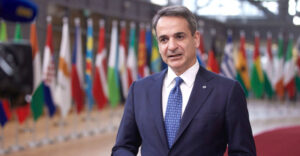
As the crisis in the Middle East continues with no clear end in sight regarding geopolitical and economic uncertainty, scenarios within the government are intensifying about the need for a stronger response to the risk of negative economic consequences.
As Kyriakos Mitsotakis noted in his Sunday post, the government may have fiscal reserves and may have carried out the necessary exercises, but European intervention will also be required. This is expected to be the “elephant in the room” at the upcoming European Union Summit, scheduled to take place on March 19 in Brussels.
“Our compass for navigating the uncharted waters ahead is political stability. It is a comparative advantage that we must safeguard so that the country’s course is not threatened amid geopolitical and economic storms, and so that we continue moving toward collective progress and individual prosperity,” Mitsotakis said in an exclusive statement to the media outlet THEMA, setting the political framework of the discussion.
As was also highlighted during the third pre-conference event of the ruling New Democracy party held on Saturday in Larissa, economic and geopolitical strength could be the formula for a strong performance in the 2027 elections. In any case, Mitsotakis is already posing dilemmas to citizens, asking them to consider what it would be like for a government to have to make difficult decisions while negotiating with a diverse group of actors.
National and European response
Although the government appears to have successfully passed the “crash test” of the rapid mobilization of the Armed Forces, the major challenge lies in the economic consequences of a war whose duration remains uncertain.
It is only a matter of time before pressures in international markets affect the Greek market more strongly, which has proven to be vulnerable. Through THEMA, Mitsotakis warned that no country can remain immune to the international situation.
“As no country can maintain ‘immunity’ against these trends, we are preparing for every possibility—with honesty and without alarmism. In this direction, we have already announced targeted measures. These include a cap on profit margins for liquid fuels, both wholesale and retail, as well as for 61 categories of supermarket products, both measures remaining in force until the end of June. In this way, we are raising a shield against potential profiteering,” the prime minister stressed.
Later today, Mitsotakis will speak at an event organized by the Greek Ministry of Development on the development law and the productive transformation of the economy. It is expected that both he and the Minister of Development, Takis Theodorikakos, will refer to the need for vigilance regarding new interventions, beyond the implementation of the new profit-cap framework.
In any case, energy costs remain under close scrutiny. A combination of oil prices above $100 per barrel and higher natural gas prices, which directly affect electricity generation costs, would trigger a “red alert” in Athens and across Europe.
At the same time, Athens is also considering scenarios involving European fiscal flexibility, although the President of the Eurogroup and Greek Finance Minister Kyriakos Pierrakakis has been particularly cautious in his remarks.
The Strait of Hormuz
A major driver of global economic turbulence is the escalating situation following the blockade of the Strait of Hormuz.
Behind the scenes, various efforts are underway to ease the situation, including European communications with Iran and discussions about deploying a naval convoy to ensure safe navigation in the region. The issue is expected to be discussed at today’s meeting of EU foreign ministers, attended by the Greek Foreign Minister Giorgos Gerapetritis.
Athens, however, remains cautious due to risks to maritime navigation, and has not agreed to extending the Operation ASPIDES mission—currently operating in the Red Sea—into the Persian Gulf.
Ask me anything
Explore related questions




