





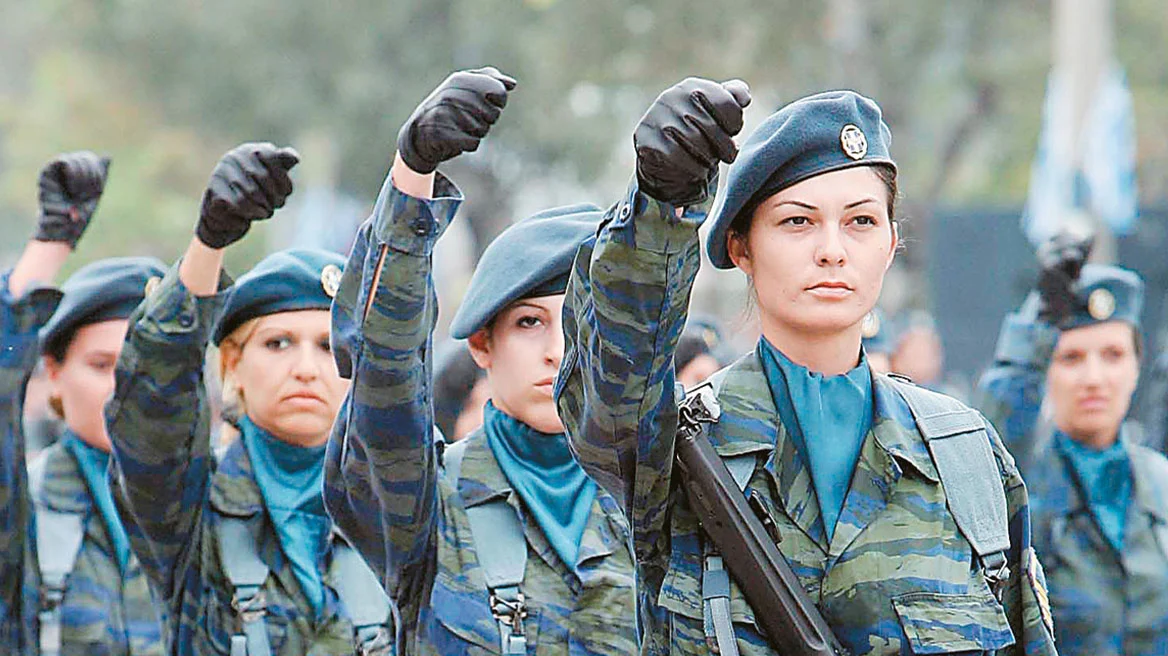
At a time when draft evaders are now being given a second chance to serve in the Armed Forces, a growing number of Greek women are considering voluntary enlistment in the first intake, with the application deadline set for March 31, 2026, following the institutional framework introduced by the “Armed Forces Transition Charter to a New Era.”
Specifically, Article 275 of the Ministry of National Defence’s latest bill grants, for the first time in the history of the modern Greek state, women the opportunity to train in the Hellenic Army and fulfill military obligations, with the possibility of even being selected as candidate or probationary reserve officers.
The institutional effort by the Defence Ministry to bring more women into military service has been accompanied by an audiovisual communication campaign that has gained significant traction on social media. According to reports, a related video by the Hellenic Army General Staff on voluntary female enlistment recorded 40,000 views on Instagram and 41,000 on Facebook, reflecting growing interest among both men and women in this new initiative.
A similar response was seen for an Armed Forces tribute video marking International Women’s Day, which reached 40,000 views on Instagram and 51,000 on Facebook—figures that underline increasing engagement from women with the idea of voluntary or professional involvement in the military.
Although no official data have yet been released regarding the first wave of female volunteers—since the application process remains open—reliable sources indicate that applications have already reached a steady three-digit number, with an upward trend in recent days.
This is particularly notable given that voluntary military service for women will last 12 months and is open to Greek women aged 18–26, classified as physically fit category I/1 or I/2 and with a clean criminal record. Participants are also offered a range of incentives to support their professional development.
For the first intake, 200 positions have been allocated, with enlistment expected to take place by April at the Army Materiel Training Center in Lamia. Beyond the symbolic significance of their enlistment, a series of benefits and incentives has been предусмотрено by law to boost female participation. In particular, voluntary service provides additional points for public sector recruitment, offering a competitive advantage, while time served in the Armed Forces will be officially recognized as prior work experience, strengthening participants’ CVs.
Furthermore, after completing the 12-month service, women will have the option to reenlist as Short-Term Reenlisted Soldiers (OVA) or be recruited as Professional Soldiers (EP.OP).
In terms of administrative support, female volunteers will have free access to military hospitals and officers’ clubs, while provisions have also been introduced for the recruitment of university-educated female conscripts as civilian personnel (such as nurses or administrative staff) within the Armed Forces.
Additionally, upon completion of their service, women will be registered in the Army reserve until the age of 40, maintaining their connection with the military and contributing to the strategic goal of 150,000 active reservists.
KKE opposition
The main potential obstacle for applicants may be rejection on medical grounds following clinical examinations conducted after submitting their applications. Nevertheless, voluntary enlistment of women is not a uniquely Greek innovation but rather a longstanding practice in many European and Mediterranean countries—though in Greece it has drawn strong opposition from the Communist Party (KKE).
“We are fundamentally opposed to the conscription of women, in all the ways the government is attempting, under conditions of escalating imperialist war. The provocative campaign by the Ministry of National Defence for the voluntary enlistment of young women complements the deepening involvement of the country and its Armed Forces in imperialist wars serving the interests of the domestic ruling class,” the party said in a strongly worded statement, describing as “misleading and out of touch” the government’s argument that female enlistment would strengthen national defence.
Ask me anything
Explore related questions




