





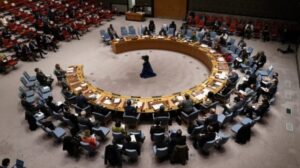
Gulf countries have called on the UN Security Council to give the “green light” for the use of force in order to reopen the Strait of Hormuz, at a time when a draft resolution is dividing nations.
The Secretary-General of the Gulf Cooperation Council (GCC) today urged the UN Security Council to authorize the use of force to reopen the Strait of Hormuz, after Iran closed it, blocking commercial ships and tankers and imposing conditions for allowing certain vessels to pass.
“We call on the Security Council to assume its responsibilities and take all necessary measures to protect maritime routes and ensure international navigation,” he added.
The 15 members of the Security Council have been discussing for about ten days a draft resolution submitted by Bahrain, which would allow a country or coalition of countries to use “all necessary means” to guarantee free navigation in the Strait.
However, the proposal is facing opposition. Diplomatic sources say Russia, China, and France—who hold veto power—have raised strong objections despite multiple revisions to the text. Russia’s deputy UN representative stated that they want a decision addressing the root causes of the situation, not one that is biased or unbalanced.
French President Emmanuel Macron said that a military operation to “liberate” the Strait would be “unrealistic.”
China calls for de-escalation, not escalation
China’s Foreign Minister Wang Yi said that the US-Israeli attack on Iran constitutes a “clear violation of international law” and stressed that the Security Council should work to prevent further escalation.
He made these remarks after talks with counterparts from Saudi Arabia, Germany, and the EU.
“The military attack by the US and Israel on Iran was not approved by the Security Council and clearly violates international law,” Wang said, adding that the Council should focus on resolving the situation, not legitimizing unauthorized military actions or worsening the conflict.
China is a close partner of Iran and a major buyer of its oil, much of which passes through the Strait of Hormuz. At the same time, it maintains economic ties with Gulf countries and has criticized Iranian attacks on neighboring states. Together with Pakistan, China has proposed a five-point plan to resolve the crisis.
Bahrain remains optimistic
A fifth version of the draft resolution was circulated today among the 15 Council members.
“We hope for a unified position in tomorrow’s vote, God willing,” said Bahrain’s Foreign Minister, who currently presides over the Security Council.
Bahrain’s UN ambassador defended the proposal, accusing Tehran of “economic terrorism.”
While effectively allowing the use of force in the Strait of Hormuz and nearby waters, the latest draft clarifies that such measures must be “defensive in nature.”
Ask me anything
Explore related questions




