





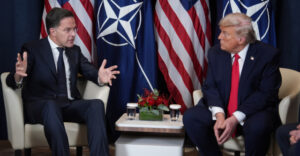
A new message about his view on NATO and the future of the North Atlantic Alliance was sent by Donald Trump after his meeting on Wednesday with Mark Rutte in the shadow of the Wall Street Journal’s report on the White House’s plan to punish and reward those who did or did not help in the war with Iran.
“NATO wasn’t there when we needed it, and it won’t be there if we need it again. Remember Greenland, that big, mismanaged chunk of ice!!! President DJT,” the US president wrote on Truth Social after the closed-door meeting with the NATO Secretary General, raising the thermometer on the future of the alliance.
Adding fuel to the fire in his own way, Route also called the meeting with Trump “sincere” and told CNN that “it’s true that not all European countries have kept these commitments. I fully understand that he is disappointed about that.”
The punishment and reward plan
Just hours before the Trump-Rutte meeting, the Wall Street Journal unearthed the US administration’s plan to redeploy US troops within NATO to “punish” countries it believes have not adequately supported Washington and Tel Aviv in the war with Iran.
The plan calls for the transfer of US troops from North Atlantic Alliance member states deemed “uncooperative” during the war operation against Iran to countries that have shown greater support for the US military campaign – including Greece, according to the US publication.
The proposal is a significant departure from Donald Trump’s threats of a full US withdrawal from NATO, which cannot be carried out without congressional approval.
The plan, which has been circulating within the administration in recent weeks and appears to be gathering support from senior officials, is still in its early stages. It is one of the options the White House is considering to counter the stance of some European allies, illustrating the growing divide between Washington and European capitals following Trump’s decision to go to war with Iran.
The US maintains about 84,000 troops on European soil, with the number changing depending on military exercises and periodic force deployments. US bases in Europe are a key hub for US global military operations, and contribute to the economies of host countries through investment. The bases in Eastern Europe also act as a deterrent against Russia.
The White House declined to comment on the contents of the proposal, and it remains unclear which countries would be affected. However, some member states have caused Trump’s displeasure since his return to power, particularly because of their opposition to the war with Iran.
Spain – the only NATO country that has not pledged to increase defense spending to 5 percent of GDP – has banned the use of its airspace by U.S. aircraft involved in the operation against Iran. At the same time, US administration officials have expressed displeasure with Germany, as its top officials have been critical of the war, despite the country being one of the most important hubs of support for US operations in the Middle East.
Italy also temporarily blocked the use of a US air base in Sicily, while France allowed the use of a base in its southern territory only on the condition that aircraft not involved in attacks against Iran would land there.
In addition to redeploying troops, the plan may also include closing a US base in at least one European country, possibly Spain or Germany.
Conversely, countries considered more supportive – such as Poland, Romania, Lithuania, and Greece – may benefit from a stronger US military presence. Eastern European states, after all, are among the highest-spending members of NATO and were among the first to say they were willing to participate in an international mission to monitor the Strait of Hormuz.
After the war began, Romania typically immediately approved US requests to use its bases by the US Air Force, the WSJ notes.
Ask me anything
Explore related questions




