





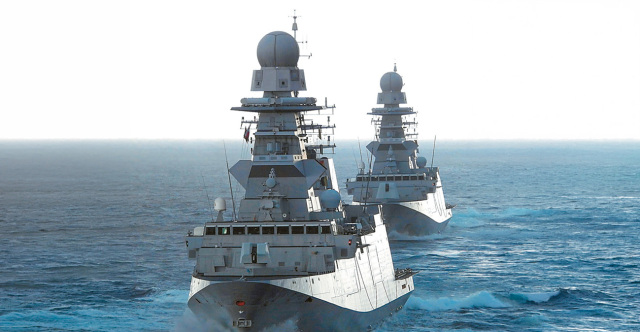
Formal approval for the acquisition of the two Italian Bergamini frigates on behalf of the Hellenic Navy is only a matter of time, as the Ministry of Defense continues implementing the 12-year armaments program, at a moment when the discussion around defense autonomy is becoming dominant within the EU.
After a series of negotiations and intense regional competition, the Greek side managed to secure priority for the two Italian-built ships, which—barring unforeseen developments—are expected to join the Greek fleet by the end of 2028.
However, reaching an agreement between Greece and Italy was far from easy, as the excellent condition of these frigates made them highly sought-after, even among Mediterranean countries. They are described as possessing “increased operational flexibility and strategic power,” according to the Minister of National Defense, Nikos Dendias. In this context, if Italy does not alter its strategic planning-maintaining distance from war zones-the two Bergamini frigates will gradually be released to Greece. Each will join the Hellenic Navy once Italian shipyards complete a new frigate to replace it in Italy’s fleet.
In this way, Italy gives more space and capital to its domestic industry, renewing its fleet in parallel—something it has already done in the case of Egypt and Singapore—while also gaining added value from deploying its ships in the Southeastern Mediterranean.
Erdogan also knocks on the door
Rome is seeing increasing demand for its defense industry products, something recently confirmed in Turkey’s case. Although Greece’s interest in the Bergamini frigates was strong and publicly expressed, Turkey began looking more intensively at the Italian defense market after its initial step of acquiring Piaggio–Leonardo assets.
The reason lies in gaps identified by Turkey in its missile and anti-ballistic defense, highlighted by attacks it faced following the second U.S. operation in Iran. As a result, Ankara requested NATO assistance, including the deployment of two Patriot missile batteries on its territory.
Following this-and after assessing the risk of a serious blow to its air defense and public confidence, especially after the perceived success of its domestic defense industry-Ankara turned to Rome for help. According to Bloomberg, Turkey aims to acquire the SAMP/T air defense system, produced by the Franco-Italian consortium Eurosam. This system could fill the gaps caused by the lack of advanced systems, particularly due to the forced inactivity of the S-400 systems.
Turkey’s “steel dome”
In this context, the SAMP/T system would significantly ease Turkey’s situation and address many coverage deficiencies. It is expected to become part of a multi-layered air defense system—the Turkish “steel dome”—modeled after the Israeli and Greek equivalents.
So far, Turkey’s attempt to acquire the system has faced objections from France, which is why Ankara now appears to be leaning toward purchasing and co-producing it with Italy.
A key objective for Turkey is to integrate into the European defense ecosystem as an active member rather than a third country. This goal could become more achievable if Ankara strengthens ties with Rome through cooperation with Eurosam. In such a scenario, even France’s strong objections might soften, especially as Paris leads discussions on European defense autonomy amid warnings from U.S. President Donald Trump about reducing America’s operational and financial involvement in NATO.
Until then, Turkey must urgently address its air defense shortcomings, exposed by its inability to counter aerial threats originating from Iran. President Recep Tayyip Erdogan has already taken initiatives, inaugurating earlier this month the first phase of a $3 billion missile production facility near Ankara, operated by the state company Roketsan, aiming to boost domestic production of anti-missile and anti-ballistic defense systems.
Ask me anything
Explore related questions




